
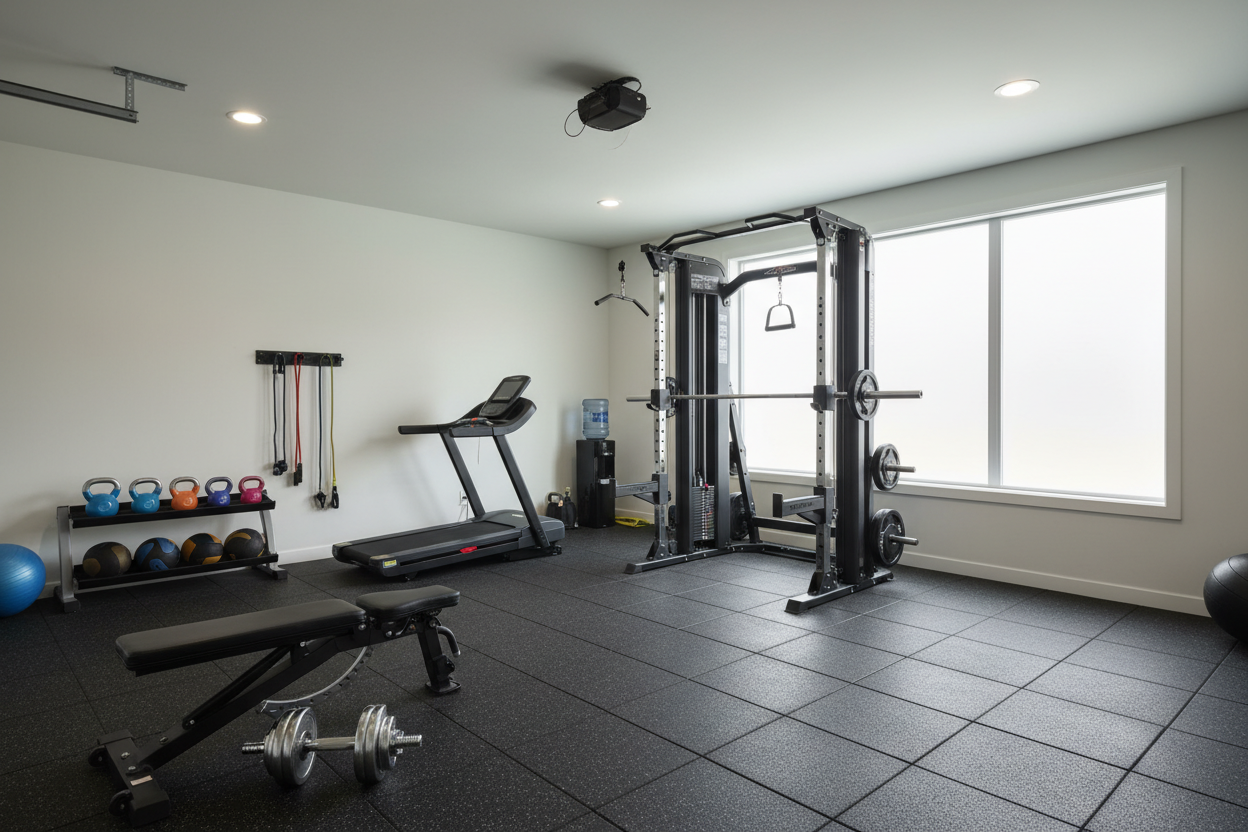
I remember the night I decided to bail on my commercial gym. It was a Tuesday, the place was packed, and I was third in line for a squat rack that looked like it hadn't been greased since the 90s. It is tempting to jump online and buy the first at home workout machine that catches your eye, but that is exactly how people end up with a 200-pound clothes hanger in their spare bedroom.
- Gravity over everything: Real weight plates or selectorized stacks provide a consistent resistance curve that bands can't touch.
- Check the steel: Look for 11 or 12-gauge steel frames; if it weighs less than you do, it’s going to wobble.
- The 3-foot rule: Always add three feet to the advertised footprint to account for plate loading and range of motion.
- Safety first: If you train solo, prioritize machines with built-in spotter arms or a Smith track.
The 'Clothes Hanger' Syndrome: Why Most Purchases Fail
Most home exercise systems fail because they feel 'janky' compared to what you’re used to at the local club. When you’re used to commercial-grade bearings and heavy steel, a residential unit made of thin, 14-gauge tubing feels like a toy. It flexes under load, the pulleys stutter, and the biomechanics feel off. If a machine forces your joints into an unnatural path because the manufacturer wanted to save three inches on the frame, you’ll stop using it because it hurts.
The key is looking for structural integrity. You want to see thick frames and high-quality cables. If the machine uses plastic bushings instead of sealed ball bearings, the friction will drive you crazy. You want a smooth, consistent pull from start to finish so you can focus on the muscle, not the machine's mechanical groans.
Resistance Types That Actually Build Muscle
When evaluating home workout systems, the resistance source is the most important factor for hypertrophy. I’ve tried the tension rods and the elastic bands—they’re okay for a hotel room, but they don't cut it for serious progress. The resistance on a band increases as it stretches, meaning it’s easiest at the bottom and hardest at the top. This uneven curve makes it difficult to track progressive overload accurately.
Gravity-based resistance—using actual iron—is still the gold standard. Why The Best At Home Workout Machines Use Cables Not Bands comes down to constant tension. Whether you are at the start of a lat pulldown or the very bottom, that 50-pound stack is still 50 pounds. This creates better mechanical tension and, ultimately, more muscle growth over time.
What is the Best Home Fitness Machine for Your Specific Goals?
The answer to 'what is the best home fitness machine' depends entirely on how you train. If you’re a generalist who just wants to stay moving, a simple cable tower might work. But if you want to actually change your physique, you need something that allows for heavy, stable movements. Why the Best Full Body Home Workout Machine Is Actually a Smith Rig is because it combines the safety of a fixed path with the versatility of a squat rack.
For the Heavy Lifters (Strength Training)
If you are building a strength training home gym, stop looking at the 'all-in-one' gadgets with 50 attachments. You need a foundation of heavy-duty steel. Look for a rack or functional trainer that uses 3x3 or 2x3 11-gauge steel. Check the J-cups and spotter arms—they should be lined with UHMW plastic to protect your bar. When you’re outfitting a Home Gym, the goal is to buy gear that can handle a 400-pound squat without shaking like a leaf in a hurricane.
For the Solo Bodybuilder (Hypertrophy)
Training to failure is the fastest way to grow, but it’s dangerous if you’re alone. This is where a Smith Machine Home Gym Station becomes the ultimate tool. It allows you to push your limits on chest presses and squats without needing a human spotter to save your neck. For isolation work, look for machines with independent moving arms, like the Weight Bench Chest Press Machine Independent Arms Z1 Pro. This prevents your dominant side from doing all the work and ensures a better contraction through a converging axis of motion.
The Footprint Lie: Factoring in Your 'Working Space'
Manufacturers love to list the 'product dimensions' as the only space you need. Don't fall for it. An at home weight system might only be 4 feet wide, but if you’re using a standard 7-foot Olympic bar, you need at least 9 feet of width to actually load the plates. You also need clearance behind the machine for cable extensions and in front for bench placement.
I always recommend taping out the dimensions on your floor before hitting 'buy.' If you can't walk around the machine without hitting a wall, you're going to hate using it. Give yourself at least 24 to 36 inches of 'working space' on all sides. A cramped gym is a gym that doesn't get used.
Personal Experience: The 'Deal' That Wasn't
A few years back, I bought a cheap lat pulldown off a liquidator site. It looked great in photos, but the second I loaded two 45-pound plates on it, the upright started to bow. The cable was so thin it felt like a cheese wire, and the seat wobbled every time I pulled. I spent more time tightening bolts than I did actually training. I eventually sold it for a third of what I paid and bought a proper selectorized unit. The lesson? Buy once, cry once. High-quality steel and smooth pulleys are worth every extra penny.
FAQ
What is the best home workout machine for small spaces?
A functional trainer or a folding power rack is usually the best bet. They offer hundreds of exercises within a 4x4 or 4x5 foot area. Just make sure the ceiling height accommodates pull-up bars.
Are in home exercise machines better than free weights?
They aren't 'better,' they are different. Free weights build stabilizers, but machines allow you to isolate muscles and train to failure safely when you don't have a spotter.
What should I look for in the best workout machines for home?
Prioritize cable quality (look for 2,000-lb rated aircraft cable), pulley material (aluminum is better than plastic), and the gauge of the steel frame.
Share:
How to Build a Brutal Machines Workout Without Touching Free Weights
Stop Buying Single-Use Gear: The Best Gym Equipment for Home