
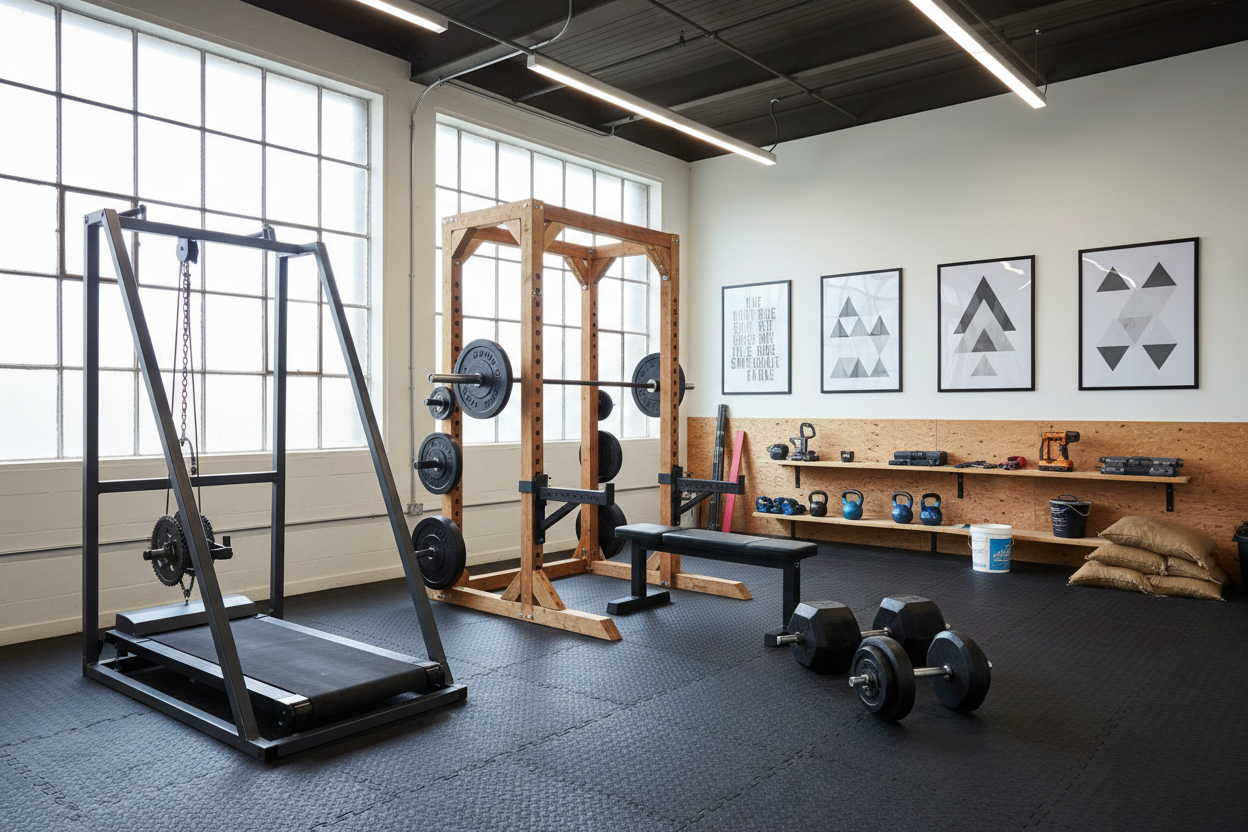
I remember staring at a $1,200 power rack online and then looking at a stack of pressure-treated 4x4s in my driveway. I was convinced I had hacked the system. I thought I was a genius who could outsmart the fitness industry with homemade gym machines. I spent three days covered in sawdust, convinced that my garage-built setup would be just as good as the professional steel I saw on Instagram.
The reality? Most of it was garbage. I’ve spent the last five years building, breaking, and eventually throwing away DIY gear. If you are looking to save a few bucks, you need to know where the line is between a 'clever budget hack' and a 'structural disaster' waiting to drop a barbell on your neck.
Quick Takeaways
- DIY is great for static loads like plyo boxes and deadlift platforms.
- Never trust wooden threads or lag bolts for overhead safety catches.
- The cost of high-grade lumber and structural hardware often rivals entry-level steel.
- If it moves or holds more than 200 lbs, buy the engineered version.
The Home Depot Trap: Why DIY Gear Always Seems Like a Bargain
The 'spreadsheet math' is a dangerous drug. You see a commercial cable crossover for $800, then you go to the hardware store and see a pulley for $10 and some aircraft cable for $0.50 a foot. You tell yourself you can build workout equipment for a tenth of the price. On paper, you’re saving $700. In reality, you’re buying a weekend of frustration and a machine that feels like it’s held together by hope and wood glue.
Wood is an incredible building material, but it isn't steel. It has grain, it knots, and it reacts to the humidity in your garage. When you try to build your own exercise equipment out of 2x4s, you’re dealing with 'nominal dimensions' that aren't actually straight. By the time you buy the specialized drill bits, the structural screws (don't even think about using drywall screws), and the wood glue, your 'cheap' project is suddenly costing you $150 and twelve hours of labor. Most people value their time at $0 when doing DIY, but that’s a mistake you only make until your first structural failure.
The 2 Homemade Gym Machines That Actually Work
Not everything I built was a disaster. There are two specific areas where DIY actually makes sense: static weight support and basic physics. I built a set of pulling blocks out of stacked 2x10s that are virtually indestructible. They’ve handled 500-lb deadlift drops without flinching. Because the force is going straight down through the grain into the concrete, there’s almost zero risk of failure.
The other winner is the basic PVC cable pulley. If you have a sturdy rafters or a pull-up bar, a $20 investment in a high-quality pulley and some coated cable is a legitimate win. The best equipment for home gym gains doesn't always need a motor or a fancy shroud. A simple gravity-based pulley for tricep pushdowns or face pulls is easy to maintain and shockingly effective. Just don't try to max out the stack; keep it for high-rep accessory work where a cable snap won't result in a trip to the ER.
Please Don't Build Your Own Gym Equipment for Heavy Loads
Here is where it gets ugly. I once built a wooden squat stand. I used 4x4 posts, heavy-duty lag bolts, and even reinforced the base with plywood gussets. It looked like a tank. Then I loaded 315 lbs on the bar. As soon as I unracked, I felt the wood 'settle.' It didn't break, but it groaned in a way that steel never does. The lateral stability was non-existent. If I had tripped or missed a rep, those wooden uprights would have splintered like toothpicks.
When you try to build your own gym equipment for heavy compound movements, you are gambling with your life. Steel is predictable; wood is not. If you are serious about heavy lifting, especially movements like the hip thrust where the pivot point carries massive force, stop looking at the lumber yard. A dedicated hip thrust machine is engineered to handle shear force and heavy plate loads that would shear a lag bolt right out of a pine board. I’ve seen DIY benches collapse under a 225-lb press because the builder didn't understand how wood splits under tension. It isn't worth the 'savings.'
The True Cost of Lumber vs. Real Steel
Let’s talk about the 'hidden' costs. To build something that won't kill you, you can't use the cheap, wet lumber from the bottom of the pile. You need kiln-dried, straight-grain wood. You need Grade 8 bolts, not the zinc-plated trash from the bulk bin. You need a miter saw, a drill press, and probably a heavy-duty sander so you don't get splinters every time you change the weights. When I finally added up the receipts for my failed wooden power rack, I was at $340.
For $400, I could have bought a budget-friendly steel rack with a 700-lb capacity and actual safety pins. When you build your own workout equipment, you also lose the ability to use standard attachments. No J-cups fit, no dip bars fit, and you can't easily add a lat pulldown later. You’ve built a dead-end product. Homemade exercise gear is only a bargain if you value your time at zero and your safety at even less.
When to Put Down the Saw and Buy Once
Keep your DIY energy for the stuff that stays on the floor. Build your own deadlift platform using horse stall mats and plywood. Build a storage rack for your kettlebells or a shelf for your chalk. These are low-stakes projects that actually save you money and customize your space. But for the core of your gym? Invest in the anchors. A high-quality Smith machine home gym station provides the safety and versatility that a pile of lumber never will. It’s a 'buy once, cry once' situation.
The modern home lifter has access to better, cheaper steel than ever before. In the 1970s, you had to build your own gear because commercial equipment was only for pros. Today, the price gap has closed so much that DIY is more of a hobby than a necessity. Build the platform, buy the rack, and keep your woodshop projects for the patio furniture.
FAQ
Is a wooden squat rack safe?
Generally, no. While wood is strong in compression, it is weak in shear and lateral stability. Over time, the holes for your bolts will widen, leading to wobbles that can cause a catastrophic failure during a heavy lift.
What is the easiest DIY gym project?
A deadlift platform or a plyo box. These use simple geometry and the weight is supported directly by the floor, making them the safest and most cost-effective projects for beginners.
Can I save money making my own weights?
Concrete weights are cheap but bulky and prone to cracking. They also vary in weight significantly (a '45-lb' concrete plate might be 41 or 49 lbs). For consistent training, stick to iron or bumper plates.
Share:
Is a Leg Press Weight Bench Actually Worth the Space?
How Stance Changes the Smith Machine Squat Muscles Worked