
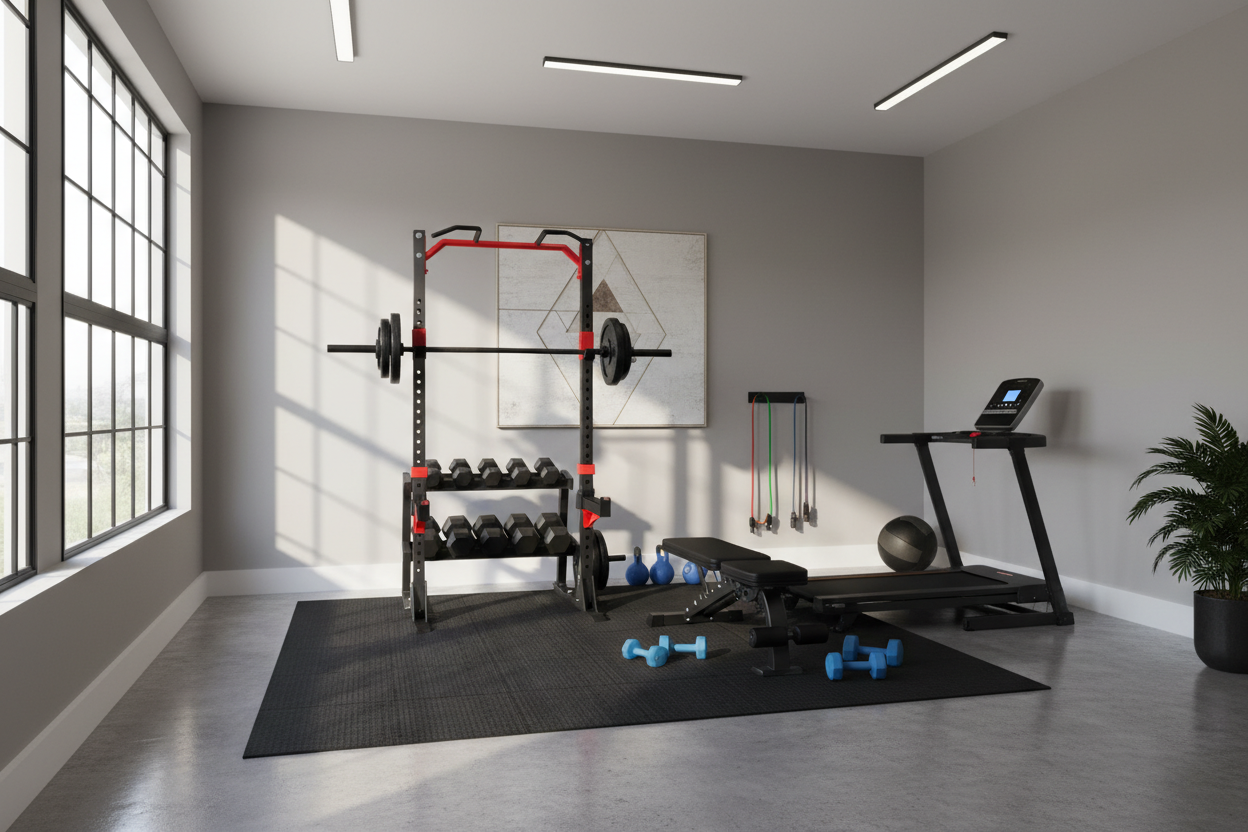
I used to think I needed a three-car garage and a commercial-grade budget to build a real strength sanctuary. Then I moved into a 700-square-foot apartment and realized my compact at home gym had to live in a corner of the living room or it wasn't happening. Most people quit before they start because they think small means weak, but after a decade of testing gear, I’ve learned that footprint doesn’t dictate intensity.
Quick Takeaways
- Measure the bar path, not just the machine’s footprint.
- Prioritize 11-gauge steel over folding gimmicks that use plastic parts.
- Vertical storage is your best friend for small fitness equipment.
- Adjustable dumbbells and folding racks are the non-negotiable foundations.
The Problem With Most Space-Saving Fitness Gear
Walk into any big-box sporting goods store and you’ll see 'compact workout equipment' that looks like it was designed by people who have never touched a barbell. These small workout machines for home are often built with thin-gauge steel and plastic pulleys that feel like they're going to explode the moment you load more than 100 pounds. It’s a safety hazard masquerading as convenience. I’ve seen compact gym for home setups snap or tip over because the base wasn't wide enough to handle a legitimate eccentric load.
Marketing teams love to talk about 'easy storage,' but if a bench takes ten minutes to unfold and feels like a wet noodle when you're trying to chest press 80-pound dumbbells, you aren't going to use it. You need equipment that stays rigid. When you’re looking at small fitness equipment for home, check the weight capacity first. If a rack is rated for less than 500 lbs, it’s a coat rack, not a gym. Real training requires stability, and most 'mini fitness equipment' simply can't provide the floor-to-frame contact needed for heavy compounds.
Mapping Out Your Tiny Footprint Without Guessing
Before you buy a single plate, get a roll of blue painter’s tape. I’ve seen dozens of lifters buy a 'compact' rack only to realize they don't have the 7 feet of lateral clearance needed to actually load a standard Olympic barbell. This is how I successfully designed a home gym small enough for a bedroom without hitting the walls every time I did a clean and press.
Block out the 'dead zones.' These are the areas where your body needs to move—like the space behind a bench for a spotter or the overhead clearance for pull-ups. If you’re working with a 50-square-foot corner, every inch is a premium. Use the tape to mark the footprint of your small gym equipment for home, then stand inside those marks. Mimic a squat. Mimic a press. If your knuckles hit the ceiling or your bar hits the bookshelf, you need to pivot to a short-stature rack or a specialized compact workout machine.
The Core Pieces You Actually Need to Lift Heavy
If you want a high-functioning gym for small spaces, you have to stop buying single-use machines. A dedicated leg extension machine is a waste of 12 square feet. Instead, look for multi-purpose small weight machines. A high-quality folding wall-mount rack is the gold standard here. It gives you the ability to squat and press in a 4x4 area, then folds flat against the wall so you can actually walk through your room when you're done. Pair that with a set of adjustable dumbbells that replace 15 pairs of traditional weights, and you’ve already won 80% of the battle.
For those who train alone in tight quarters, safety is the biggest hurdle. A Smith machine home gym station is actually a brilliant solution for a compact at home exercise equipment setup. It combines a rack, a cable system, and a self-spotting barbell into one footprint. You lose the 'functional' stabilization of a free barbell, but you gain the ability to push to failure in a 5x5 space without dying under a heavy bar. It’s the ultimate small home exercise equipment for people who value their floor space as much as their PRs.
Fitting a Brutal Leg Day Into a Closet-Sized Space
Leg day is usually where small at home gym equipment fails. You can only do so many goblet squats before your grip gives out before your quads. The problem is that a standard leg press takes up half a garage. To get around this, you have to look for specialized engineering. I’ve found that a compact leg press hack squat combo is one of the few ways to get commercial-grade lower body volume in a footprint that doesn't swallow your entire living room. These machines use a steeper angle to reduce the horizontal length while still letting you load up hundreds of pounds of iron.
If a combo machine is still too big, look for small weight machine for home options like a sissy squat bench or a high-capacity step-up box. The goal is to find tools that allow for high mechanical tension without requiring a 10-foot runway. Remember, the 'smallest workout machine' isn't always the best; it’s the one that allows for the greatest range of motion without wobbling. I’ve seen guys try to do heavy lunges in a cramped hallway and end up putting a knee through the drywall. Don't be that guy. Choose compact fitness equipment that respects the physics of a heavy squat.
Cardio That Won't Eat Your Entire Floor Plan
Most treadmills are massive, loud, and eventually become expensive laundry racks. If you’re building a gym for small spaces, you need cardio gear that disappears. I’m a big fan of under bed exercise equipment like slim walking pads, but if you want high-intensity intervals, you need something with resistance. A foldable upright exercise bike is the move here. You can hammer out a 20-minute sprint session, then tuck the entire machine into a closet or behind a door.
Don't overlook the low-tech options either. A weighted jump rope and a single kettlebell can provide more cardiovascular utility than a $2,000 elliptical while taking up literally zero permanent floor space. When you’re selecting exercise equipment for small space living, ask yourself: 'Can I move this by myself in under sixty seconds?' If the answer is no, it’s not truly compact. Your gym should adapt to your life, not the other way around.
My Experience: The 'Compact' Mistake I'll Never Make Again
When I first started building my apartment setup, I tried to save money by buying a cheap, 'ultra-compact' adjustable bench from a random Amazon brand. It looked great in the photos. But the first time I tried to do incline presses with 90-pounders, the backrest shifted two inches to the left. I almost blew out my shoulder because I prioritized 'small' over 'solid.' Now, I only buy 11-gauge steel. It’s heavier to move, but I’d rather struggle with a heavy bench for two minutes than spend six months in physical therapy. If you're building a compact at home gym, buy the heavy-duty version of the small tool.
FAQ
What is the smallest workout machine that actually works?
A set of high-quality adjustable dumbbells. They replace an entire rack of weights and allow you to perform hundreds of exercises in the space of a single floor tile. If you mean a 'machine' with pulleys, a wall-mounted cable station is the most space-efficient way to get constant tension.
Can I really do a full workout in 50 square feet?
Absolutely. A 7x7 area is enough for a folding rack and a bench. You just have to be disciplined about plate storage—use wall-mounted pegs to keep your weights off the floor and out of your walking path.
Is under bed exercise equipment actually effective?
For recovery and light cardio, yes. For building muscle or serious power, no. Walking pads are great for getting steps in while you work, but they won't replace a heavy squat or a high-intensity bike session.
Share:
Why Every Infomercial Ab Machine Belongs in the Dumpster
I Matched Every Gym Machine With Name (So You Can Stop Guessing)