
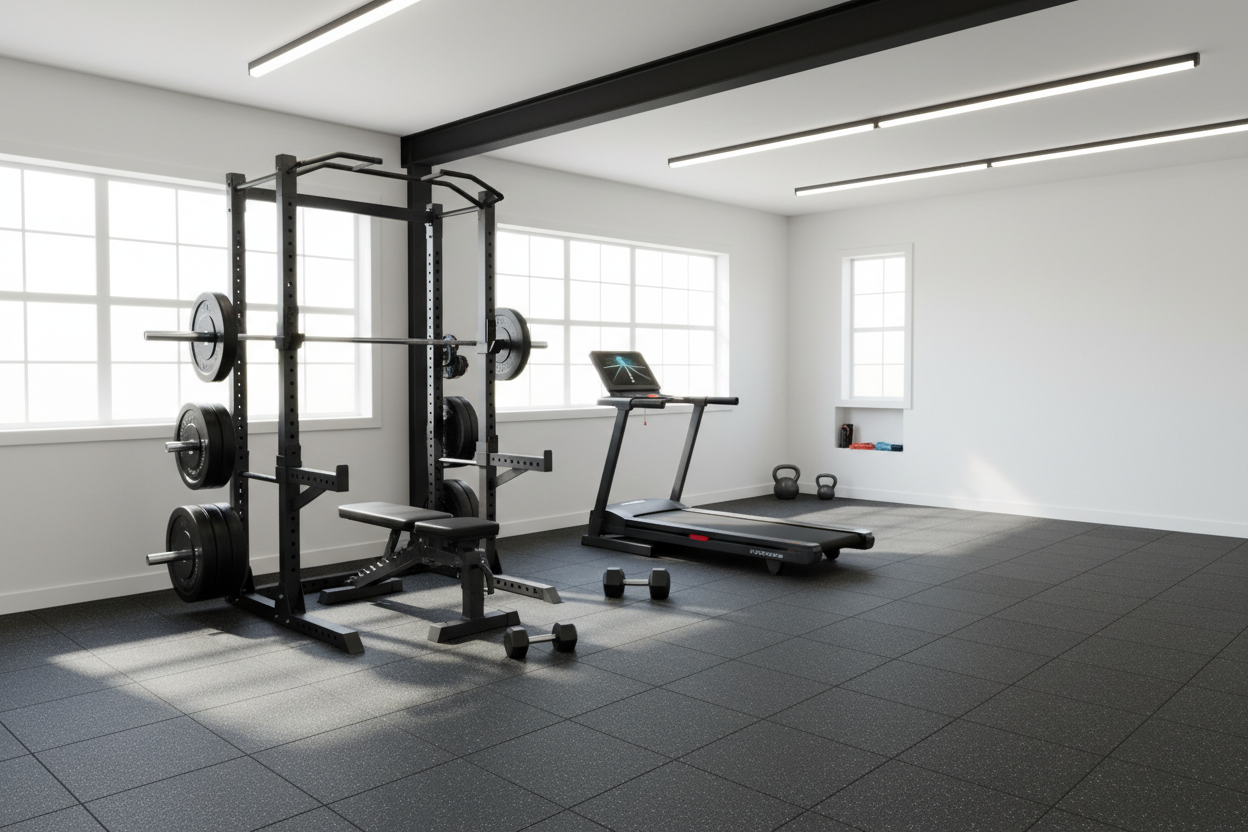
I remember the excitement of ordering my first real power rack. I had saved for months, obsessed over the 11-gauge steel specs, and pulled the trigger on a Friday night. When the freight truck dropped three massive boxes on my driveway, I realized I had made a rookie mistake regarding exercise equipment dimensions. I had measured my floor, sure, but I hadn't measured my life.
- Manufacturers list 'static footprint,' which doesn't include the space you need to move.
- Barbells add over 7 feet of width to any rack setup.
- Vertical clearance is the most common failure point for basement and garage gyms.
- Taping the floor with painter's tape is the only way to truly visualize your layout.
The Day I Had to Saw Off My Pull-Up Bar
I bought a rack that was 90 inches tall. My garage ceiling? Also 90 inches. I thought I was being efficient, utilizing every inch of vertical space. But when I went to bolt the top crossmembers together, I realized there was no room for the hardware, let alone my head. I spent a miserable Saturday with a hacksaw and a prayer, ruining the powder coat and likely voiding my warranty just to make the thing fit. This is the painful reality of ignoring gym equipment sizes before clicking buy.
It wasn't just about the height. Because the rack was flush against the ceiling, pull-ups became a joke. Every rep ended with my forehead tapping the drywall. If you don't account for the 'head space' above the bar—usually 12 to 18 inches—you've just bought a very expensive squat stand that can't do half of what it's designed for. Don't be the guy with the hacksaw.
Static Footprint vs. Working Clearance (The Biggest Trap)
A manufacturer might tell you a rack is 48 inches wide. That sounds manageable for a small corner. But a standard Olympic barbell is 86 inches long. If you don't have at least 9 or 10 feet of width, you aren't loading plates without hitting a wall or your car. When planning your home gym, you have to account for the 'working clearance.' This is the buffer zone where your body actually moves.
I’ve seen people wedge a functional trainer into a corner only to realize they can’t extend the cables fully because they hit a storage shelf. Fitness equipment dimensions on a spec sheet are just the skeleton; you need to add at least 24 inches of buffer on every side. If you're tight on space, that buffer is the difference between a productive session and a frustrating game of Tetris every time you want to change plates.
Ceiling Height Rules You Absolutely Cannot Cheat
Vertical gym equipment dimensions are the silent killer of basement gyms. A Smith machine home gym station often stands 80 to 84 inches tall. That fits under a standard 8-foot ceiling, but have you considered the pull-up handles? Or the height of the weight stacks when they're fully raised? Some machines have guide rods that extend higher than the frame itself during use.
You also need to measure from the floor to the lowest obstruction. In my basement, that wasn't the ceiling—it was a low-hanging HVAC duct and a garage door opener motor. If your hands hit a joist before your arms are locked out on an overhead press, your training is going to feel cramped and dangerous. Always measure to the lowest point, not the highest.
Cardio Machines Always Take Up More Room Than You Think
Treadmills are the worst offenders when it comes to floor hogging. They require a significant 'safety zone' behind the belt. If you trip at 8 mph and there's a wall six inches behind the treadmill, you're going to have a very bad day. Most manuals suggest 6 feet of clear space behind the machine. For many, a foldable exercise bike is a much smarter play than a commercial-grade treadmill that eats 20% of your total square footage.
Rowers are another trap. They are long—often 8 feet or more—but narrow. People forget they need space to actually get on and off the machine. If you're looking at gym equipments measurements for a rower, remember that your body extends past the end of the rail at the finish of the stroke. If you're 6'4', that 96-inch rower suddenly needs 105 inches of floor space.
How to Tape Out Gym Equipments Measurements Before Buying
Grab a roll of blue painter's tape and a tape measure. Don't eyeball it; your brain is a liar when it comes to spatial awareness. Use the manufacturer's gym equipment sizes and mask off the floor. Then—and this is the part everyone skips—actually stand in that taped-off box. Mimic a squat. Mimic a bench press. Do you have room to walk around the rack to change the weights without shimmying like a thief in a laser hallway?
If the tape is touching your workbench or the water heater, the gear won't fit. I once taped out a leg press only to realize I wouldn't be able to open my gym's mini-fridge if I bought it. That 10-minute exercise saved me a $300 'restocking fee' and the headache of shipping 400 pounds of steel back to the warehouse.
What to Do When You Have Zero Space
If you're working with a 10x10 spare room, stop looking at massive single-use machines. Focus on essential fitness equipment like an adjustable bench, a pair of heavy dumbbells, and a wall-mounted folding rack. Versatility beats volume every single time when square footage is the limiting factor.
One piece of gear that does five things is always better than five pieces of gear that turn your room into an obstacle course. I've found that the more cramped a gym is, the less likely I am to use it. A clean, open 100-square-foot space feels better to train in than a 400-square-foot room packed so tight you can't breathe. Prioritize the movement, not the machine.
FAQ
How much width do I need for a 7-foot barbell?
You need at least 9 feet. The bar is 86 inches, and you need about 10-12 inches on each side to slide plates on and off without punching a hole in your drywall.
Can I put a power rack in a room with 7-foot ceilings?
Yes, but you need a 'shorty' rack. Most standard racks are 82-90 inches, but companies make 72-inch versions specifically for low-ceiling basements. Just realize your pull-ups will be done with tucked knees.
How much space should be between gym machines?
Aim for a minimum of 24 inches of walking space between any two pieces of equipment. This ensures you aren't tripping over feet or frames while moving through your workout.
Share:
How to Actually Fit Strength Training Machines in a 1-Car Garage
Can a Single All In One Gym Machine Really Replace a Commercial Club?