
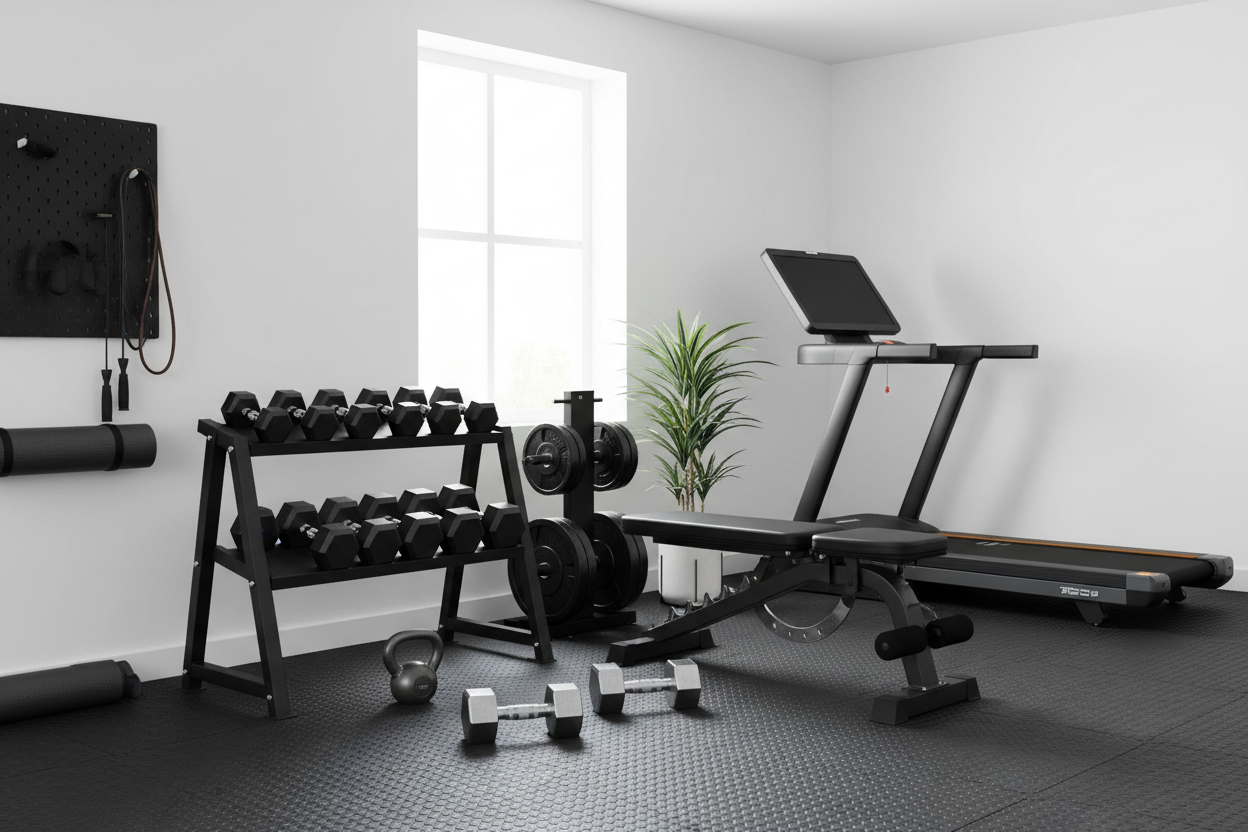
I remember standing in a fluorescent-lit commercial gym, staring at a PDF on my phone that told me to do 'Face Pulls.' I spent ten minutes looking for a machine labeled 'Face Puller' before giving up and doing curls. It is humiliating to feel like a tourist in a place where you are trying to better yourself, all because you do not know the proper gym equipments name.
We have all been there. You see someone doing something impressive on a contraption that looks like a medieval torture device, and you want to try it, but you do not even know what to search for on YouTube. Whether you are tired of the 'gymtimidation' or you are finally ready to stop overpaying for a monthly membership, getting the terminology right is the first step to owning your training.
Quick Takeaways
- A Power Rack is a four-post cage; a Squat Stand is two uprights.
- Selectorized machines use a pin and weight stack; plate-loaded machines require manual loading.
- The Smith Machine has a fixed barbell path, which is different from a free-weight rack.
- Cables are the most versatile gym item names to learn for accessory work.
The Awkward Locker Room Google Search
The first time I saw a program call for a 'Hack Squat,' I walked over to a standard leg press and felt like an idiot when the trainer corrected me. Learning gym item names is not just about semantics; it is about safety and efficiency. If you are looking for a 'leg pusher,' you might find five different machines that do five different things.
When you know the name of the equipment in gym settings, you stop wandering. You walk in, you see the gear, and you execute. It builds a level of confidence that actually makes you want to train harder. No more scrolling through Google Images in the locker room while you pretend to tie your shoes for the tenth time.
The Big Iron: Decoding Free Weights and Racks
If you are piecing together a home gym, the rack is your centerpiece. Do not confuse a Power Rack with a Squat Stand. A Power Rack is a full cage with four or six uprights. It is built for safety; you can set 'spotter arms' inside the cage so the bar does not crush you if you fail a rep. I personally will not max out my bench press without one.
A Squat Stand is the minimalist cousin. It is two uprights, often taking up way less floor space, but it is less stable for heavy re-racks. Then there is the Half Rack, which is the middle ground—usually two main uprights with two smaller ones for plate storage. Knowing these workout machines names saves you from buying a rack that is too big for your garage or too flimsy for your PRs.
Pushing and Pulling: Navigating the Machine Maze
Machines usually fall into two camps: selectorized and plate-loaded. Selectorized machines have that stack of weights with a pin. They are great for quick transitions. Plate-loaded machines, like a heavy-duty Leg Press or a Lever Row, require you to lug 45-lb plates over to them. They feel more 'raw' and usually allow for a higher weight capacity.
The most misunderstood piece is the Smith machine home gym station. People call it a squat rack, but it is not. The bar is attached to rails. It moves in a strictly vertical (or slightly angled) path. It is fantastic for hypertrophy because you do not have to stabilize the weight, but do not think your Smith squat numbers will translate 1:1 to a free-weight barbell.
Cables and Pulleys: The Functional Trainer Family
Cables are the 'Swiss Army Knife' of the gym. A Functional Trainer is the big unit with two adjustable pulleys. You can do almost anything on these, from chest flies to woodchops. If you see two of these facing each other, that is a Cable Crossover setup.
Then you have dedicated towers. A lat pulldown low row station is a specialist. While a functional trainer is a jack-of-all-trades, a dedicated lat tower usually has a higher weight stack and better stability for heavy pulling movements. I made the mistake of trying to do heavy rows on a cheap door-mounted pulley once; the bracket snapped and nearly took my teeth out. Buy the dedicated station if you have the room.
The 'Weird' Stuff: Odd Objects and Conditioning Gear
You might hear people talk about 'gym instruments name' when referring to conditioning tools. The 'big fan bike' you see people dying on is usually an Air Bike or an Echo Bike. The rowing machine is officially an Indoor Rower or Ergometer (Erg for short). If it looks like a giant treadmill but it is curved and has no motor, that is a Manual Treadmill.
Do not forget the small stuff. Those cast-iron weights with handles? Kettlebells. The big wooden or foam boxes? Plyo boxes. Even the 'name of the equipment in gym' lists for small accessories matter. If you are looking for 'wrist straps' but buy 'wrist wraps,' you are going to be very disappointed when you try to deadlift.
Why Knowing the Right Terminology Actually Matters
Knowing the lingo prevents you from getting ripped off. Marketing teams love to invent fancy names for basic gear to hike the price. When you know you are looking for a 'Functional Trainer' and not a 'Total Body Bio-System,' you can compare specs like pulley ratios and steel gauge effectively.
If you want a quick reference to keep on your phone, I actually cheat sheet for gym equipment that breaks this down visually. It helps when you are trying to find a substitute exercise because the machine you wanted is taken by someone doing 'curls' in the squat rack.
FAQ
What is the difference between a barbell and a standard bar?
An Olympic barbell has 2-inch diameter sleeves for Olympic plates and weighs 45 lbs (20kg). A 'standard' bar is 1-inch thick throughout and usually weighs about 15-20 lbs. Do not buy standard gear if you plan on lifting heavy; it will bend.
What is a GHD?
It stands for Glute Ham Developer. It is a large station with ankle rollers and a big half-moon pad. It is one of the best tools for posterior chain strength, but it takes up a massive footprint.
Is a Leg Press the same as a Hack Squat?
No. On a Leg Press, you sit and push the weight away from you. On a Hack Squat, you stand in the machine and push yourself up away from the floor. They hit the quads differently.
Share:
Why an Adjustable Bench for Workout Progression Beats a Flat Pad
Hotel Gyms Suck: Finding the Best Portable Gym System Instead