
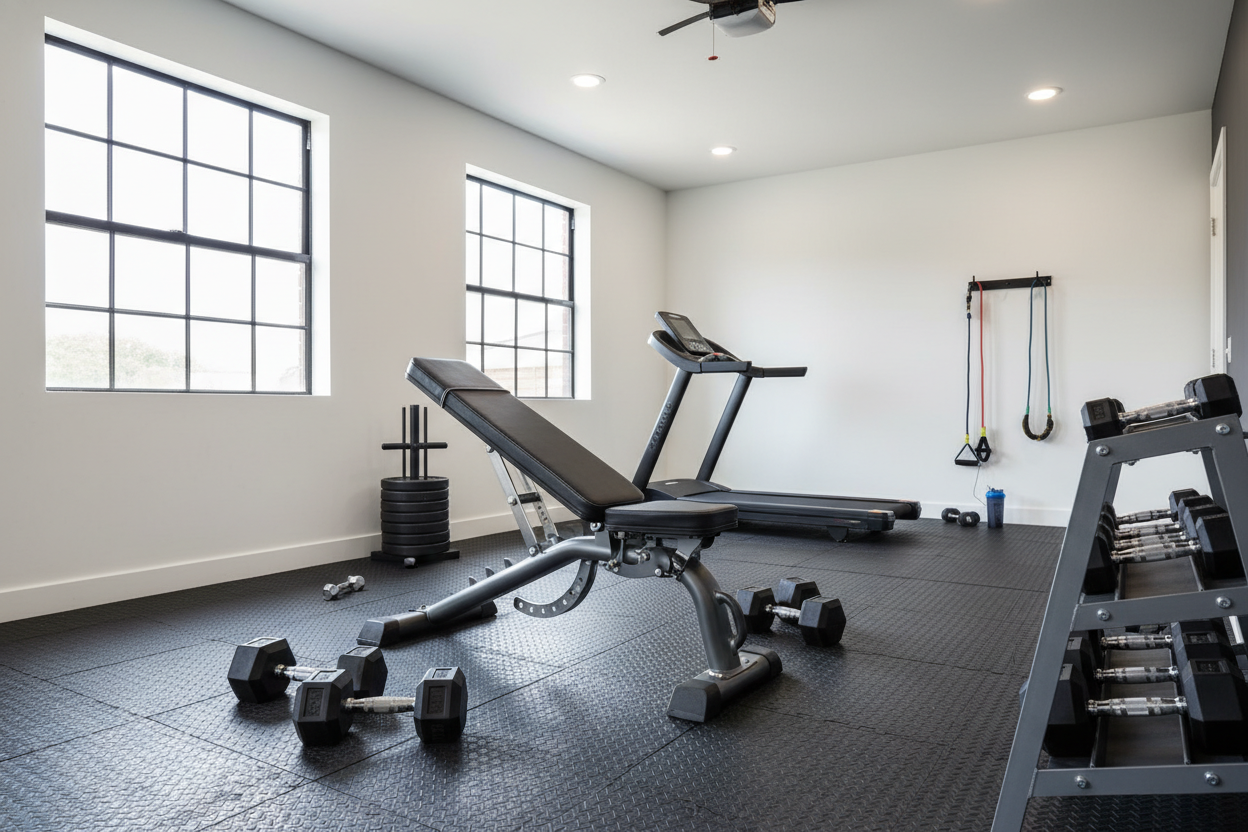
I remember my first garage gym setup. It was a $40 flat bench from a big-box store and a pair of rusty 25-pound dumbbells. After three months, my progress hit a brick wall. There is only so much you can do lying flat on your back before your shoulders get cranky and your chest development stalls. To build a physique that actually looks like you lift, an adjustable bench for workout variety is the single most important upgrade you can make.
Quick Takeaways
- Incline angles target the upper pecs and delts where flat benches fail.
- A 'pad gap' can ruin your positioning; look for designs that minimize it.
- Heavy-duty steel (11 or 12 gauge) is non-negotiable for safety under load.
- Adjustable benches turn a simple pair of dumbbells into a full-body hypertrophy system.
The Flat Bench Trap: Why You Are Missing Out on Gains
Flat benches are great for powerlifting, but for general hypertrophy and shoulder health, they are a dead end. When you are stuck in a single horizontal plane, you are missing out on the mechanical tension required to build a 'shelf' on your upper chest. An adjustable bench for workout progression allows you to manipulate the angle of attack, shifting the load from the mid-chest to the clavicular head and the anterior delts.
If you have ever felt that nagging 'pinch' in your front shoulder during a heavy flat press, it is usually because your humerus is stuck in a fixed path. Moving to a slight 15-degree or 30-degree incline can often alleviate that pain while actually increasing muscle fiber recruitment. For any serious adjustable weight bench home gym, the ability to move through different planes of motion is the difference between a plateau and a PR.
How Changing Angles Completely Transforms Your Dumbbells
Moving the pin on your bench transforms your entire training space. I have seen guys who swapped my rack for adjustable weights and bench because the versatility is just that high. When you have a solid adjustable dumbbell bench, you aren't just limited to pressing. You can perform chest-supported rows to blow up your mid-back without stressing your lumbar spine, or seated overhead presses that actually support your trunk.
Using an adjustable bench weight lifting setup allows for 'mechanical dropsets.' You can start with a heavy set of incline presses, then immediately drop the bench to flat and squeeze out five more reps. This kind of intensity is impossible on a fixed pad. It turns a basic adjustable weight bench home gym into a high-performance laboratory where every degree of incline serves a specific purpose for your muscle growth.
Red Flags to Watch For When Buying Your Setup
Do not just buy the cheapest adjustable bench you find during a late-night Amazon scroll. Most of those budget options are made of thin-walled steel that will wobble the second you pick up anything heavier than a 30-pounder. A wobbly bench is a dangerous bench. If the frame flexes when you are trying to set your scapula, your force production drops and your injury risk skyrockets.
I have written before about why that $150 adjustable bench with weights is a terrible idea—it is usually a recipe for a pinched spine or a collapsed frame. When searching for an adjustable workout bench for sale, check the weight capacity first. If it is rated for under 600 lbs (including your body weight), keep moving. You also want to check the 'pad gap.' Cheap benches often have a massive 3-inch gap between the seat and backrest that swallows your lower back during flat presses.
What Actually Matters in an Adjustable Bench Home Gym Setup
The best gym bench for home adjustable setups needs three things: heavy-gauge steel, a wide footprint, and high-density foam. You want at least 2x3-inch steel tubing. This provides the mass needed to keep the bench anchored to the floor during leg drive. A wide rear stabilizer is also crucial so you don't tip over when doing seated lateral raises or incline curls.
When you are browsing for a weight bench, pay attention to the adjustment mechanism. Ladder systems are generally faster for quick transitions between sets, while pop-pins offer a more locked-in feel. The foam should be firm. Cheap, soft foam bottoms out, meaning your shoulder blades are pressing against raw steel mid-set. Look for a pad thickness of at least 2.5 inches to ensure your joints stay protected during heavy triples.
The Buy-Once, Cry-Once Rule for Benches
Your bench is the foundation for your spine. It is the one piece of equipment you should never cheap out on. I have seen too many people hunt for a sketchy adjustable weights bench for sale on a local marketplace only to have the adjustment pin shear off after a month of use. It is a classic 'buy-once, cry-once' scenario.
Investing in a high-quality piece like the Adjustable Weight Bench Owb01 ensures that the frame stays rigid and the vinyl doesn't crack after a few sweaty sessions. A good bench should last a decade, not a season. Spend the extra money now on a piece that can grow with your strength rather than one that will end up in a landfill by next Christmas.
Personal Experience: The Wobbly Bench Lesson
Early in my training, I bought a 'pro' bench from a generic brand that looked great in photos. The first time I tried to hit a heavy set of 90-pound dumbbell presses, the bench shifted two inches to the left. It was terrifying. I realized that the bolt-together construction was low-quality and the steel was too light. I ended up selling it for $20 and buying a welded, heavy-duty model. My presses immediately felt stronger because I wasn't wasting energy trying to balance a shaking bench.
Adjustable Bench FAQ
Is the pad gap a dealbreaker?
It depends on your height and where your hips sit. A 1-2 inch gap is standard, but anything over 2.5 inches will likely cause lower back discomfort during flat presses. Look for benches with a tapered seat to minimize this.
What is the ideal weight capacity?
For a serious lifter, look for a combined capacity (user + weights) of at least 600-800 lbs. This ensures the frame is overbuilt and won't flex under pressure.
Are wheels necessary on a bench?
In a home gym, yes. Unless you have a massive dedicated space, you will need to move the bench in and out of your rack. Look for high-quality urethane wheels that won't scuff your floor.
Share:
I Refuse to Buy Junk: Building the Best Home Gym Under 2000
I Was Too Embarrassed to Ask for Every Gym Equipments Name