
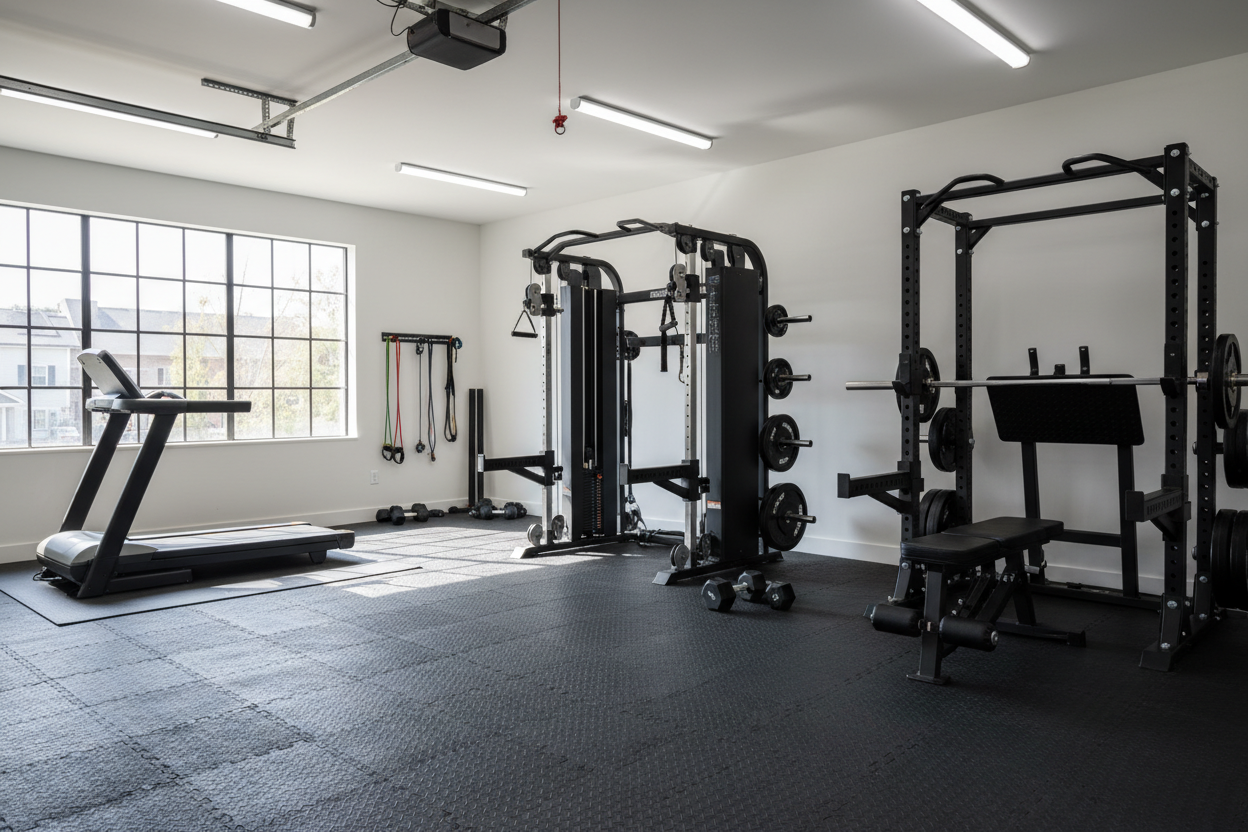
I remember standing in the middle of a crowded commercial gym, staring at a leg extension machine for five minutes, wondering if I should do ten or twelve reps. Meanwhile, some guy in a sweat-soaked stringer was grunting through heavy cleans in the rack next to me. I felt like a total fraud. For a long time, I convinced myself that exercise equipment routines were just the 'easy way out' for people who didn't want to do the real work of barbell training.
- Stop hopping: Pick a routine and stick to it for 8 weeks minimum.
- Track everything: Machine settings (seat height, pin position) matter as much as the weight.
- Embrace failure: Machines are safer for reaching absolute muscle failure without a spotter.
- Intentionality: If you do not have a plan before you walk in, you are just exercising, not training.
The 'Gym Wanderer' Mistake You Need to Stop Making
The biggest killer of progress isn't your genetics; it's the 'open machine' philosophy. You walk in, see the chest press is taken, so you wander over to the bicep curl. Then you see the lat pulldown is free, so you jump on that. This lack of a structured gym machine routine is why most people look exactly the same in December as they did in January. You aren't giving your muscles a consistent reason to grow.
An intentional gym machine workout program requires you to treat the machines with the same respect you'd give a heavy squat rack. You need to know exactly which station you are hitting first, second, and third. When you wander, you lose the ability to measure progressive overload. If the seat is at height '4' one week and '6' the next, your leverage changes. You might think you got stronger, but you just made the movement easier. Stop being a wanderer and start being a technician of your own mechanics.
Why I Stopped Treating Machines Like Second-Class Gear
I used to be a total barbell snob. If it wasn't a knurled bar with iron plates, I didn't think it counted. But eventually, my joints started feeling like glass, and my hypertrophy stalled because my lower back would give out long before my legs or lats did. I finally swallowed my pride and traded free weights for a full body workout machine for a focused six-week block. My mind-muscle connection skyrocketed.
Machines remove the stability requirement. While 'functional fitness' gurus hate that, it is actually a massive advantage for building muscle. When you don't have to worry about balancing a 225-lb bar on your back, you can push your quads to the point of absolute screaming failure. That is where the growth happens. Using a machine gym workout plan allows you to isolate specific muscles without your central nervous system frying out from the technical demands of free weights.
How to Actually Program a Machine Weight Training Routine
Programming for machines isn't about doing '3 sets of 10' on everything and leaving. You need a split that allows for recovery. I'm a huge fan of the Push/Pull/Legs (PPL) split for a machine workout program. It ensures you hit every muscle group with enough volume to actually trigger a change. You still need to apply progressive overload—if you did 150 lbs last week, you better try for 155 lbs or an extra rep this week.
Push Day: Chest and Shoulders Without the Wobble
On push day, your goal is to hammer the pecs, delts, and triceps. I always start with a heavy, converging chest press machine. Unlike a standard flat bench, a converging machine follows the natural arc of your chest muscles, getting tighter as you reach the top of the movement. It provides a much better squeeze than a barbell ever could. Follow this with a machine shoulder press and some cable flyes to round out the session. You'll find you can move more weight safely because the machine handles the stabilization for you.
Pull Day: Back and Biceps on the Cables
For back development, cables are king. A smith machine with a cable crossover is basically a one-stop shop for a pull day. I use the high pulleys for lat pulldowns and the low pulleys for seated rows. The constant tension of a cable system is vastly superior to dumbbells for back training because the resistance doesn't drop off at the bottom of the movement. I finish with cable curls, which keep my biceps under load through the entire range of motion, unlike a standard barbell curl where the tension disappears at the top.
Leg Day: Heavy Compound Movements on a Track
Leg day on machines is where you can truly test your grit. I've shifted my heavy squatting to a smith machine home gym station. By moving my feet about six inches forward of the bar, I can maintain an upright torso and absolutely torch my quads without my lower back rounding or my balance wavering. It allows for a depth that most people simply can't achieve with a free-weight squat. Pair this with a leg press and some lying leg curls, and you'll be hobbling to your car in the best way possible.
Can You Actually Use Machines for Fat Loss?
Most people think machines are just for 'bulking,' but a weight loss machine workout is incredibly effective because of the 'density' factor. Since you don't have to spend five minutes loading plates or hunting for a matching pair of dumbbells, you can keep your rest periods short. I like to run machine circuits—moving from a chest press to a row to a leg press with only 30 seconds of rest. This keeps the heart rate pinned in a high-burn zone while still providing enough mechanical tension to keep your muscle mass from wasting away during a calorie deficit.
FAQ
Are machines better than free weights for beginners?
Yes, because they have a lower barrier to entry. You can learn the movement pattern without the risk of dropping a weight on your chest. However, even pros use them for the isolation benefits.
How often should I change my machine gym workout routine?
Stick to the same movements for at least 8 to 12 weeks. You need time to get proficient at the machine and actually add weight to the stack before switching things up.
Can I build a pro-level physique with only machines?
Absolutely. Some of the greatest bodybuilders in history, like Dorian Yates, relied heavily on machines to push their muscles past the point where free weights became the limiting factor.
Share:
Your Complete Home Gym Doesn't Need to Look Like a CrossFit Box
How to Buy Weight Machines Cheap Without Buying Complete Junk