
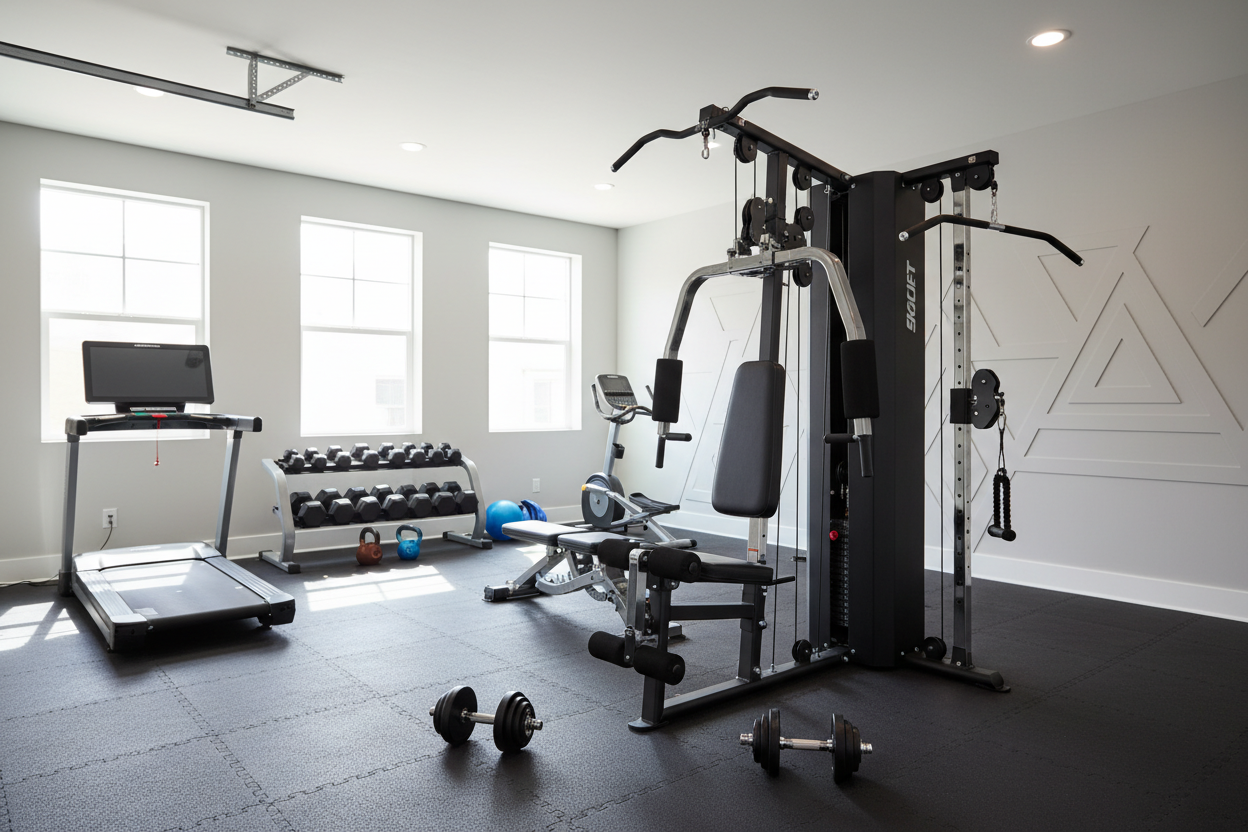
I remember standing in my garage three years ago, staring at a pile of boxes that promised to replace my entire commercial gym membership. I had spent months dodging crowds at the local big-box gym, tired of waiting twenty minutes for a squat rack. The idea of a gym machine all in one footprint seemed like the ultimate hack for my 12x12 space.
But here is the thing about those flashy all-in-one rigs: they either become the centerpiece of your gains or a very expensive clothes rack. Most of these units look great in a rendered photo, but the second you load 200 pounds on the cable, the whole frame starts screaming for mercy. I have tested enough of these to know which ones are built for real lifting and which ones are basically toys.
Quick Takeaways
- Look for 11-gauge or 12-gauge steel frames; anything thinner will wobble during heavy rows.
- Aluminum pulleys beat plastic every single time for cable smoothness and longevity.
- Dual weight stacks allow for true functional trainer movements like chest flys.
- Check the footprint twice; you need at least two feet of clearance around the unit to actually use the attachments.
The All-In-One Dream vs. The Wobbling Reality
The marketing for a home gym multi machine is seductive. They show a guy doing twelve different exercises in a thirty-second clip, making it look like the only gym equipment combo you will ever need. In reality, a cheap home multi gym often feels like lifting through a bucket of sand. If the frame is made of thin, 14-gauge steel, it will shake the moment you try a heavy lat pulldown.
I once tested a home gym combo that literally tipped forward when I tried to do a standing cable row with 150 pounds. That is not just annoying; it is dangerous. A real multi fitness machine needs enough mass and a wide enough base to stay planted when you are moving heavy iron. If you can move the entire rig by pushing it with one hand, keep your credit card in your pocket.
The All-In-One Gym Machine Price Trap (Don't Get Fooled)
Price is the biggest lie in the fitness industry. You see a multi functional workout machine for $499 on a clearance site and think you found a steal. You didn't. At that price, the manufacturer cut corners on the bearings, the cable coating, and the steel thickness. You will spend more time tightening bolts than actually training.
I learned this the hard way before I knew better. I wrote about My $1,500 Mistake Buying a Multi-Station Gym Machine for Home because I thought mid-range meant high quality. It didn't. A quality gym station equipment setup that actually lasts usually starts north of $2,000 once you factor in the weight stacks. If the all in one gym machine price seems too good to be true, it is because the cables are probably going to snap within six months.
Why Flimsy Pulleys Will Ruin Your Workout
The feel of a workout comes down to the pulleys. Budget rigs use nylon pulleys with cheap ball bearings that catch and stutter. This ruins the resistance profile. Instead of a smooth, constant tension on your triceps, you get a jerky, start-stop motion that kills your mind-muscle connection. If you are serious about a fit for home multi gym, look for machines using high-grade aluminum pulleys with sealed bearings.
What Actually Makes a Combo Rig Worth Your Floor Space?
If you are going to commit to one gym equipment unit, it needs to be versatile. The best value usually comes from a Smith Machine Home Gym Station. This setup combines a power rack, a Smith bar for controlled movements, and a functional trainer. It covers the big three—squat, bench, and deadlift—while giving you the isolation options of a commercial gym.
Weight capacity is the next non-negotiable. I look for a Smith bar rated for at least 600 pounds and cable systems with a 2:1 ratio. A 2:1 ratio means 100 pounds on the stack feels like 50 pounds at the handle, which gives you more cable travel for lunges or crossovers. If the machine uses a 1:1 ratio with a light stack, you will max out the machine on day one.
The Best Exercises to Hammer on a Multi-Station Setup
Not every movement works well on a combo rig. Stick to what these machines do best. Cable crossovers and face pulls feel incredible on a dual-stack system. Supported Smith squats allow you to incinerate your quads without worrying about your balance, which is great for high-volume hypertrophy days. I also love using the multi purpose gym machine exercises like low-row variations and single-arm lat pulldowns.
Skip the movements that feel cramped. If the machine forces your elbows into a weird angle during a chest press, do not do it. Use the cable handles to find a natural path of motion instead. The beauty of a gym station equipment setup is the ability to adjust the pulley height to fit your specific limb length and joint mechanics.
The Final Verdict: Can One Rig Actually Do It All?
If you have a massive basement, sure, buy five separate machines. But for the rest of us living the garage gym life, a high-quality combo unit is a legitimate way to build a pro-level physique. It saves you from buying five different pieces of gear and saves your floor space for a decent rack of dumbbells and a bench.
For those who want a rig that won't fall apart after a year of heavy use, I usually point people toward the Full Body Multi Training Station Smith Machine Dm01. It hits that sweet spot of commercial-grade durability and home-gym footprint. It is the kind of setup that actually justifies the investment because you will actually use it every day.
FAQ
How much space do I really need?
Most all-in-one units need at least an 8x8 foot area. You need room to extend your arms for flys and space behind the machine if it uses plate-loaded carriages rather than stacks.
Are plate-loaded or selectorized stacks better?
Selectorized stacks are faster for supersets and drop sets. Plate-loaded units are cheaper and allow you to use the Olympic plates you already own, but they take up more lateral space.
Can I perform heavy deadlifts on these?
Do not deadlift on the cables. If the machine has a built-in power rack or a Smith machine, use those. Most cable systems aren't designed for the sudden, heavy pull of a 400-pound deadlift.
Share:
My $2,000 Mistake Acting as a Solo Fitness Equipment Importer
Stop Treating a Smith Barbell Like a Regular Olympic Bar