
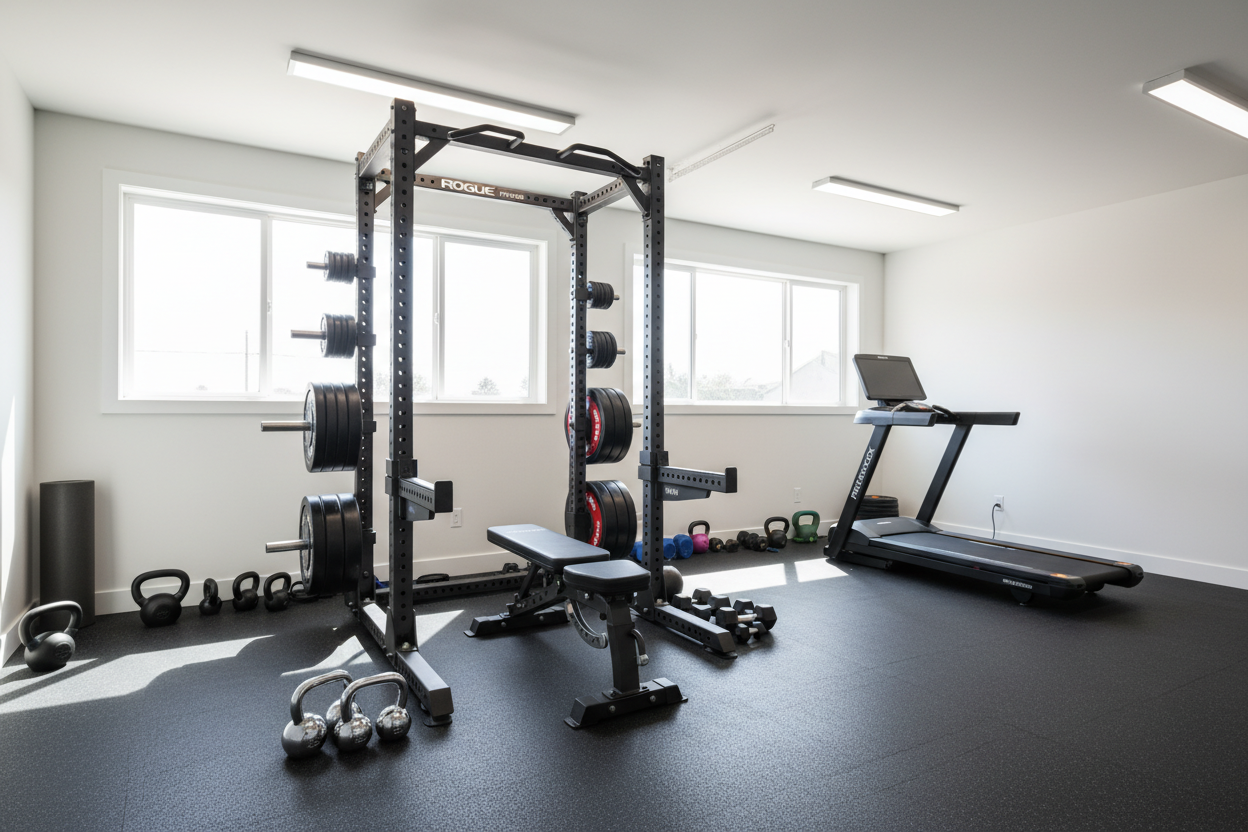
I spent three nights staring at my screen, comparing american exercise equipment specs against the cheap stuff on Amazon before I pulled the trigger on my first 'real' rack. I wanted to believe that the extra two grand was buying me something magical, but I also didn't want to be the guy who paid a 40% markup just for a sticker of a flag. After ten years of building, breaking, and selling gear in my garage, I've learned that the 'Made in USA' label is sometimes a badge of honor and sometimes just a very expensive piece of tape.
Quick Takeaways
- Buy American for structural steel like power racks and barbells where weld integrity is a safety issue.
- Imports win on complex machines, cardio, and anything with a screen or a pulley.
- Watch out for 'Assembled in USA'—it often means foreign steel with a domestic bolt.
- A hybrid gym is the smartest move for your wallet and your PRs.
The Made in USA Illusion
You need to look closely at the fine print because american gym equipment brands are masters of linguistic gymnastics. There is a massive difference between 'Manufactured in the USA' and 'Assembled in the USA.' The FTC is supposed to police this, but plenty of companies get away with 'Designed in the USA' which basically means a guy in Ohio drew a picture of a bench and sent the CAD files to a factory in Ningbo.
When you see 'Assembled in the USA,' it usually means the heavy lifting—the casting of the iron, the extrusion of the steel, the messy welding—happened overseas. The parts arrived in a container, and a guy in a warehouse in Texas put three bolts in it and slapped a sticker on the box. You are paying a premium for the warehouse rent, not the craftsmanship. If you want real domestic quality, you are looking for 11-gauge steel sourced from US mills and welds performed by certified domestic workers. Anything less is just marketing fluff designed to make you feel patriotic while you overpay for the same 2x2 tubing you could find at a big-box store.
The steel quality matters because domestic steel tends to have more consistent carbon content. Imported steel can be 'dirty,' meaning it has impurities that make welds brittle. If you are just doing bicep curls, it doesn't matter. If you are dropping a 500-lb barbell onto safety spotter arms, it matters a lot.
When You Absolutely Should Buy Domestic Steel
If you are outfitting a home gym that you plan to keep for twenty years, there are three things I will never buy from an overseas catalog: power racks, barbells, and flat benches. These are the skeleton of your training. This is where you want 3x3-inch 11-gauge steel and 5/8-inch or 1-inch hardware that feels like it belongs on a bridge.
American manufacturing shines when the design is simple but the execution needs to be flawless. Take a standard power rack. A domestic shop like Rogue or Sorinex uses robotic welders that produce 'stack of dimes' welds every single time. There is no porosity, no slag, and the powder coating is thick enough to survive a nuclear winter. When you buy from top gym equipment brands usa collectors trust, you are buying a resale value that stays at 80% or higher for a decade.
Safety is the other factor. I have seen imported J-cups with foam padding that disintegrates after three months, leaving your expensive barbell to grind against raw, poorly-finished metal. American-made J-cups usually feature UHMW plastic liners that are actually fastened correctly. It sounds like a small detail until you realize your $300 barbell is getting scarred every time you re-rack a set of squats. Spend the money on the structural pieces that keep the weight off your neck.
Where Imports Actually Win (And Save You Thousands)
Now, let's talk about where the 'USA Tax' becomes a joke. If you are looking for a smith machine home gym station or anything with a complex series of pulleys, cables, and bearings, the domestic options are often five times the price without five times the performance. China has mastered the art of the functional trainer. The bearings they use in their high-end export units are often the exact same ones used in domestic units, but because they produce them by the millions, the cost is a fraction of the price.
Cardio is another area where domestic manufacturing is almost non-existent. Even the biggest names in the industry have their electronics and frames built in Taiwan or China. If you are looking for an upright exercise bike, don't go hunting for a 'Made in USA' version. You won't find one that isn't just a rebranded import with a massive markup. The tech components—the magnetic resistance flywheels, the LCD consoles, the heart rate sensors—are all part of a global supply chain that lives in Asia.
Specialty accessories like landmines, collars, and dip handles are also great places to save. A hunk of powder-coated steel that holds a barbell doesn't need to be forged in the fires of Pennsylvania to work. If the steel is thick enough and the pin fits the hole, the import will do the job. I've saved enough on imported plates and accessories to pay for my entire American-made rack.
The Truth About Your Favorite Brands
Before you drop three grand based on a brand name, you need to do some homework. Are Your Favorite Brands for Gym Equipment Actually Making Their Gear? The answer might annoy you. Some of the most 'patriotic' brands in the space are actually just massive logistics companies. They don't own a single welding machine. They have contracts with factories in China, and they spend their entire budget on Instagram influencers and professional photography.
Real manufacturers like Williams Strength or Legend Fitness actually have sparks flying in their buildings. You can tell the difference the moment you try to bolt the gear together. If the holes don't line up and you have to use a rubber mallet to force a bolt through, you bought a sticker, not a piece of engineering. If you want to support American jobs, look for companies that are transparent about their supply chain and don't hide behind 'Designed in California' labels.
How I Split My Budget Today
If I were starting over with a $5,000 budget, I wouldn't go all-American. I'd be smart about it. I call it the 3-5 Split. I buy 3 items American: the Power Rack (for safety), the Barbell (for the knurling and whip), and the Flat Bench (for stability). These are the touchpoints. These are the things that make a workout feel high-end or like a cheap hotel gym.
Then, I buy 5 items imported: Bumper Plates (iron is iron), a Functional Trainer (cables are a commodity), Dumbbells (unless you have a trust fund), a Cardio Machine, and all the small 'clutter' like bands and handles. This approach gets you the 'tank-like' feel of a professional facility without the $15,000 price tag. Don't let the 'all or nothing' crowd convince you that your gains won't count if they were made on an imported lat pulldown.
Personal Experience: The 'USA' Barbell That Wasn't
A few years back, I bought a 'Limited Edition' barbell from a company that wrapped itself in the flag. It cost $450. When it arrived, the knurling was as dull as a butter knife and the sleeve spin was non-existent. I opened the end cap to grease the bushings and found a 'Made in PRC' stamp hidden on the internal snap ring. I felt like a sucker. Since then, I've stopped buying based on the logo and started buying based on the spec sheet and the location of the actual factory. Now, my rack is American steel, but my plates are 'cheap' imports that weigh exactly what they say they do. My squats feel just as heavy, and my bank account feels a lot better.
FAQ
Is American steel actually stronger?
It is more consistent. While the 'strength' depends on the gauge and grade, US-sourced steel usually has better quality control, meaning fewer weak points in the grain that could lead to bending under extreme loads.
Why are American racks so much more expensive to ship?
Because they don't pack them in 'flat-pack' boxes as efficiently as imports. Domestic racks often feature large, fully-welded side frames rather than pieces you bolt together. This makes them stronger but turns the shipping box into a giant, heavy sail that LTL carriers hate.
Do I need a USA-made barbell for a home gym?
If you are doing Olympic lifts (cleans, snatches), yes. The heat treatment and 'whip' of American steel like 190k PSI tensile strength bars are significantly better than the stiff, brittle bars found in budget import kits.
Share:
Why Your Fancy Adjustables Can't Beat a Standard Weight Dumbbell
Why Buying a Used Commercial Multi Gym Is a Massive Mistake