
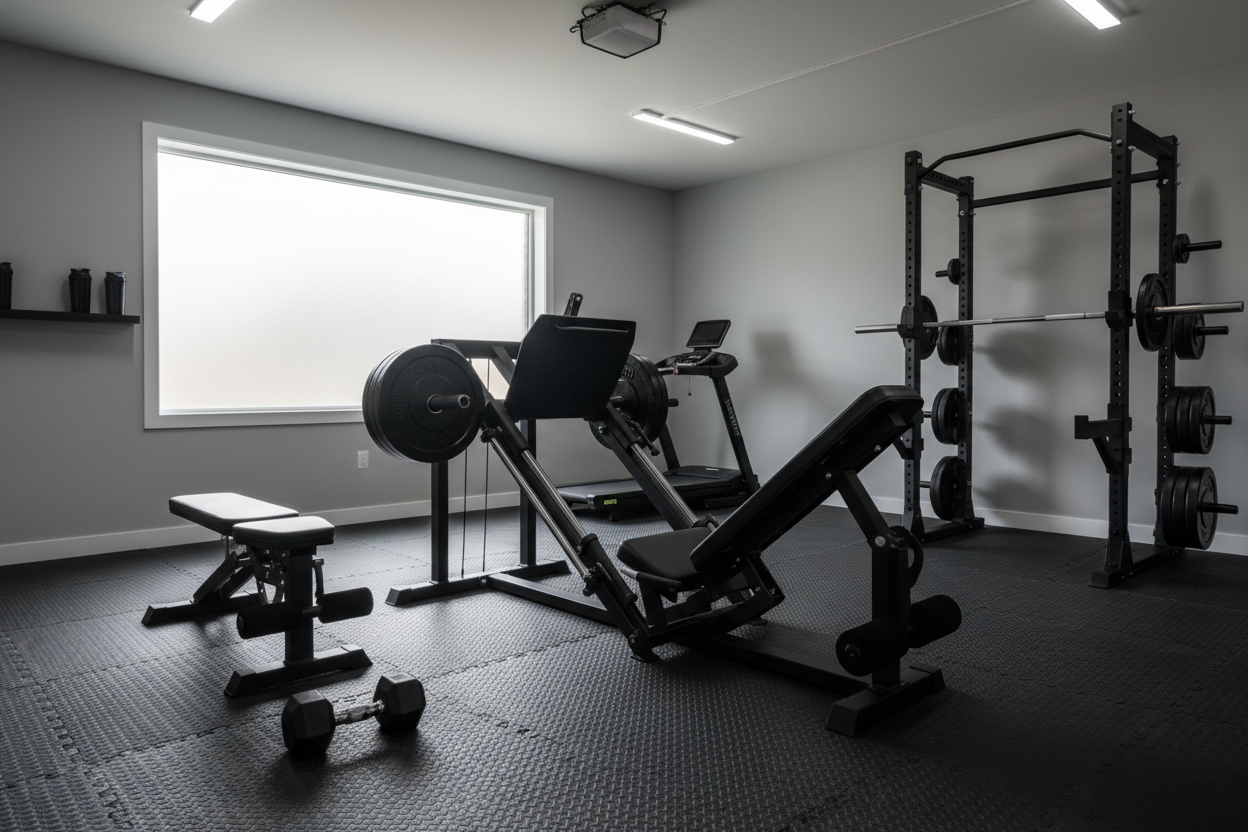
I remember staring at my garage floor with a roll of blue painter's tape, trying to convince myself that my truck didn't actually need to be inside during the winter. I wanted a leg press. I wanted those high-volume quad pumps without my lower back screaming at me after heavy squats. But leg press equipment isn't just another piece of gear; it is a roommate that doesn't pay rent.
Quick Takeaways
- Measure for plate loading, not just the machine base—you need at least 2 feet of clearance on both sides.
- Vertical presses are the cheapest space-savers but feel the least natural.
- 11-gauge steel and linear bearings are the 'gold standard' for safety and smoothness.
- A leg press home machine is a luxury, not a necessity, unless you have specific hypertrophy goals or injury constraints.
The Brutal Floor Space Math of Dedicated Leg Machines
Most people look at the footprint specs on a website and think, 'Yeah, I can squeeze a 7-foot machine into that corner.' They are wrong. When you are planning a home gym, you have to account for the 'active' footprint. A leg press for home use usually has weight horns sticking out of the sides. If the machine is 4 feet wide, you actually need 8 feet of width to comfortably slide 45-lb plates onto the pegs without hitting your power rack or the wall.
Then there is the length. A standard 45-degree sled needs a runway. You aren't just sitting there; the sled moves. I have seen guys buy a leg press home machine only to realize they can't fully extend their legs because the sled hits a storage shelf. It is a massive commitment. If you are working in a standard one-car garage, adding a leg press machine at home usually means your car is living in the driveway forever. You have to ask yourself if 20 sets of quads a week is worth scraping ice off your windshield in January.
Vertical vs. 45-Degree vs. Leverage: What Actually Fits?
Not all leg press weight machine designs are created equal. If you are tight on square footage, you have to choose your poison. The 45-degree sled is the king of feel, but it is a floor-space hog. If you want something that bridges the gap between a massive commercial unit and a tiny footprint, you might look at a compact 30 degree leg press. These hybrid designs often use a shallower angle to shave two or three feet off the total length while still giving you that smooth, sliding sensation.
Leverage machines are another beast entirely. Instead of a sled on tracks, they use a pivot point. They feel different—the resistance curve changes as you push—but they are often more reliable because there are fewer moving parts to gunk up. When you are looking for home exercise equipment leg press options, the pivot vs. sled debate is usually decided by how much you value that 'gym feel' versus how much you value your floor space.
The Vertical Leg Press (Cheap But Terrifying)
The vertical leg press is the budget pick. It has the smallest footprint because you are literally lying on your back and pushing the weight straight up toward the ceiling. It saves a ton of space, but it feels sketchy. Gravity is working directly against you, and if the safety catches are cheap, you are the crumple zone. I have used them, and while they get the job done, the range of motion often feels cramped, and the weight capacity is usually lower than a sled-based home gym leg machine.
The 45-Degree Linear Sled (The Gym Standard)
This is what you see at Gold's Gym. It uses linear bearings and steel rods to guide a sled at a 45-degree angle. It is the gold standard for a reason: it feels incredible. The weight distribution is consistent, and the safety catches are usually robust. The downside? It is usually 8 feet long and weighs 400 lbs before you even put a plate on it. It is the best home gym leg press experience, but it is a permanent installation. You aren't moving this thing once it is bolted together.
Can You Just Get a Machine That Does Everything?
The 'all-in-one' trend is huge right now. You’ll see plenty of best home gyms with leg press attachments advertised on social media. These are usually functional trainers or power racks with a plate that attaches to the cables. Do they work? Sort of. A home gym with leg press attachment is a great compromise if you are a casual lifter. It saves you from buying a separate $1,500 machine.
However, if you are pushing 500+ lbs, these attachments often feel wobbly. The setup time is also a pain. You have to drag the bench over, lock the plate in, and adjust the cables. If your workout takes 20 minutes just to set up, you’ll eventually stop doing it. A dedicated home gym with leg press machine is always going to feel more stable than a bolt-on accessory, but you pay for that stability in both cash and floor space.
The Specs You Cannot Compromise On
If you are going to pull the trigger on a leg press home machine, don't buy the cheapest one on Amazon. Look for 11-gauge steel. If the frame is made of thin, 14-gauge tubing, it will flex when you load it up. That flex causes the sled to bind, which ruins the movement and can actually be dangerous. Linear bearings are also a must. Some cheap machines use plastic rollers; these get flat spots and start to feel 'clunky' within six months.
Check the safety stops. You need multiple lockout positions. When you are training solo in a garage, you don't have a spotter to grab the sled if your quad cramps up. I also look at the footplate size. A small footplate limits your stance options. A wide, adjustable footplate allows you to target different areas of the leg by moving your feet higher or lower. This is one area where 'bigger is actually better.'
The Final Verdict: Should You Pull the Trigger?
Is a home gym and leg press setup worth it? If you have the room and you are serious about bodybuilding, yes. Nothing builds quad volume like a leg press without the systemic fatigue of a heavy barbell squat. But if you are cramped for space, don't force it. A good set of dumbbells for Bulgarian split squats will build just as much muscle without requiring you to park your car on the street.
My Experience: The Marketplace Mistake
I once bought a used vertical leg press because I was cheap and obsessed with saving space. It had no side safety pins, just one center rod. One morning, I was doing high-rep sets and my foot slipped on a sweaty plate. I spent three minutes pinned under 300 pounds, yelling for my wife to come save me from my own stupidity. I sold it the next day. Now, if I can't afford a machine with proper safety catches and linear bearings, I just stick to the squat rack. Safety isn't a 'feature'—it is the whole point.
FAQ
Is a leg press better than squats?
Not better, just different. Squats are a full-body movement that builds more 'functional' strength. A leg press isolates the quads and glutes without taxing your lower back and CNS as much. Use both if you can.
Can I use standard 1-inch plates?
Most leg press equipment is designed for 2-inch Olympic plates. Some budget models have adapters, but Olympic plates are the standard for a reason—they can handle the weight capacity these machines require.
How much weight can a home leg press hold?
Budget models usually max out around 400-500 lbs. High-end residential units with linear bearings can often handle 1,000 lbs or more. Always check the manufacturer's weight rating before buying.
Share:
Your Balance Sucks (And Why the One Leg Squat Smith Machine Fixes It)
What Are Smith Machines Actually Doing for Your Gains?