
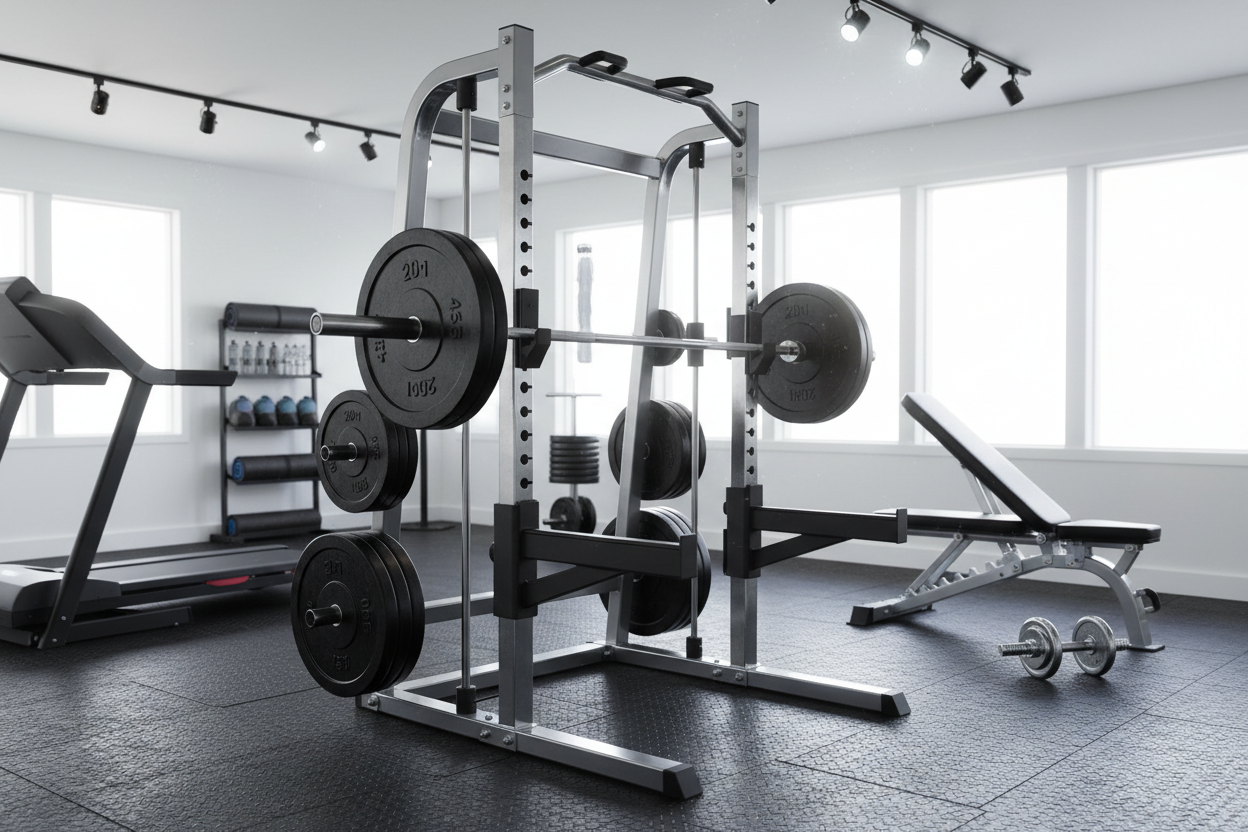
I remember the first time I felt like a hero in a commercial gym. I’d just finished a heavy set of squats and decided to 'burn out' on the Smith machine with two plates per side. It felt light. Too light. I started telling myself I was just having an 'on' day, but the nagging voice of a gear nerd in my head wouldn't shut up. I actually went back the next day with a digital luggage scale and a sling to weigh the bar carriage because I had to know how much is 2 plates on smith machine for real.
The truth is a punch in the gut for your ego. If you’re counting two 45s on each side as a 225-lb lift, you’re almost certainly lying to yourself. Between the counterweights, the friction of the guide rods, and the actual weight of the sliding carriage, your 'two-plate' milestone is a moving target that usually lands way short of a standard barbell.
Quick Takeaways
- Standard barbell math (45lb bar + 180lbs of plates) does not apply to Smith machines.
- Most commercial Smith machines are counterbalanced, making the starting bar weight anywhere from 0 to 25 lbs.
- A 'two-plate' lift on a counterbalanced machine is typically 190–205 lbs.
- Friction from the bearings can add 5–10 lbs of perceived resistance that doesn't show up on a scale.
The 225lb Illusion: Why Free Weight Math Doesn't Work Here
In a squat rack, the math is simple. A standard Olympic bar is 45 lbs. You add two 45-lb plates to each side, and you have 225 lbs. It’s the universal language of the gym. But the Smith machine isn't a barbell; it’s a carriage system. The bar is attached to bearings that slide on fixed steel rods. This mechanical connection changes everything.
When you’re stacking weight plates on a Smith machine, you aren't just fighting gravity; you're interacting with a machine's internal resistance. Most people assume the bar weighs 45 lbs because it looks like a barbell. In reality, that bar is often a hollow steel tube or a specialized carriage designed to be as light or as heavy as the manufacturer intended. Assuming it's 45 lbs is the fastest way to overstate your PR by 30 pounds.
The Three Types of Bars (And What They Actually Weigh)
You’ll generally run into three setups. The most common in big-box gyms is the counterbalanced system. These use a series of cables and weights hidden inside the frame to offset the weight of the carriage. In many cases, the bar literally floats. I’ve seen some where the starting weight is a measly 6 lbs. If you're using a Valor Fitness Smith machine or a similar home unit, you might find a 'true weight' carriage that isn't counterbalanced, which usually sits between 25 and 35 lbs.
Then you have the angled tracks. These are usually set at a 7 to 12-degree angle. Because you’re moving the weight on an incline, physics dictates that you aren't moving the full force of gravity vertically. It’s a double whammy: the bar is lighter because of the counterbalance, and the path makes the plates feel lighter because they aren't moving straight up and down.
So, Exactly How Much is 2 Plates on Smith Machine?
Let’s do the real math. If you have two 45-lb plates on each side, you have 180 lbs of iron. Now we add the bar. On a high-end counterbalanced machine (like a Life Fitness or Matrix), the bar is usually rated at 15 lbs or 20 lbs. That puts your total at 195–200 lbs. You're effectively missing an entire 25-lb plate compared to a free-weight bench press.
On a non-counterbalanced machine—the kind often found in garage gyms—the carriage usually weighs about 30 lbs. In that specific scenario, your 2-plate lift is 210 lbs. Still not 225. Unless the machine specifically states '45lb Starting Weight' on the frame (which is rare), you are safely 15 to 30 lbs under the 'two-plate' milestone everyone brags about.
The Friction Factor: Why the Bar Feels Heavier on the Way Up
Here is where it gets weird. Even if the scale says the bar is 15 lbs, it might feel like 25 lbs. This is due to 'stiction' and linear bearing friction. Dirt, old grease, or slightly misaligned guide rods create drag. When you slide your adjustable weight bench into the rack for some incline press, you’ll notice that the weight feels 'sticky' compared to a free barbell.
This friction actually helps you on the way down (eccentric) by slowing the weight, but fights you on the way up (concentric). It’s a mechanical tax. This is why 200 lbs on a Smith machine can sometimes feel just as exhausting as 210 lbs on a barbell, even if the raw numbers don't match. The machine is literally rubbing against itself while you work.
Does the Number Even Matter for Your Gains?
At the end of the day, the Smith machine is a tool for hypertrophy, not a stage for powerlifting records. Your chest doesn't have a calculator. It only knows tension and mechanical failure. If you're using the same machine every week and you go from two plates to two plates and a dime, you’ve gotten stronger. That’s the only metric that actually builds muscle.
Stop worrying about whether it 'counts' as 225. Use the machine for what it's good for: stability and isolation. If you really need to know the number for your logbook, look for a sticker on the side of the frame. Most commercial units will list the 'Effective Starting Resistance.' If it's not there, just log it as 'Smith + 180' and move on with your life.
My Honest Take: The Time I Got Humbled
I spent an entire summer training in a hotel gym that only had a Smith machine. I was hitting '315' for sets of 8, feeling like an absolute monster. When I got back to my home gym and loaded three plates on a Texas Power Bar, I couldn't even grind out a triple. I realized that specific hotel machine was heavily counterbalanced—the bar probably weighed 10 lbs tops. It was a lesson in humility. Now, I always assume the Smith bar is 20 lbs and I don't let it touch my ego.
FAQ
Is a Smith machine bar always 45 pounds?
Almost never. Most commercial Smith machine bars weigh between 15 and 25 lbs due to counterbalance systems. Some residential models without counterbalances can weigh up to 35 lbs, but 45 lbs is extremely rare.
Why is the Smith machine easier than free weights?
It’s easier because the machine handles all the stabilization for you. You don't have to worry about the bar tilting left or right, which allows your primary movers (like your chest or quads) to push harder without being limited by smaller stabilizer muscles.
How do I track Smith machine weight in my app?
The most honest way is to track only the weight of the plates added. If you want to be precise, check the manufacturer's spec sheet for the starting carriage weight and add that to your total.
Share:
Your Lifting Math Is Wrong: The Truth About Barbell Weight Sizes
I Built a Homemade Gym From Scratch (And Regret Half of It)