
I spent a decade convinced that if I didn't squat until my nose bled or bench until my shoulders felt like they were full of broken glass, I wasn't really training. My reward for that 'hardcore' attitude? A physique that looked the same for three years and a bottle of ibuprofen that lived in my gym bag. I was terrified that bodybuilding with machines was a shortcut for the lazy, a way to dodge the real work of the barbell.
The 'Free Weights Only' Cult Is Lying to You
The local dungeon I train at has a sign that says 'No Machines, No Excuses.' It sounds cool on a t-shirt, but it's physiologically narrow-minded. The dogma that barbells are the only path to mass is a lie that ignores how muscles actually grow. Your quads don't have eyes; they don't know if you're under a 400-pound bar or locked into a hack squat. They only know tension and mechanical load.
When we look at bodybuilders who only use machines for their primary hypertrophy work, we see a common thread: extreme longevity and terrifying detail. Take a look at guys like Dorian Yates or Jordan Peters. These aren't people who avoid hard work. They simply realized that by removing the need to balance a heavy object in space, they could funnel 100% of their effort into the target muscle. If you're bodybuilding machines only, you aren't wasting energy on your stabilizers or your lower back. You're just annihilating the muscle group you actually came to train.
The 'functional' crowd will tell you that machines don't build 'real' strength. Tell that to the guy with 30-inch legs who can't find jeans that fit. If your goal is strictly hypertrophy—getting as big as possible—the barbell is often the least efficient tool in the shed because your lower back or your grip will almost always fail before your prime movers do. Stepping away from the rack isn't a retreat; it's a strategic pivot for anyone whose joints are starting to feel their age.
The Biomechanics of Using Only Machines at Gym
Physics doesn't care about your feelings. When you're using only machines at gym, you are operating within a fixed path of motion. This is a massive advantage for hypertrophy because it allows you to push to absolute failure safely. On a barbell bench press, 'failure' usually means a trip to the ER or a very awkward conversation with a spotter. On a chest press machine, failure just means the weight doesn't move another inch. You can sit in that hole of fatigue and grind without the fear of being crushed.
Your central nervous system (CNS) also responds differently to fixed-path resistance. When you're balancing a heavy free weight, your brain is constantly sending signals to dozens of tiny stabilizer muscles to keep you from falling over. This creates massive systemic fatigue. By switching to a machine-focused block, you reduce that 'noise.' This is where you have to ask: Are Commercial Bodybuilding Machines Worth the Floor Space? If the goal is to isolate a specific muscle without frying your entire nervous system, the answer is a resounding yes.
Machines also allow for consistent tension throughout the entire range of motion. Think about a dumbbell fly—at the top of the movement, there's zero tension on the pecs. On a pec deck or a cable crossover, that tension is constant from the stretch to the squeeze. That constant mechanical tension is the primary driver of muscle growth. Bodybuilding with machines only isn't about taking the easy way out; it's about making the work more focused and harder for the muscle that matters.
Real-World Machine-Only Workout Results
Last year, I hit a wall. My elbows were so inflamed I couldn't even hold a coffee mug without wincing. I decided to drop all free weights for six weeks. I ran a dedicated block of bodybuilding with machines only, and the results were eye-opening. I didn't lose size; I actually gained it. My 'pumps' were more intense because I could finally focus on the mind-muscle connection instead of just survival. My machine-only workout results included a noticeable jump in my quad sweep and lat width—areas I’d struggled to hit with squats and rows.
If you're ready to try this, you can't just wander around the gym. You need a plan. I recommend starting with A Full Body Matrix Machine Workout For Lifters Who Hate Machines. This provides the structure needed to ensure you aren't just doing 'light' work. To get the most out of this phase, you have to be willing to take sets past the point of discomfort. Since the machine handles the stability, you can use techniques like rest-pause, drop sets, and slow eccentrics that would be suicidal with a barbell.
My biggest mistake during this phase was thinking I could just go through the motions. I bought a cheap, used leg extension machine for my garage that felt like it was made of coat hangers. The resistance curve was terrible—it felt heavy at the bottom and light at the top. It taught me that not all machines are created equal. If the movement feels 'clunky' or doesn't match your natural limb length, it’s going to do more harm than good. Quality matters more here than it does with a simple piece of iron.
Building a Machine-Heavy Garage Gym Without Going Broke
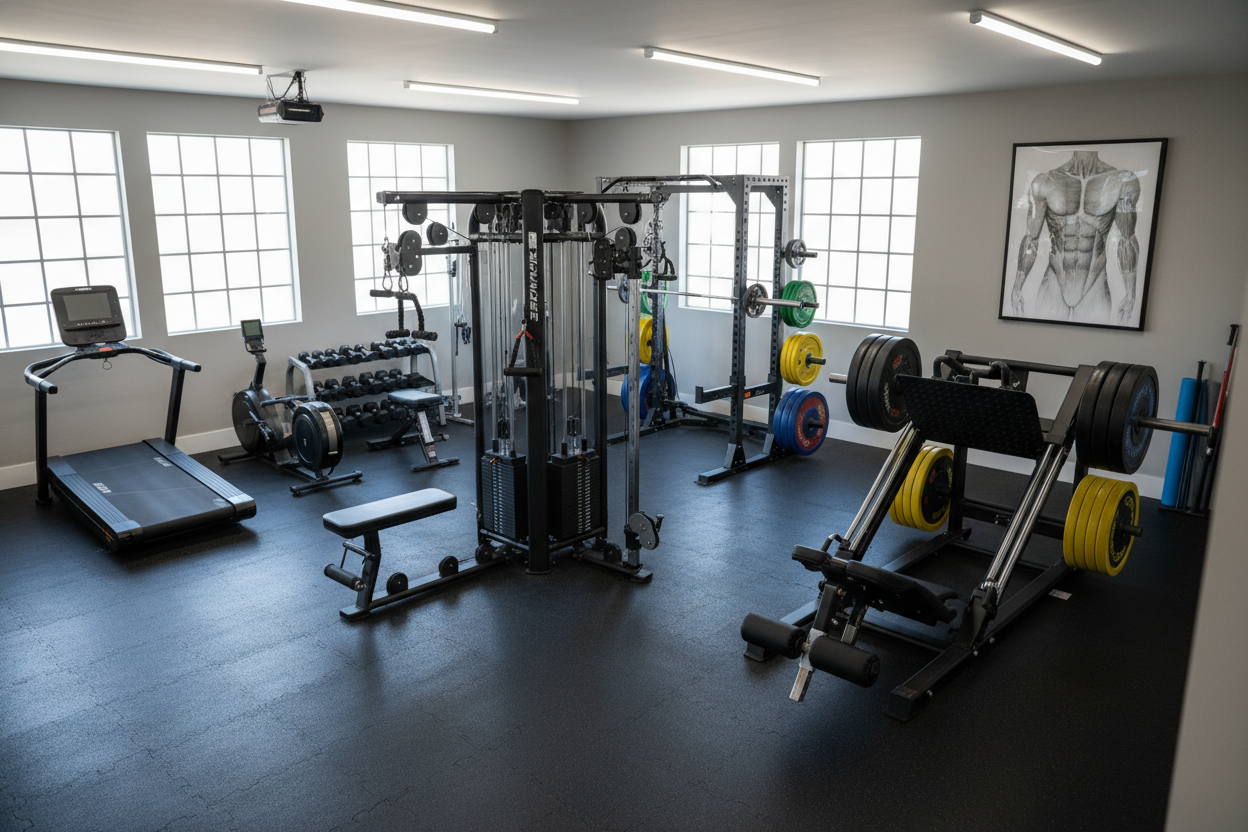
The biggest hurdle for home lifters is space. You can't fit a 15-machine commercial circuit in a standard two-car garage. You have to be smart. You need pieces that do the work of five machines in the footprint of one. This is where a Smith Machine Home Gym Station becomes the MVP of your setup. A Smith machine gets a lot of hate from the 'purists,' but for hypertrophy, it's a godsend. It gives you that fixed-path safety for squats, presses, and rows without needing a spotter.
If I were building from scratch today with a focus on hypertrophy, I’d look at something like the All In One Smith Machine With Cable Crossover S1 V4. This rig is the Swiss Army knife of bodybuilding. It combines a Smith bar, a functional trainer (cables), and a power rack. Cables are the secret sauce of bodybuilding with machines because they allow for 'free-form' movement within a constant-tension environment. You can hit high-cable chest flies, face pulls, and tricep pushdowns all in a 6x8 foot corner.
Don't fall into the trap of buying 'single-use' machines unless you have a massive budget and a warehouse. Focus on pulley systems and Smith-based units. A good cable system with a 2:1 ratio and smooth aluminum pulleys will do more for your physique than a dozen cheap, plate-loaded knockoffs. Look for units with at least a 200-lb weight stack—anything less and you'll outgrow it in a month if you're training legs or back seriously.
When (and How) to Bring Free Weights Back
You don't have to stay in the machine world forever. Think of it as a 'hypertrophy vacation' for your joints. After 8 to 12 weeks of bodybuilding with machines, your connective tissues will be healed, your muscles will be primed, and your hunger for the barbell will be back. When you do return to free weights, you'll likely find that your 'weak links' have been strengthened because you weren't able to cheat the movements on the machines.
The goal isn't to choose a side in the machines vs. free weights war. The goal is to use the best tool for the job. If the job is 'build as much muscle as possible while staying healthy,' then machines aren't just an option—they're a requirement. Stop listening to the guys who think pain is a prerequisite for progress. Train smarter, get bigger, and let your joints live to fight another day.
Quick Takeaways
- Machines allow for 100% focus on the target muscle by removing the need for stabilization.
- Fixed-path movements let you train to absolute failure safely without a spotter.
- Cable systems provide constant tension that dumbbells simply can't match.
- A Smith machine or functional trainer is the most space-efficient way to bring machine bodybuilding home.
- Machine blocks are the ultimate 'reset' for lifters suffering from chronic joint pain.
FAQ
Can you really build muscle using only machines?
Absolutely. Muscle grows through mechanical tension and metabolic stress. As long as you are training close to failure and progressively increasing the load, your body will respond. Many pro bodybuilders use machines for 80-90% of their volume.
Are machines safer than free weights?
Generally, yes. Because the path of the weight is fixed, you can't 'drop' the weight on yourself, and you're less likely to use momentum or poor form that leads to acute injuries. However, you still need to ensure the machine is adjusted correctly for your height.
Do I need a commercial gym for a machine-only workout?
Not anymore. All-in-one Smith machines and functional trainers have become affordable enough for home use. You can get a full-body bodybuilding workout in a single multi-function unit that fits in a garage corner.
Will I lose my 'functional' strength if I stop using barbells?
You might lose some specific skill in the squat or deadlift, but you won't lose the actual muscle mass. When you return to the barbell, your strength usually returns (and often exceeds previous levels) within 2-3 weeks because you're carrying more muscle and less systemic fatigue.
Share:
I Tried 5 Types of Portable Weights on the Road (Most Are Trash)
Most Beginner Gym Equipment Is Overpriced Junk (Buy This Instead)