
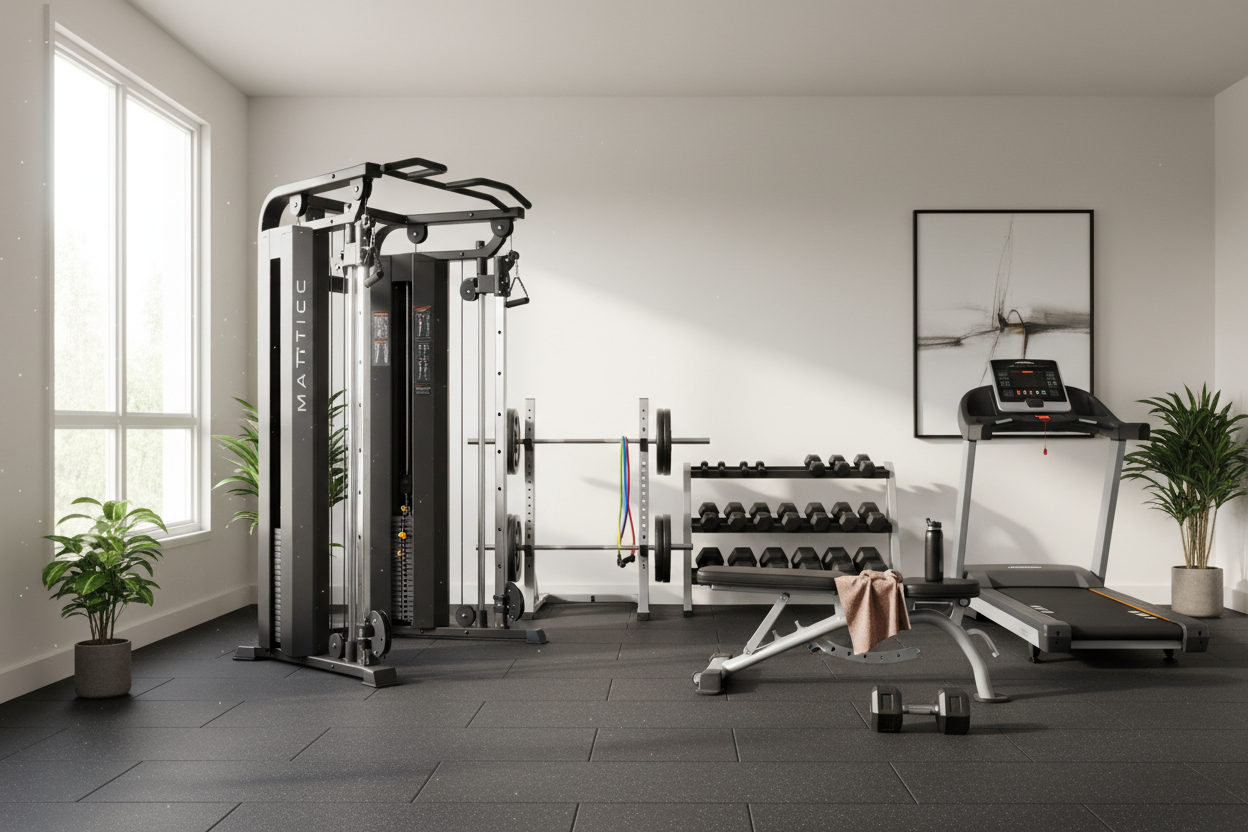
I used to be the guy who spent two hours hogging the power rack, looking down my nose at anyone sitting on the selectorized circuit. I thought matrix machine workout sessions were for hotel gyms and people who didn't want to sweat. Then my left shoulder started clicking like a Geiger counter every time I benched, and my squat progress hit a wall because my lower back was fried before my quads even woke up.
The truth is, matrix weight machines aren't a 'backup' for when the racks are full. They are precision tools. When you stop worrying about balancing a 45-lb bar and start focusing on the actual muscle fibers you're trying to destroy, things change. I realized that by removing the stabilization requirement, I could take a muscle to absolute failure without my joints paying the price.
- Align your joints with the yellow pivot points for maximum leverage.
- Use a 3-second eccentric (lowering) phase to maximize time under tension.
- Prioritize straight sets over circuits if your goal is actual muscle growth.
- Don't sleep on the 'increment' weights to bridge the gap between heavy plates.
Why I Stopped Treating Selectorized Rigs Like a Joke
Barbell snobbery is a real disease in the lifting community. We convince ourselves that if we aren't fighting for our lives to keep a bar level, it doesn't count. But here is the reality: your chest doesn't know if you're holding a dumbbell or a machine handle. It only knows tension. When I finally learned how to use matrix gym equipment properly, I found I could move more weight with better form than I ever could on a flat bench.
Ego-lifting with free weights is the fastest way to a physical therapy appointment. By switching to a matrix workout, I was able to isolate my lats and chest without my secondary stabilizers giving out first. If you want hypertrophy, you need to reach muscular failure. It is a lot safer to reach that failure on a machine where you can just let go of the handles than it is under a loaded barbell.
The Setup: How to Actually Use Matrix Gym Equipment
The biggest reason people hate machines is that they don't know how to use matrix gym equipment correctly. They just sit down, shove the pin in a random slot, and start pumping. That is how you wreck your rotator cuffs. Every Matrix machine has a yellow pivot point. This is the axis of rotation. Your joint—whether it is your shoulder on a press or your knee on an extension—needs to be perfectly aligned with that yellow dot.
Seat height is the second most important factor. If the seat is too low on a chest press, you are putting a massive amount of shearing force on the front of your shoulder. If it is too high, you are basically doing a decline press. Take the thirty seconds to adjust the seat. If you ignore the setup, you ruin the resistance curve the engineers spent thousands of hours perfecting. You want the hardest part of the lift to match the strongest part of your range of motion.
The Ultimate Matrix Machine Workout Routine
This matrix machine workout routine isn't about moving the pin down the stack as fast as possible. We are focused on mechanical tension and controlled eccentrics. You are going to do three sets per exercise, aiming for the 8-12 rep range. On the last set of every movement, you are going to go to absolute failure, then immediately drop the weight by 30% and do as many 'burnout' reps as possible. This is where the selectorized stack shines—you can change weights in two seconds.
Upper Body: Torching the Chest and Back
For the upper body portion of this matrix workout, we start with the Converging Chest Press. Unlike a standard fixed-path machine, the Matrix handles move inward as you push, mimicking the natural path of a dumbbell press. If your gym has the option, I always recommend a chest press machine with independent arms. This forces your weak side to pull its own weight and prevents you from leaning into your dominant shoulder.
Move immediately to the Lat Pulldown. Most people use too much momentum here. Sit tall, lock your thighs under the pads, and think about pulling your elbows into your back pockets. The Matrix pulleys are incredibly smooth, so you should feel a constant 'stretch' at the top. Follow this with the Seated Row. Keep your chest pressed firmly against the pad to prevent your lower back from taking over the movement. These matrix machine exercises are designed to keep the tension on the muscle, not the spine.
Lower Body: Leg Day Without the Lower Back Pump
Leg day on Matrix equipment is a different beast. We start with the Leg Press. Because the sled is on a fixed track, you can experiment with foot placement to target different areas. High feet for glutes and hams, low feet for quads. The best part? You can push to failure without needing a spotter. When your legs give out, the safety catch is right there.
Next, hit the Leg Extension and Seated Leg Curl. I prefer the seated curl over the prone (lying) version because it keeps the hamstrings in a more lengthened position, which is better for growth. By taking the lower back out of the equation, you can focus entirely on the quad or hamstring contraction. I have found that I can get a much deeper 'burn' on these machines than I ever could with Romanian Deadlifts, simply because I'm not worried about my grip or my lumbar spine failing first.
Matrix Circuit Training vs. Straight Sets for Hypertrophy
You often see people doing matrix circuit training, jumping from one machine to the next with zero rest. If you are trying to improve your heart health or lose weight on a lunch break, that is fine. But if you want to build a physique, stop doing it. You need rest periods of at least 90 to 120 seconds to allow your ATP stores to recover so you can move heavy weight on the next set.
If you are a home lifter trying to replicate this experience, you don't need twelve different machines. A full body multi training station can give you that same selectorized feel in a much smaller footprint. The key is to treat each movement with the same respect you'd give a heavy squat. Don't just go through the motions; fight the weight on the way down.
Graduating to the Matrix Smith Machine
Once you have mastered the selectorized stacks, the Smith machine is your next stop. It is the bridge between a fixed machine and a free barbell. It allows for heavy compound pressing—like overhead presses or inclined bench—with a safety net. However, be careful with your 'gym math.' You need to know the real matrix bench press bar weight before you start adding plates. Most Matrix Smith bars are counterbalanced, meaning the starting weight is often lighter (or sometimes heavier) than a standard 45-lb bar.
I personally love the Smith machine for 'reverse lunges' and 'split squats.' The stability allows you to really sink into the movement without wobbling. If you're looking to bring this level of training home, a smith machine home gym station is probably the most versatile piece of equipment you can buy. It covers your compounds and your isolations in one rig. I spent years hating on the Smith machine until I realized my calves and quads were growing twice as fast once I stopped struggling to balance and started focusing on the load.
FAQ
Are Matrix machines better than Life Fitness?
It is a toss-up, but Matrix often wins on ergonomics. Their 'Ultra' series has some of the best joint-tracking I have ever felt in a commercial setting. The handles feel more natural in the hand, and the increment weights are easier to reach from the seated position.
Can I build muscle using only Matrix machines?
Absolutely. Muscle doesn't care where the resistance comes from. As long as you are applying progressive overload—adding weight or reps over time—and eating enough protein, you will grow. Many pro bodybuilders use machines for 80% of their prep to stay injury-free.
What is the 'increment' weight on the stack?
Most Matrix stacks have a sliding weight or a dial at the top. This allows you to add small increments (like 5 lbs) instead of jumping a full 15 or 20 lbs to the next plate. Use these to keep your progress linear when the full jumps feel too heavy.
Share:
Why Finding a Weight Bench UK Lifters Trust Is So Hard
I Downsized My Garage Gym to Just Free Weights and Bench