
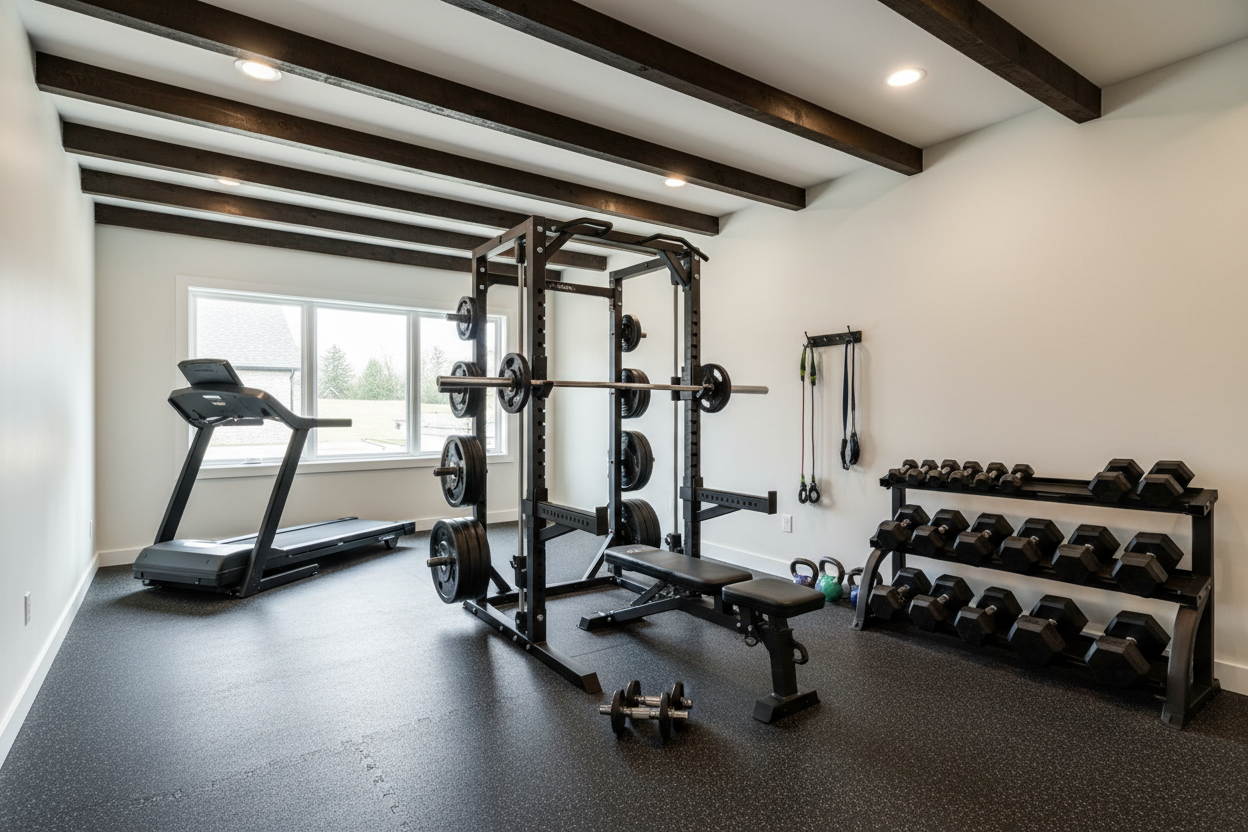
I know the feeling. You are tired of waiting for the only functional squat rack at the local commercial gym, so you finally pull the trigger on your own gear. Ordering a massive machine home is a rush of endorphins that lasts exactly until the freight driver calls you from a blocked-off street asking where you want the 600-pound, double-wide pallet. Suddenly, that 'Add to Cart' button feels like a heavy liability.
Quick Takeaways
- Freight drivers are only required to drop the pallet at the curb; the rest is on you.
- Concrete slabs are ideal, but second-story installs require serious joist calculations.
- Never assemble a Smith machine alone unless you enjoy cross-threaded bolts and misaligned rails.
- Measure your doorways twice—then measure the length of the longest guide rod.
So You Clicked 'Checkout' on a Massive Rig
The photos on the website are always pristine. You see a 3x3 11-gauge steel frame sitting in a massive, sun-drenched room with 12-foot ceilings. What they don't show is the three hours of cardboard breakdown and the literal mountain of Styrofoam that will soon consume your garage. The Biggest Mistake Lifters Make Buying A Home Smith Machine is assuming the hard part ends once you pay the invoice.
You are moving into the big leagues of equipment. This isn't a pair of adjustable dumbbells that arrive in a reinforced box. This is industrial-grade steel. Most of these units ship on oversized pallets that can be up to 8 feet long. If you live on a narrow cul-de-sac or a busy main road, the logistics of even getting the truck to your house become a tactical operation. I have seen guys have to meet a freight driver at a grocery store parking lot and move boxes piece-by-piece into a pickup truck because the semi couldn't clear their neighborhood trees.
Freight Delivery Doesn't Mean 'White Glove' Installation
Standard shipping for a Smith machine or a functional trainer is almost always 'Curbside Freight.' That is industry speak for 'I am dropping this at the end of your driveway, good luck.' If you have a steep driveway or a gravel path, that pallet is staying right where it lands. The driver is not your training partner. They are on a tight schedule, and they are not going to help you pivot a 500-pound crate around your car.
Check if your order includes a liftgate service. Without it, you are expected to have a loading dock or a forklift—which I am guessing you do not have in your suburb. Even with a liftgate, the driver will drop the pallet on the pavement and hand you a clipboard. From that moment, you are the foreman of a heavy-lifting crew. I always keep a crowbar and a heavy-duty utility knife ready to break the crate down right there on the street. It is much easier to carry individual 80-pound uprights than to move a 600-pound crate in one go.
Will Your Floor Actually Hold the Dead Weight?
Before you designate a corner of your Home Gym for a fixed-path machine, you need to do some math. A commercial-grade Smith machine usually weighs between 400 and 700 pounds. Now, add 300 pounds of iron plates, a 100-pound bench, and your own body weight. You are looking at a localized load of nearly 1,200 pounds in a very small footprint. Home Gym flooring needs to be more than just thin foam tiles from a big-box store.
If you are in a garage with a 4-inch concrete slab, you are golden. But if you are planning to put this in a spare bedroom on the second floor, you need to be careful. Most residential floors are rated for 30-40 pounds per square foot of 'live load.' A heavy machine can easily exceed this. I always suggest placing the unit across floor joists rather than parallel to them, and using a 3/4-inch horse stall mat to distribute the pressure. If the floor flexes when you walk, it is definitely not ready for a half-ton of steel.
The Doorway Geometry Problem Nobody Measures For
This is where most people lose their minds. You measured the footprint of the machine—say, 50 inches wide by 80 inches deep—and it fits the room. But did you measure the guide rods? A Smith machine's vertical rods are often a single piece of solid steel, sometimes 82 to 84 inches long. If you have to make a tight turn from a hallway into a bedroom, you are going to be playing a very stressful game of Tetris.
Standard residential doors are 80 inches tall. If your machine's uprights are taller than that, you cannot tilt them through the door if the hallway is narrow. You have to unbox everything outside. I have spent many afternoons helping buddies carry greasy, chrome-plated rods through their front doors, praying we don't dent the drywall. Pro tip: wrap the ends of the bars in old towels. The steel is harder than your walls; the steel will always win.
Why Assembly is a Guaranteed Two-Person Job
You might be a DIY hero, but don't try to build a Smith Machine Home Gym Station alone. These machines rely on perfect alignment. If the two main uprights are even an eighth of an inch out of parallel, the linear bearings will bind. You will feel a 'catch' every time you try to squat, and it will drive you insane. You need one person to hold the upright perfectly vertical while the other torques the bolts at the base. Smith Machine Home Gym Station setups often have over 100 bolts; if you rush it, you will cross-thread something vital.
Also, let's talk about the cables. If your machine has a pulley system, threading those cables is a test of patience. One wrong loop over a pulley wheel and you will shred the nylon coating in a single workout. Take your time, use a real socket set instead of the flat tin wrenches they give you in the box, and don't fully tighten any bolts until the entire frame is standing. This allows the parts to 'settle' into alignment before you lock them down.
Personal Experience: The 3 AM Floor Disaster
I once ordered a high-end functional trainer and thought I could handle the delivery solo. The driver arrived two hours early, dropped the crate in a puddle during a rainstorm, and left. I spent four hours in the dark, dragging 11-gauge steel tubes into my garage one by one. I missed a small washer inside the crate, and the entire weight stack felt 'crunchy' for a month until I realized my mistake. Now, I never start a build without a headlamp, a magnetic parts tray, and a friend who I've bribed with a post-assembly steak.
FAQ
Can I put a Smith machine on carpet?
Technically yes, but it is a bad idea. The weight will permanently compress the fibers, and the machine may wobble. Put a 3/4-inch plywood sub-floor or a heavy rubber mat over the carpet first to create a stable, level surface.
What tools do I actually need?
Throw away the included tools. You need two adjustable wrenches, a full metric and SAE socket set, and a rubber mallet to seat the plastic end caps without marring the finish.
How much ceiling height do I really need?
If the machine is 82 inches tall, you need at least 86 inches of clearance. You need space to actually get your hands over the top to tighten the bolts, and you don't want to be hitting the ceiling every time you do a pull-up on the integrated bar.
Share:
I Built My Entire Routine Around One Adjustable Dumbbell Set
Stop Wandering: A 4-Day Life Fitness Workout Routine That Works