
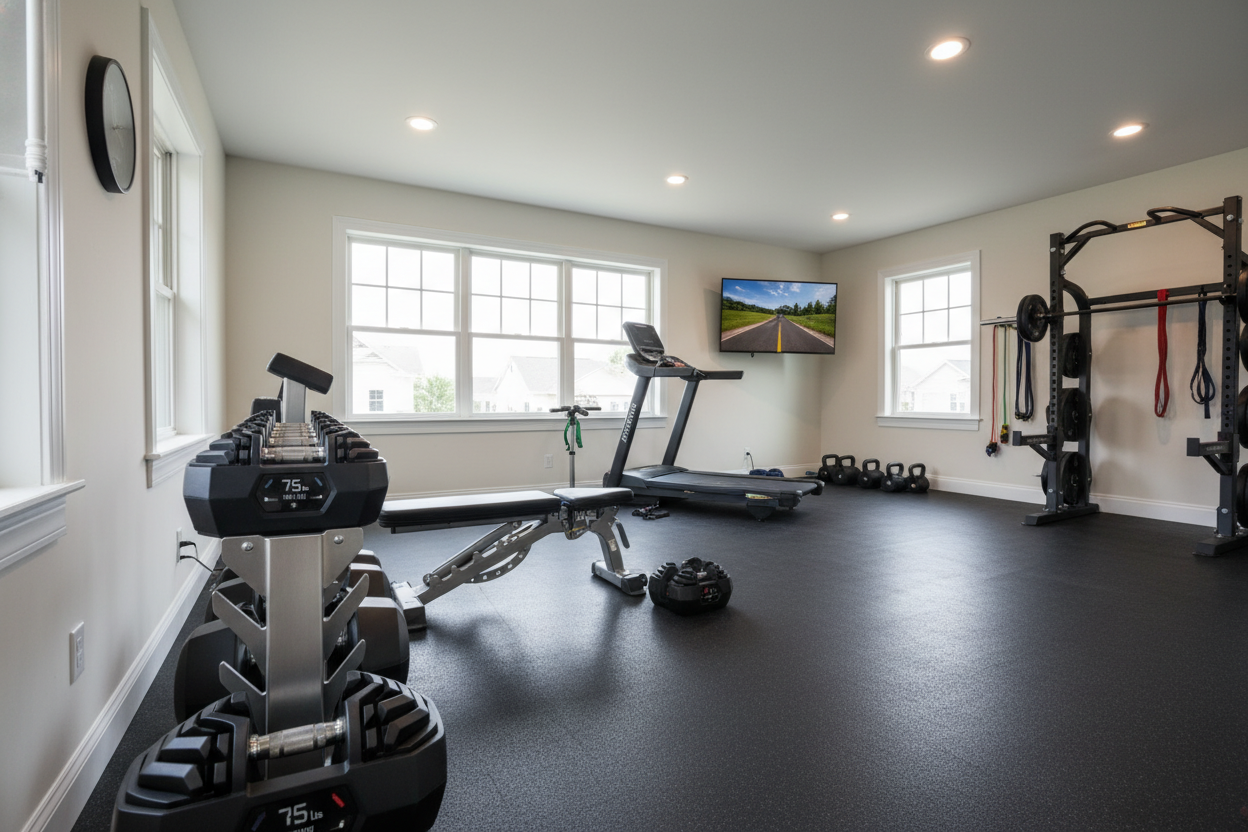
I remember the exact moment my 50-pound 'beginner' set became a paperweight. I was mid-way through a set of single-arm rows, hitting rep fifteen with zero struggle, and realized I was basically just doing cardio with a piece of metal. I spent the rest of the night scrolling through forums, torn between the massive 100-pound monsters and the standard 50s I’d already outgrown. That is when I discovered that 75lb adjustable dumbbells are the real sweet spot for anyone training in a garage.
- 50-pound sets are outgrown by intermediate lifters in months, not years.
- 75-pound sets offer the best balance of heavy resistance and compact physical size.
- Avoids the awkward 'clunkiness' and safety concerns of massive 100-pound modular systems.
- Cost-effective compared to buying a full rack of individual hex dumbbells.
The Frustrating Reality of the 50-Pound Plateau
The 50-pound dumbbell set is the industry standard for a reason: it is cheap to manufacture and easy to ship. But if you are actually training with intensity, you are going to hit a wall faster than you think. I see it all the time with guys who start their home gym journey. They make great progress for six months, then suddenly they are maxing out the rack on chest presses and rows. Once you hit 12 to 15 reps with the heaviest weight you own, your hypertrophy goals start to stall.
Progressive overload is the only way to keep seeing results. When you are stuck at 50 pounds, you are forced to increase reps or decrease rest times, which only takes you so far. I tried doing 30-rep sets of goblet squats with my old 50s just to feel a burn, and all I got was a high heart rate and a sore back. You need more iron. Moving to an 75-pound adjustable dumbbells set gives you that critical 50% increase in total load, which is enough to keep most lifters busy for years of consistent training.
Why 75-Pound Adjustable Dumbbells Are the Real Sweet Spot
There is a physical limit to how much weight you can cram onto a single handle before the dumbbell becomes a liability. Most 50-pound sets are nice and tight, but once you start looking at those massive 100-pound systems, things get weird. They become incredibly long—sometimes 18 inches or more—which completely ruins your range of motion. If you are trying to do a deep dumbbell press, those extra-long ends are going to bang together or hit your shoulders before you get a full stretch in the pec.
The 75-pound range is the 'Goldilocks' zone. You get enough weight to actually build a thick back and a strong chest, but the footprint remains manageable. Most 75-pounders stay under 16 inches in length, meaning you can still perform curls, overhead presses, and lateral raises without feeling like you are swinging a pair of suitcases. If you are upgrading from a fixed-weight setup, looking into a versatile dumbbell collection that caps at 75 is usually the smartest move for your floor space and your joints.
I have tested sets where the plates felt like they were going to slide off at the 70-pound mark, but the higher-quality 75lb units usually utilize a more robust locking mechanism. You want something that feels like a solid piece of steel, not a box of loose LEGOs. When the weight is balanced correctly at 75 pounds, the center of gravity stays in your palm, where it belongs.
Do You Actually Need to Go Heavier?
It is tempting to look at the 90 or 100-pound sets and think, 'I will just buy those so I never have to upgrade again.' I made that mistake once. I bought a pair of 100-pound adjustables that were so blocky I could barely get them into position for a bench press. The internal gears felt gritty under that much load, and I constantly worried about the safety of the locking pins. You have to ask yourself: are those triple-digit weights safe for heavy presses when they are held together by a plastic dial?
For 95% of home trainees, 75 pounds is plenty. Unless you are a competitive powerlifter or a high-level bodybuilder, you likely won't be doing high-volume lateral raises or incline flies with 80+ pounds. By sticking to a 75-pound limit, you get a more durable mechanism and a much tighter fit. The heavier you go with adjustable tech, the more points of failure you introduce. I’d rather have a rock-solid 75-pound set than a shaky 100-pound set any day of the week.
The Best Lifts to Maximize an Adjustable Dumbbell 75 lbs Set
Once you have that extra 25 pounds per hand, a whole new world of programming opens up. Kroc rows are a prime example. You can’t build a massive back with 50s; you need to be able to rip heavy weight for high reps. The 75-pound increment allows you to actually challenge your grip and lats. Similarly, for goblet squats, holding a 75-pounder against your chest is a completely different stimulus than a 50. It forces your core to stabilize in a way that lighter weights just can't mimic.
Chest work is where these really shine. If you pair your weights with a sturdy adjustable weight bench, you can cycle through flat, incline, and decline presses. At 75 pounds, you are moving 150 pounds of total mass. That is more than enough to build a pro-level chest. I also love using this weight range for weighted lunges and Bulgarian split squats. It is just enough weight to make your legs scream without being so heavy that you lose your balance because the dumbbells are too wide.
Final Verdict: Should You Pull the Trigger?
If you are currently staring at your 50-pound set and wondering why your progress has stalled, the answer is simple: you have outgrown your gear. Buying a durable adjustable dumbbell set that goes up to 75 pounds is the single most effective upgrade you can make for a home gym. It bridges the gap between 'fitness enthusiast' and 'serious lifter' without requiring the massive footprint of a full commercial rack.
Don't fall for the trap of buying the heaviest thing on the market just for the sake of it. The 75-pound limit keeps your movements natural, your equipment safe, and your wallet a little heavier. It is the pragmatic choice for the guy who wants to get strong without turning his garage into a cluttered mess of oversized plastic weights.
FAQ
Can I drop adjustable dumbbells?
Absolutely not. Whether they are 50lbs or 75lbs, the internal locking mechanisms are precision-engineered. Dropping them from even a foot up can crack the housing or misalign the plates. If you need to drop weights, buy iron hex dumbbells.
Are 75lb adjustables too big for small hands?
The handle diameter is usually standard (around 28mm to 35mm), but the overall length can be an issue. Look for sets that use a 'cradle' design where the length of the dumbbell grows as you add weight, rather than staying at full length the whole time.
How often should I lubricate the adjustment dial?
Most modern sets are 'dry' systems, meaning they don't need oil. In fact, oil can attract dust and gym chalk, which will gunk up the gears. Just keep them wiped down and keep the chalk use to a minimum near the selector pins.
Share:
Is a Premium Rogue Dumbbell Actually Worth the Price Tag?
Your Premium Iron Came From the Same Dumbbells Factory as Mine