
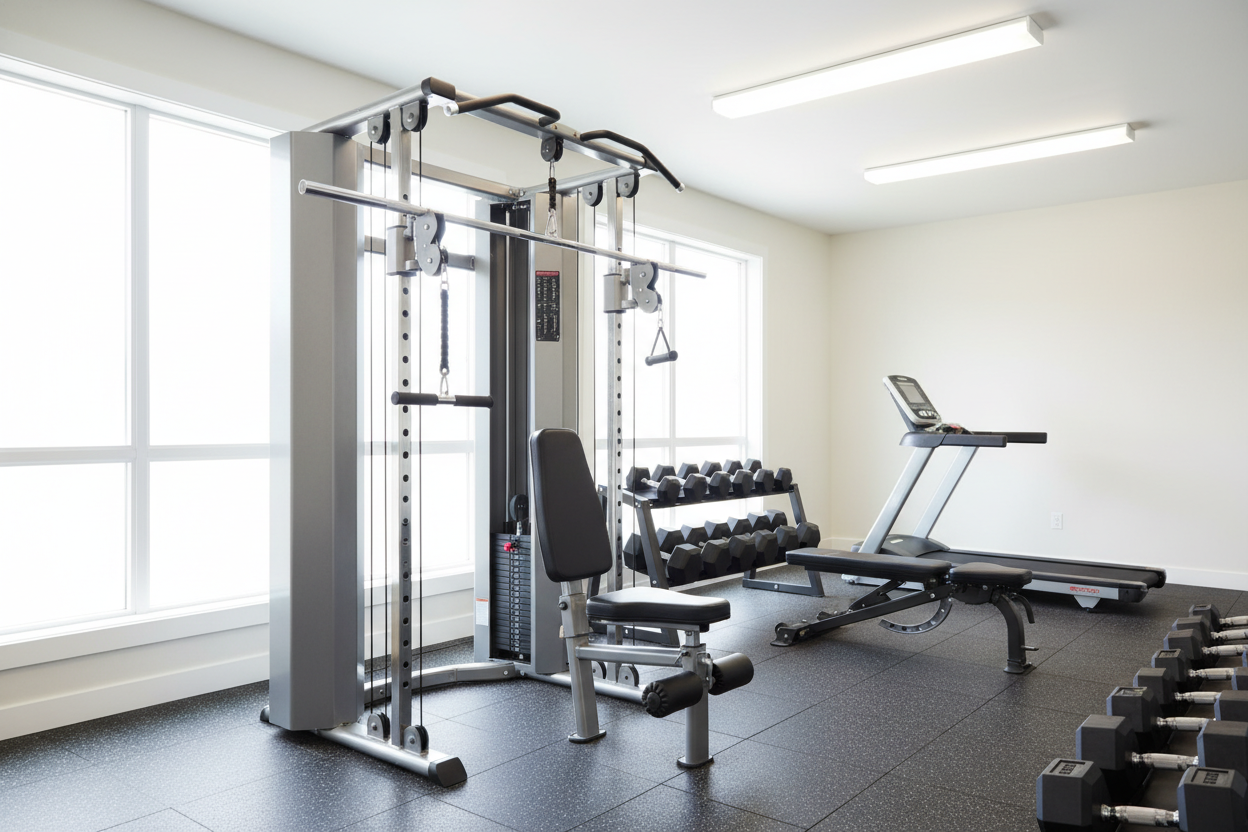
I remember walking into my first big-box gym after years of training in a dusty basement. I felt like a tourist in a foreign country without a dictionary. I knew how to deadlift, but seeing a sea of pulleys and levers was intimidating. I spent way too much time wandering around, trying to figure out which back workout machine name actually matched the piece of gear I wanted to use.
The 'point and grunt' method works for a while, but it makes you look like a novice. Plus, if you're trying to follow a specific program, you need to know if that lever-arm thing is a high row or a pulldown. Let’s clear the air so you can walk into any weight room—or shop for your own garage—with some actual authority.
Quick Takeaways
- The Lat Pulldown is the king of vertical pulling and width.
- Seated Cable Rows are the gold standard for mid-back thickness.
- Chest-supported machines are better for isolation because they stop you from using momentum.
- For home gyms, one versatile cable tower beats five single-purpose machines every time.
The Big Players: Matching the Gear to the Name
Most commercial gyms follow a standard blueprint. You’ll see the same five or six gym back machine names everywhere from Gold’s to the local YMCA. These are the staples that build the foundation of a 'V-taper' and keep your shoulders from slumping forward like a caveman.
The Lat Pulldown Station
This is the tall one with the long bar and the knee pads. It’s the most common back machine name you’ll hear. You sit down, hook your knees under the pads, and pull the bar toward your upper chest. Most commercial versions use a selectorized weight stack (the one with the pin), but many home versions are plate-loaded to save a few thousand dollars. It’s essentially a pull-up for people who can’t do ten pull-ups yet, or for those of us who want to hammer the lats with high volume without burning out.
The Seated Cable Row
If you see a low pulley, a bench, and two footplates, you’re looking at a seated cable row. This specific back exercise machine name is synonymous with 'thickness.' Unlike the pulldown, you’re pulling horizontally. It hits the rhomboids and traps like nothing else. I’ve found that using a close-grip 'V-bar' handle on this machine gives the best stretch in the lats, but you can swap handles to change the feel entirely.
Chest-Supported T-Bar Row
This is the one where you lie face-down on an angled pad. It’s a lifter favorite because it removes the 'cheat' factor. When you do a standard barbell row, your lower back often gives out before your lats do. By using a dedicated gym roller machine or a chest-supported row, you isolate the upper back without your spine screaming for mercy. It’s the best way to move heavy weight safely after a long day of work. using a dedicated gym roller machine after these heavy sessions can also help with the general stiffness that comes with heavy rowing.
Decoding the Weird Machines for Back and Biceps
Once you get past the basics, you’ll find the specialized machines for back and biceps. These are usually plate-loaded, meaning you have to grab 45-lb plates from a rack and load them yourself. The 'ISO-Lateral High Row' is a common back machine gym name for the one where the arms move independently. This is great for fixing muscle imbalances—we all have one side that’s stronger than the other.
You might also see the assisted pull-up station. It’s the big rig with a platform that pushes your feet or knees up. Don’t be too proud to use it. It’s a fantastic tool for high-rep 'burnouts' at the end of a session when your grip is failing but your lats still have some gas in the tank.
Which of These Rigs Are Actually Worth Your Garage Space?
Here is the hard truth: most back machines gym names you see in a 10,000-square-foot commercial facility have no business being in your garage. If you buy a dedicated T-bar row, a dedicated lat pulldown, and a dedicated low row, you’ll have no room left for a car or even a squat rack.
When looking at back machines at gym names for home use, stick to versatility. A single-station machine is a luxury. I’ve seen guys spend $1,200 on a seated row machine only to realize they could have done the same thing with a $200 pulley attachment on their power rack. Unless you have a 3-car garage and a massive budget, avoid the single-purpose 'hammer strength' clones.
The Ultimate Home Hack: Doing It All on One Rack
If you want the variety of all these back machines gym names without the clutter, look at functional trainers or high-end racks. You can easily try a heavy back workout on Smith machine by using it for inverted rows or even 'Meadows rows' if you have the right setup. It’s about being smart with your footprint.
For most people, a versatile Smith machine home gym station is the ultimate answer. It combines the stability of those commercial machines with the space-saving needs of a home lifter. You get the guided path of a machine, which is great for mind-muscle connection, but you don't need 15 different pieces of gear to hit every angle of your back.
Personal Experience: The Craigslist Lesson
I once found a 'steal' on a commercial-grade seated row machine. It was a beautiful, heavy-duty piece of iron. I hauled it home, spent two hours bolting it together, and realized it took up almost a third of my lifting area. I could barely walk around my barbell. Within a month, I realized I was doing the same movements on my cable crossover anyway. I ended up selling it for $100 less than I paid just to get my floor space back. Don't buy a machine just because it has a cool name; buy it because you can't replicate that movement elsewhere.
FAQ
What is the most effective back machine?
The Lat Pulldown is generally considered the most effective for overall back development because it allows for a massive range of motion and is easy to load progressively.
What is the 'rowing machine' called in the gym?
It depends on the type. If it uses a handle and a weight stack, it's a Seated Cable Row. If it's the cardio version that mimics a boat, it's an Indoor Rower (or Ergometer).
What machine is best for lower back?
The Hyper-extension bench (sometimes called a Roman Chair) is the standard for isolating the lower back erectors, though many people prefer a belt squat for lower back safety.
Share:
Does the Form Fit Workout Bench Survive Heavy Dumbbells?
I Traded My Power Rack for an All In One Exercise Machine