
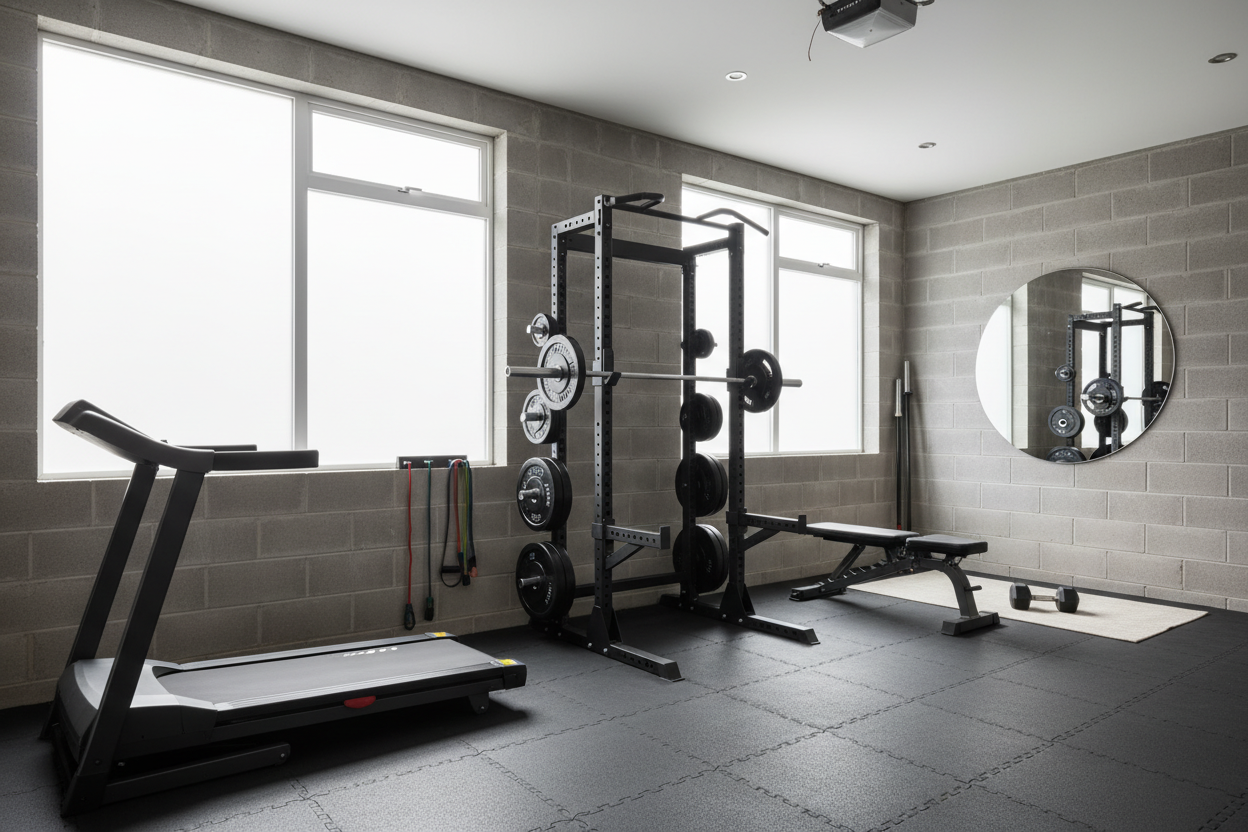
I remember staring at my spare bedroom—a 10x10 cube of carpet and beige walls—thinking there was no way a real rack was fitting in there. I was tired of the $80 monthly 'facility fee' at the local commercial gym where I had to wait twenty minutes for a squat rack that was not even level. Most people think they need a 400-square-foot garage to get strong, but the truth is, small home gyms design is about geometry and barbell paths, not just square footage.
Quick Takeaways
- Measure for the barbell width (7.2 feet) plus at least 12 inches of loading clearance on each side.
- Prioritize vertical wall storage to keep the floor clear for actual movement.
- Consider fixed-path machines to eliminate the 'safety buffer' zone required by free weights.
- Invest in multi-use 11-gauge steel equipment rather than flimsy single-purpose gadgets.
- High-velocity airflow is non-negotiable in spaces under 150 square feet.
Stop Measuring the Floor (Measure the Barbell Instead)
Most people look at a floor plan and think, 'I have 100 square feet, I am good.' They are usually wrong. A standard Olympic bar is 7.2 feet long. If you are using 45-pound iron plates, they are roughly 17.7 inches in diameter. You do not just need room for the bar; you need 'loading room.' I call this barbell math. If you are figuring out how to build a home gym in a small space, you need at least 9 feet of width. Anything less and you are going to punch a hole in the drywall every time you slide a plate onto the sleeve.
You also have to account for the 'bail zone.' If you have to dump a squat, where does that bar go? If it is going to hit your dresser or a window, your small workout area ideas are actually safety hazards. Trace the path of the bar for every lift—overhead press, deadlift, and bench. If the bar path clears the walls by less than six inches, you need to rethink the layout or look into a shorter 6-foot rackable bar.
The 3D Rule: If You Cannot Go Wide, Go Vertical
When floor space is at a premium, the walls are your best friend. I have seen guys leave three sets of dumbbells on the floor and wonder why they have no room to move. Get them on a rack. Better yet, look into folding power racks that bolt to the studs. When you are done squatting, the rack tucks away to within 4 inches of the wall. This is the foundation of building a functional home gym in a tight footprint.
Use wall-mounted weight pegs instead of a toaster rack. It keeps the floor footprint clean for deadlifts and burpees. I also recommend hanging your jump ropes, bands, and even your bench if you can find a wall-mount bracket. If it is on the floor and you are not currently standing on it or lifting it, it is in the way. Verticality is the only way to keep a 10x10 room from feeling like a storage closet.
Why Fixed-Path Machines Actually Make Sense Here
This is a hot take in the 'functional fitness' community, but free weights are not always king when you are cramped. A traditional power rack requires significant side-to-side clearance for the bar to oscillate and for you to move around it safely. A Smith machine home gym station actually saves space because the barbell path is locked. You do not need that extra 18 inches of safety buffer on either side because the bar is not going to drift.
In a tiny 8x8 corner, predictability is your best friend. It keeps your walls intact and allows you to push to failure without worrying about a bar rolling into your drywall. Modern Smith machines also often integrate cable systems and pull-up bars, effectively giving you three machines in the footprint of one. It is a trade-off I would make any day for a bedroom gym.
Finding Multi-Use Gear That Does Not Suck
Avoid the plastic junk you see on midnight infomercials. You want heavy steel that does two or three things exceptionally well. For example, a compact leg press hack squat combo machine takes up about the same space as a standard recliner but lets you hammer legs without needing a massive squat cage and a separate leg press unit. If a machine feels like it is going to tip when you load three plates, it is a paperweight. Look for 11-gauge steel and 2x3 or 3x3 tubing.
When space is tight, every piece of gear has to earn its keep. If you only use a piece of equipment once a week, it does not belong in a small gym. I am a huge fan of adjustable dumbbells like PowerBlocks or Ironmasters. They replace 20 pairs of fixed dumbbells and fit on a small stand in the corner. That is compact home gym ideas 101: consolidate your weight, not your effort.
Lighting and Airflow: The Unsexy Side of Tight Spaces
A 10x10 room turns into a swamp after three sets of heavy triples. I once squeezed a real compact in home gym into a tiny nook, and the biggest mistake I made was ignoring the air. You need a high-velocity floor fan, not a standard ceiling fan. Ceiling fans just move the hot air around the top of the room. You need a blower that moves air across your skin to facilitate evaporation.
Also, do not underestimate mirrors. They are not just for checking your pump; they provide essential depth perception. In a small room, mirrors stop you from feeling claustrophobic when you are under a heavy bar. They also help you monitor your form when you cannot back up far enough to get a 'big picture' view of your squat. Combine good lighting with a large mirror, and that 'dungeon' suddenly feels like a professional studio.
Personal Experience: The Cable Swing Mistake
I once tried to fit a full-sized functional trainer into a spare bathroom I converted. I measured the base, and it fit perfectly. What I did not account for was the cable swing. Every time I did chest flyes, the weight stacks would clank against the door frame, and my elbows would hit the towel rack. I ended up having to sell it at a loss on Marketplace because I forgot that 'static' measurements do not account for 'active' movement. Always add 20% to your equipment's footprint for your own body's range of motion.
Small Gym FAQ
Can I deadlift on an upper-floor apartment?
Technically yes, but your neighbors and your floor joists will hate you. Use 2-inch thick crash pads and stick to RDLs or slow eccentrics. If you are pulling 500 lbs to a dead stop, you belong on a ground floor or in a garage.
How much height do I need for a power rack?
Most standard racks are 82 to 90 inches tall. If you have 8-foot ceilings (96 inches), you have enough room for pull-ups, but your head will be close to the drywall. Look for 'shorty' racks if you are in a basement with low pipes.
Are adjustable dumbbells better than a full rack?
For small spaces, yes. A full rack of dumbbells from 5 to 50 lbs takes up about 6 to 8 feet of wall space. A pair of adjustables takes up 2 square feet. The choice is obvious when space is the bottleneck.
Share:
I Survived on These Space-Saving Home Gym Corner Ideas for 2 Years
Why I Finally Made Room for a Slide Squat Machine