
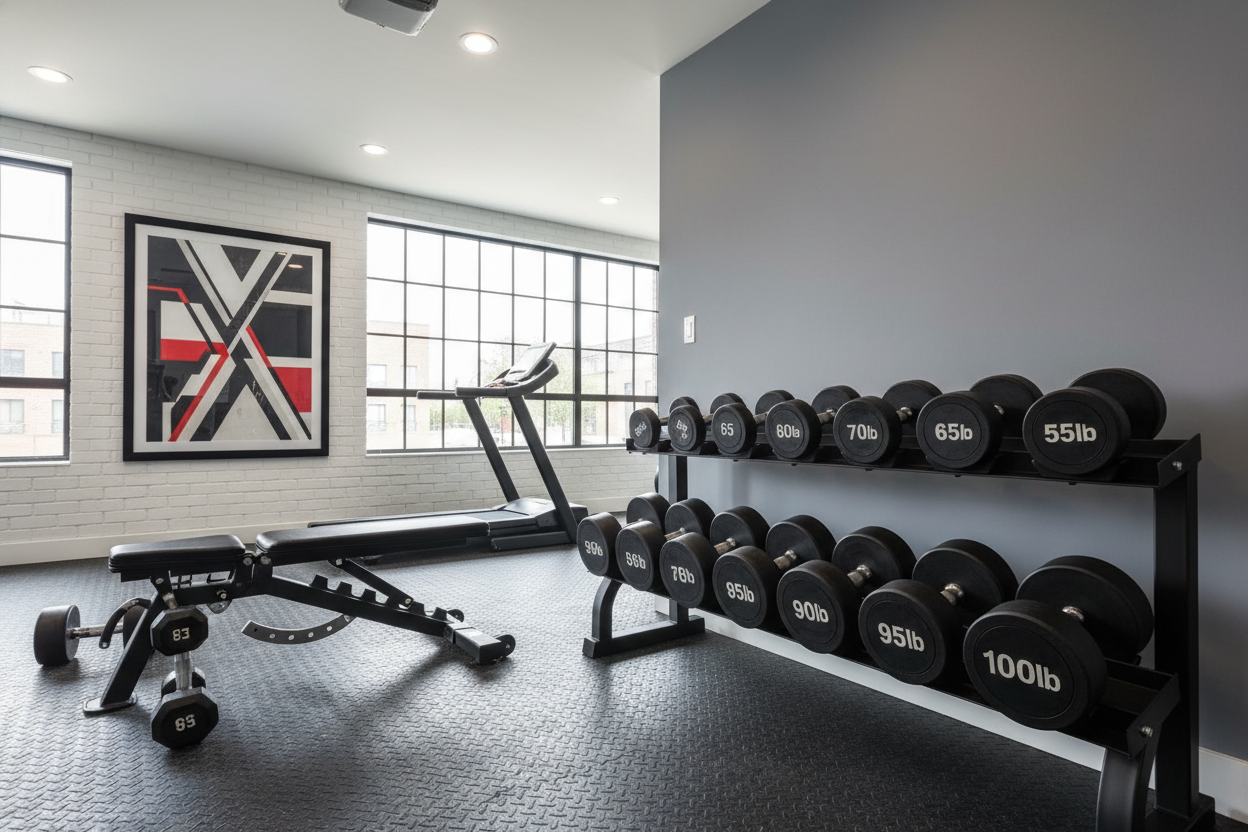
You finally did it. You hit 12 reps on the flat bench with the 50s and realized you’re officially too strong for your starter gym. It’s a proud moment until you look at the price tag for a dumbbell set 55-100 and realize your hobby is about to get very expensive.
I’ve been there. I remember staring at my rack of 5-50s and feeling like I’d beaten the game. But the jump to the heavy stuff isn't just a financial investment; it’s a logistical nightmare that most people aren't prepared for. Before you click 'buy' on that massive expansion, let's talk about what actually happens when you bring 1,500 pounds of iron into your garage.
Quick Takeaways
- Shipping freight for a 55-100 lb dumbbell set can cost as much as the weights themselves.
- Most lifters only need 10-pound increments (60, 70, 80) rather than the full 10-pair set.
- Standard home gym racks will bow or collapse under the weight of a heavy expansion.
- Fixed rubber hex is significantly safer for heavy presses than adjustable alternatives.
The 50-Pound Wall (And Why We Get Tempted to Upgrade)
The 50-pound mark is the great filter of home gym owners. Most people can stay busy for a year or two with a standard 5-50 lb set. You use them for everything: curls, lateral raises, and overhead presses. But eventually, your chest and back outpace your shoulders. You find yourself doing 20+ reps of goblet squats just to feel a burn.
It’s a psychological milestone. You feel like you can’t progress without the next tier. I remember thinking Exactly How Long a 300 lb Dumbbell Set Will Last a Beginner was forever, but once you start hitting heavy rows, those 50s feel like toys. The urge to buy the full rack is strong, but the reality of intermediate lifting is that progress slows down. You won't be jumping from 55s to 60s every week like you did with the 15s and 20s.
The Hidden Costs of a 55-100 Lb Dumbbell Set
When you buy a 5-50 set, it often ships in a few boxes via UPS. When you order a 55-100 lb dumbbell set, you’re entering the world of LTL freight. That means a semi-truck pulling up to your driveway with a wooden pallet. If you don't have a 'liftgate' service, you're hand-unloading 1,500 lbs of steel off the back of a trailer while the driver stares at his watch.
Then there’s the rack. Your $150 Amazon special rack is going to fold like a lawn chair. A full 55-100 set weighs exactly 1,550 lbs. You need a commercial-grade, 11-gauge steel rack to hold that safely. Budget another $400 to $700 just for the storage. If you don't, you'll walk into your gym one morning to find your 90s sitting on a pile of bent metal.
You Are Probably Only Going to Use Three Pairs
Here is the hard truth: you are going to ignore half of that rack. For heavy compound movements like rows or presses, 5-pound increments are almost too small to notice once you get past 70 lbs. Most days, you’ll reach for the 60s, the 80s, and the 100s. The 65s, 75s, and 85s will literally sit there collecting dust and spider webs for three years.
In a commercial gym, those intermediate weights are great for when the 'main' weights are taken. In your garage, you are the only member. Buying a full dumbbell 55-100 set means you are paying a massive premium for weights you might use once a quarter. It's a lot of floor space for 'just in case' increments.
Your Floor Space (And Mats) Will Take a Beating
A three-tier rack for heavy weights is a beast. It’s usually about 60 to 70 inches wide. In a standard 2-car garage, that’s a massive chunk of real estate. And don't get me started on the floor. Dropping a dumbbell 55-100 isn't like dropping a 25-pounder. Even with 3/4-inch horse stall mats, a 100-pound iron head will eventually crack the concrete underneath if you aren't careful. You need to be controlled, which is hard when you're training to failure.
Surviving Heavy Presses: Fixed Hex vs. Adjustables
I’m a huge fan of space-saving gear, but when it comes to the heavy stuff, I have a bias. Kicking up a pair of 80-pound rubber hex dumbbell set heads onto your thighs to start a bench press feels solid. The flat heads sit comfortably on your quads, and the balance is predictable. They are built for abuse.
On the other hand, many heavy adjustable dumbbells become incredibly unwieldy once they pass the 70-pound mark. They get longer, the weight distribution shifts, and frankly, I don't trust a plastic dial or a thin selector pin when I'm holding 90 lbs over my face. If you have the room, fixed heads are the only way to go for the heavy range. They don't rattle, and they don't break when you set them down hard after a PR set.
The Smart Way to Build Out Your Heavy Dumbbell 55-100 Range
If I could do it all over again, I wouldn't buy the pre-packaged 10-pair set. I’d go to a heavy dumbbell collection and buy exactly what I need. Start with a pair of 60s, 70s, and 80s. That covers your heavy pressing and rowing for a long time. Once you can rep the 80s for 12, then buy the 90s. This saves you thousands of dollars upfront and keeps your gym from feeling like a cluttered warehouse.
Building a home gym is a marathon. Don't buy the weights you hope to lift in three years; buy the weights you need for the next six months. Your wallet, your floor, and your lower back will thank you.
My Personal Experience
I once bought a full set of 55-100s from a closing commercial gym. I thought I got the deal of a century. Two weeks later, I realized I hadn't touched the 65s or 95s once. They just took up five feet of wall space I could have used for a cable machine. I eventually sold the odd-sized pairs on Marketplace just to get my floor space back. Now, I stick to 10-pound jumps for anything over 70 lbs. It’s more than enough for progressive overload.
FAQ
Do I really need 5-lb increments for heavy dumbbells?
Usually, no. Once you're lifting over 60 lbs, a 10-lb jump is only a 14% increase. It's manageable. You can bridge the gap by adding reps or slowing down your tempo with the lighter weight before moving up.
What is the best rack for a 55-100 lb set?
Look for a rack with a weight capacity of at least 2,000 lbs. It should be made of 11-gauge steel. Avoid anything with plastic saddles; they crack under the impact of a 100-lb dumbbell being racked quickly.
Is rubber hex better than urethane for heavy weights?
Urethane is more durable and won't smell, but it's significantly more expensive. For a garage gym, rubber hex is the sweet spot. It protects the floor and the weight itself without the 'pro-style' price tag.
Share:
What I Learned Investigating a Real USA Dumbbell Manufacturer
Stop Buying Neoprene: How to Pick Hand Weight Sets That Last