
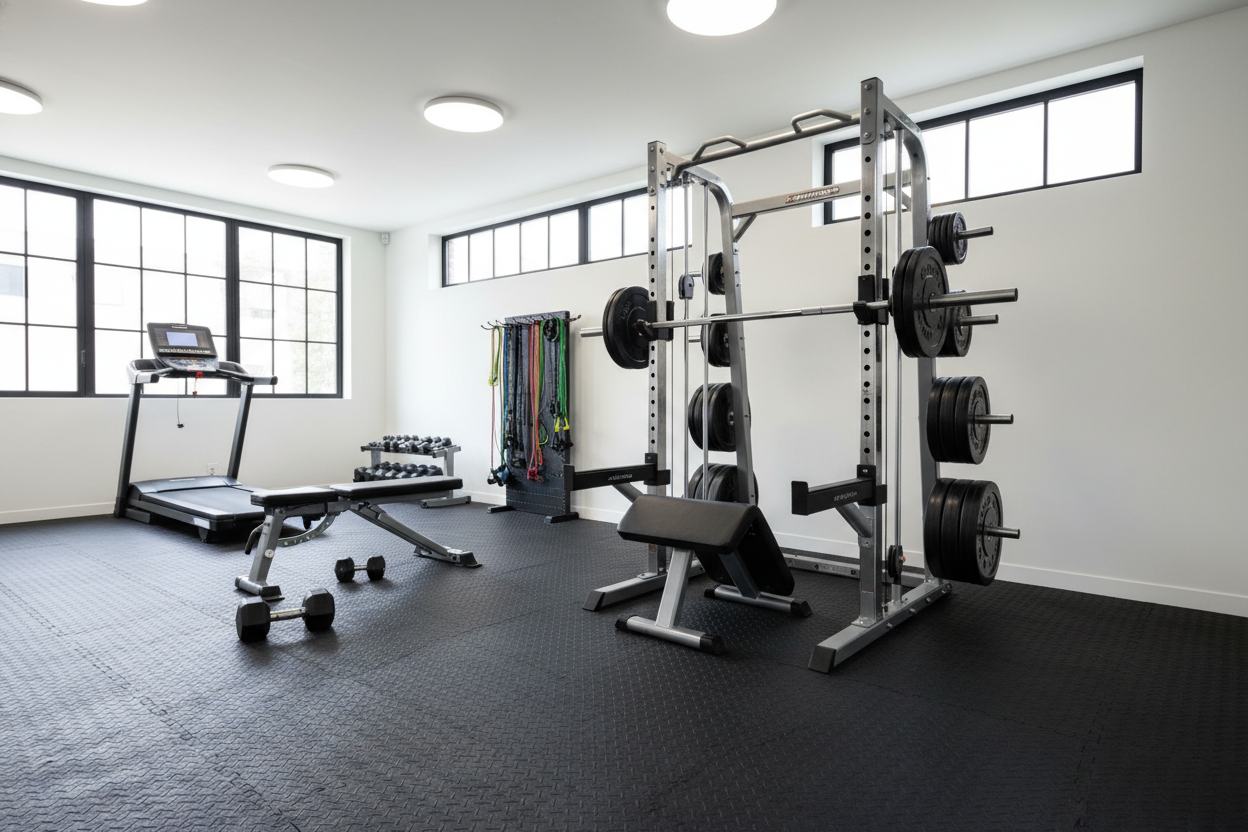
I spent my first five years in the gym as a total barbell snob. I thought if you weren't pinning a 45-lb bar to your back and fighting for your life to balance it, you weren't really training legs. Then I hit a wall where my lower back gave out long before my legs did, and my quads looked like toothpicks despite a 400-lb squat. That is when I finally swallowed my pride and started using the smith machine squat for quads.
Quick Takeaways
- Foot placement: Keep feet 3-6 inches in front of the bar to maintain a vertical torso.
- Heel elevation: Using a wedge or plates is the fastest way to increase knee travel.
- Bar height: Always use a high-bar position to keep the weight over your mid-foot.
- Constant tension: Avoid locking out at the top to keep the quads loaded.
Why Free Weight Squats Aren't Always the Best Quad Builders
The standard barbell back squat is a legendary movement, but it is often limited by your weakest link. For most of us, that is the lower back or core stability. When you get tired, your hips shoot up, your chest drops, and the movement becomes a 'good morning' that hammers your spinal erectors more than your legs. By moving from a power rack to a Smith Machine, you remove the requirement to balance the load in three-dimensional space.
Because the bar path is fixed, you can lean back into the bar. This allows you to keep your torso completely vertical, which is the holy grail for quad hypertrophy. If you are still on the fence about using 'the cage,' it is time to Stop Hating the Smith Machine Squat (Why It Works) and realize that mechanical stability equals more muscle growth. When you don't have to worry about falling over, you can push your quads to absolute failure safely.
The Exact Setup for a Quad Bias Smith Machine Squat
Most people fail at smith machine quad squats because they stand exactly like they would for a free-weight squat. If your feet are directly under the bar, your anatomy will force your butt back to maintain balance. This turns it into a glute and lower back movement. To fix this, set the bar at a high-bar position on your traps—never on your rear delts.
Step your feet forward about 3 to 6 inches from the bar path. This 'feet forward' rule is what allows your knees to track way past your toes without your heels lifting off the floor. Keep your stance shoulder-width or slightly narrower. As you descend, think about dropping your butt straight down to your heels rather than pushing it back. This creates maximum knee flexion, which is the primary driver for quad exercises on smith machine setups.
The 'Elevated Heel' Trick for Stubborn Legs
If you have stiff ankles, you will never get the depth needed for a quad focused squat smith machine session. The fix is simple: grab a pair of 5-lb plates or a dedicated squat wedge and put them under your heels. This artificial boost in ankle mobility allows your knees to travel even further forward, putting a massive stretch on the vastus lateralis and medialis (the teardrop).
When I am testing a Full Body Multi Training Station Smith Machine Dm01, I am looking for how smooth the bearings feel during this specific move. A high-quality linear bearing system is crucial here because the 'feet forward' position puts a slight shear force on the bar. You need a machine that doesn't stick or stutter when you are in the hole of a deep quad smith machine rep.
3 More Quad Exercises on Smith Machine You Should Be Doing
A quad workout smith machine shouldn't stop at back squats. To round out the leg day, I always throw in these variations:
- Smith Machine Sissy Squat: Lean your torso back and let your knees drop toward the floor. It looks crazy, but the stretch on the rectus femoris is unmatched.
- Smith Machine Front Squat: Rest the bar on your front delts. The fixed path makes this much easier on the wrists than a barbell version.
- Fixed-Path Split Squat: Put one foot forward and one back. Because you don't have to balance, you can really load up the weight to target the quads on smith machine.
If you have No Room for a Leg Sled? My Hack Squat on Smith Machine Setup is a lifesaver. You can mimic a $2,000 hack squat machine just by adjusting your foot height and leaning into the Smith bar.
Programming Your Smith Machine Quad Workout
Don't treat quad squats smith machine style like a powerlifting move. We aren't looking for a 1-rep max. Aim for 3-4 sets in the 8-12 or even 12-15 rep range. The magic happens in the tempo. Use a 3-second eccentric (the way down), a 1-second pause at the bottom to kill momentum, and an explosive but controlled ascent.
Stop just short of lockout at the top. By keeping a slight bend in the knees, you maintain constant tension on the muscle fibers. This creates that 'burn' that signals metabolic stress, which is a key driver for smith machine quad focus training. If you aren't hobbling to the water fountain after your third set, you didn't go heavy enough.
Personal Experience: My Biggest Mistake
I used to load up four plates on each side and do 'ego reps'—basically 4-inch dips where I barely bent my knees. My quads didn't grow an inch. It wasn't until I stripped the weight down to two plates, used a 5-inch heel elevation, and took every rep until my hamstrings touched my calves that my legs actually changed. Deep smith machine quad exercises beat heavy half-reps every single time.
FAQ
Is the Smith machine bad for your knees?
No, as long as your feet are positioned correctly. Stepping your feet slightly forward actually reduces the shear force on the patellar tendon compared to a vertical-shin squat.
Can I build a 'teardrop' muscle on the Smith machine?
Absolutely. By using a narrow stance and elevating your heels, you force the vastus medialis (teardrop) to do the heavy lifting at the bottom of the rep.
Should I use a belt for Smith squats?
If you are pushing to failure, a belt can help you maintain intra-abdominal pressure, but since the machine provides stability, it is less 'mandatory' than with a free-weight barbell squat.
Share:
Can't Feel Your Lats? Try a Back Workout on Smith Machine
It's Not Just You: Why Does Smith Machine Feel Heavier?