
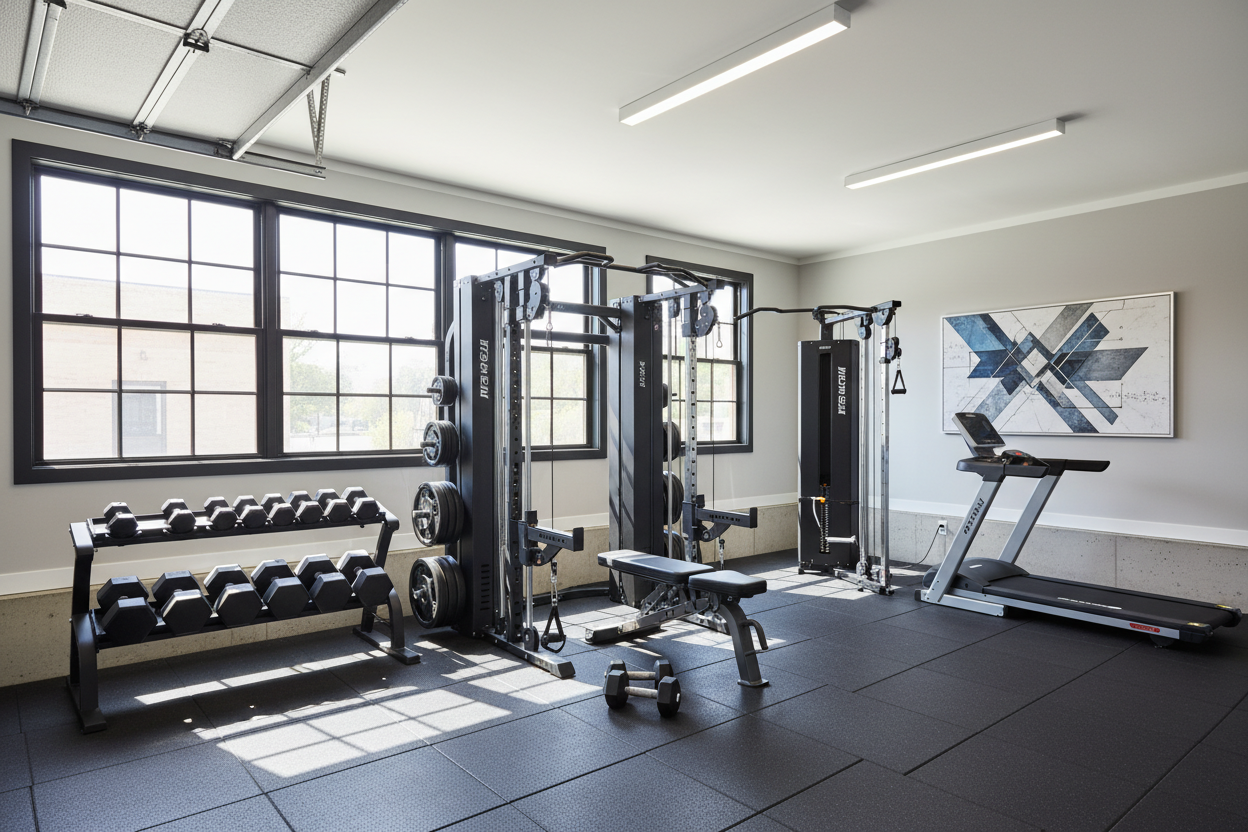
I remember the day I realized my garage was a graveyard of 'budget' gear. I had spent nearly $2,500 on a standalone squat stand, a cheap cable tower, and a literal pile of random plates, only to find I couldn't park my truck or actually finish a leg day without tripping over a sandbag. Investing in an all in one home gym system isn't just about the iron; it's about reclaiming your floor space and your sanity.
- Space Efficiency: A unified rig takes up about 40% less floor space than separate units.
- Cost Consolidation: One freight delivery is significantly cheaper than three separate shipping fees.
- Versatility: You get a Smith machine, functional trainer, and power rack in a single footprint.
- The Trade-off: You lose the ability to have multiple people training different movements at the exact same time.
The Modular Trap: How I Wasted Space and Money
I started with a basic rack because that's what the forums told me to do. Then I wanted cables for face pulls and tricep pushdowns. Then I realized I wanted a Smith machine for high-volume hack squats without needing a spotter. Suddenly, my 20x20 garage felt like a Tetris game gone wrong. Every new piece of combined gym equipment I added required its own 'safety zone' of floor space.
Separate units mean multiple footprints, multiple sets of bolts, and a massive headache when you try to clean the floor or move things around. An all in one training machine solves the 'clutter creep' that kills most home gym dreams within the first year. Instead of four different machines with four different maintenance schedules, you have one central hub.
What Actually Qualifies as a Complete Rig?
Don't be fooled by those flimsy, late-night TV infomercial gadgets that look like they're made of coat hangers. A real all in one training machine needs to handle 500+ lbs on the rack and at least 200 lbs on the cable stacks. If the uprights are less than 14-gauge steel, walk away. You're looking for a rig that integrates a legitimate half-rack with adjustable pulleys.
A great example is the All In One Smith Machine With Cable Crossover S1 V4. It bridges the gap between a commercial club feel and a residential footprint by combining a Smith system with dual cables without sacrificing load capacity. If you can't do heavy pull-ups on the frame without the whole thing wobbling, it’s not a serious piece of equipment.
The Bare Minimum Specs You Should Accept
Steel gauge is king. I look for 2x3 or 3x3 tubing. Anything thinner feels like a toy once you put 315 lbs on the bar. Then there's the cable ratio. A 2:1 ratio is standard for functional trainers—it means 100 lbs on the stack feels like 50 lbs of resistance, giving you more cable travel and smoother movement for isolation work. If the pulleys are plastic, they will squeak and eventually crack. Demand aluminum or high-grade nylon with sealed bearings.
Doing the Math: Modular Pieces vs. One Giant Rig
Let's look at the home gym machine all in one price versus the 'piece-by-piece' approach. A decent power rack is $800. A standalone functional trainer with weight stacks is $1,800. A dedicated Smith Machine Home Gym Station can run another $1,200. That is $3,800 before you even factor in the $400+ you'll spend on three separate freight shipments.
A high-end all in one weight machine for home usually lands between $2,200 and $4,500. By consolidating, you're essentially getting the Smith machine or the cable system for free. Plus, you aren't paying for three different sets of pull-up bars and structural supports that all do the same thing. The math almost always favors the unified rig if you actually plan on doing more than just bench and squat.
The Real Downsides of Putting All Your Iron in One Basket
I’ll be honest: unified systems aren't perfect. The biggest annoyance is the 'overlap.' If you're doing heavy squats in the rack, you often can't use the cables simultaneously because the pulleys are mounted to the same uprights. It makes supersetting a chore if your exercises share the same space. I've spent years debating the power rack or Smith machine for home gym dilemma, and the truth is, a hybrid system requires you to be organized.
There’s also the 'immobility' factor. Once an all in 1 fitness machine is built, it stays there. You aren't sliding a 400-lb rig around to make room for the lawnmower. You have to commit to the layout from day one. If you like to rearrange your gym every three months, this will drive you crazy.
Who Should Actually Buy a Unified Setup?
If you have a 5,000-square-foot warehouse, buy individual pieces. But if you’re a normal human with a garage or a spare bedroom, the all in one gym kit is the move. It’s for the lifter who wants to transition from heavy triples on the back squat to high-rep cable flyes without walking across the room. It maximizes training density, which is the secret to actually staying consistent. Take a look at the full Home Gym collections to see which footprint fits your specific space.
FAQ
How much floor space do I really need?
Aim for an 8x8 foot area. The machine itself might only be 4x6, but you need 'working room' to load plates on the ends of the bar without hitting the wall.
Are the cables as smooth as the ones at a commercial gym?
Only if you maintain them. I use a dry silicone spray on the guide rods once a month. If you let dust build up, any all-in one workout rack will start to feel crunchy.
Can I perform all the main lifts?
Yes. You can squat, bench, and overhead press just like a standard rack. The added benefit is having the all-in-one workout bar and cables right there for your accessory work.
Share:
Do You Actually Need to Count the Smith Machine Bar Weight?
Wait, Are Smith Machine Squats Harder? I Tested the Mechanics