
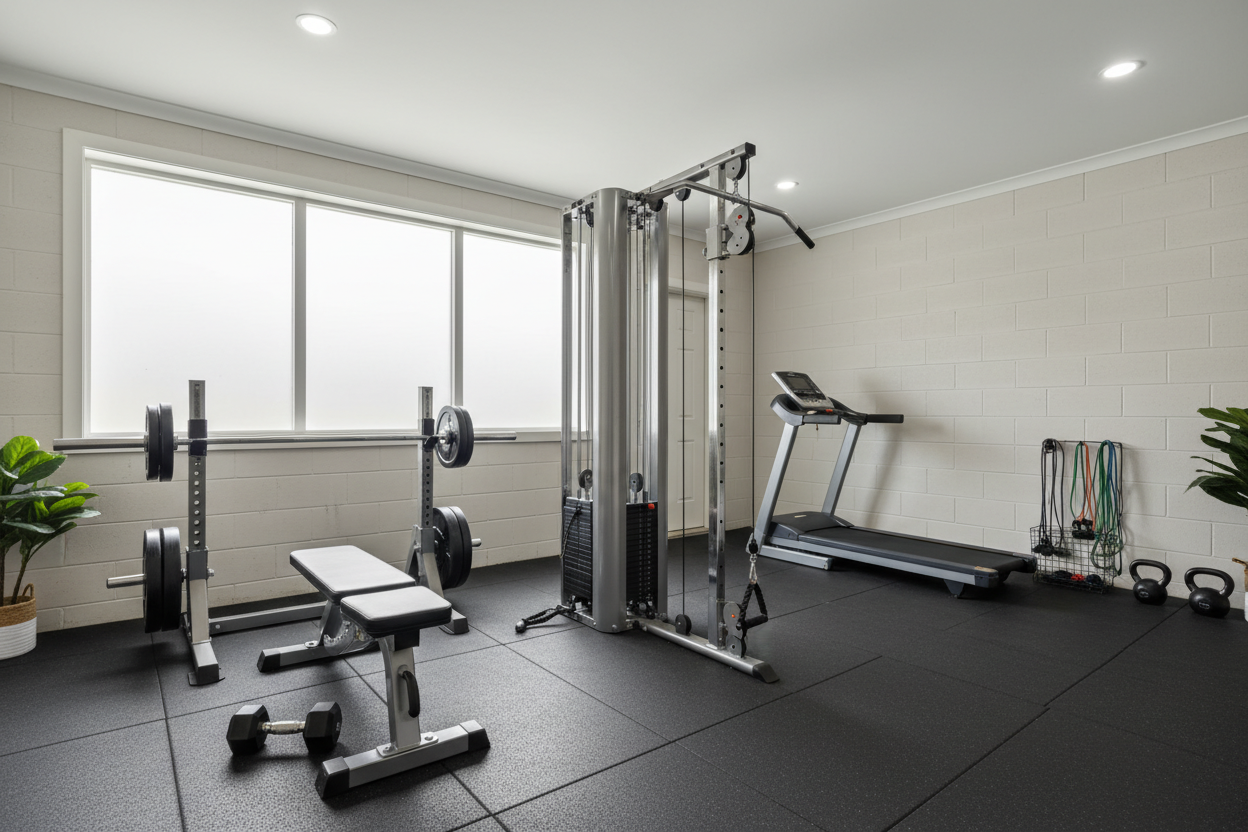
I spent three years training in a drafty garage that froze in January and turned into a sauna in July. The worst part wasn't the temperature; it was the $500 'all-in-one' lifting weights machine I bought thinking it would replace my commercial gym membership. Every time I tried to press, the cables snagged, the frame flexed, and the bar path felt like it was trying to grind my shoulder sockets into dust.
Quick Takeaways
- Cheap pulleys create friction that makes the weight feel 'jerky' and inconsistent.
- Fixed-path bars force your joints into unnatural positions, leading to elbow and shoulder pain.
- Independent arms (iso-lateral movement) are the secret to a commercial-grade feel.
- A rock-solid bench is the foundation of any heavy press; if it wobbles, your power output drops.
The Trap of the 'Do-It-All' Multi-Station
Most budget residential rigs try to be a Swiss Army knife but end up being a dull butter knife. To cram twenty exercises into a 4x4 footprint, manufacturers use tiny nylon pulleys and short cable runs. This creates a 1:1 resistance ratio that feels heavy in all the wrong ways. Because the cables are short, the weight stack starts bouncing if you move too fast, ruining your time under tension.
I've tested machines where the '100 lb' setting felt like 70 lbs at the bottom and 130 lbs at the top because of the friction in the plastic bushings. If you're serious about hypertrophy, you can't have the resistance changing mid-rep. You want a smooth, predictable curve that lets you focus on the muscle, not the equipment's mechanical failures.
Fixed Path vs. Independent Arms (The Game Changer)
The biggest flaw in most home gear is the fixed bar. When you use a standard lifting weight machine with a single connected handle, your dominant side inevitably takes over. Worse, your wrists and elbows are locked into a track that might not match your specific arm length or shoulder width. This is how 'gym shoulder' starts.
Transitioning to an independent arm chest press machine changes the math. Iso-lateral arms move separately, forcing your left and right sides to pull their own weight. It mimics the freedom of dumbbells but with the safety and stability of a machine. Your joints can follow their natural arc, which means you can actually go to failure without feeling a sharp twinge in your rotator cuff the next morning.
Your Base Matters Just As Much As the Resistance
You can have the smoothest lever arms in the world, but if your seat is shimmying while you're pushing a PR, you're leaving gains on the table. Your nervous system won't let your muscles fire at 100% if it detects instability. Most entry-level machines come with a flimsy, narrow bench that feels like sitting on a balance beam.
I always tell people to upgrade their foundation first. A heavy-duty adjustable weight bench gives you a wide, stable platform to dig your shoulder blades into. If you're currently struggling with a rig that feels like it might tip over, it's time to browse a reliable weight bench collection. Look for 11-gauge steel and a tripod or wide-base design. If the bench doesn't weigh at least 60-70 lbs, it's probably not going to hold up to heavy lever work.
How Does Lever Equipment Compare to a Standard Smith?
People often confuse lever machines with Smith machines, but the physics are totally different. A Smith machine moves on a linear track—usually straight up and down or at a slight 7-degree angle. A lever machine moves in a natural arc, which feels much closer to how your body actually moves in space.
There is also the issue of 'dead weight.' When you are calculating Smith machine barbell weight, you have to account for counterbalances and the friction of the bearings. Lever machines are more honest. There are no cables to snap or pulleys to grease. It's just you, a pivot point, and the iron. The resistance is heaviest at the start and tapers slightly as you reach lockout, matching your body's natural strength curve.
The Verdict: Should You Dedicate the Floor Space?
A dedicated lever machine takes up a decent chunk of real estate—usually about a 6x4 foot area once you account for plate loading. If you're working in a cramped 1-car garage, a power rack is still your best bet. But if you have the room, adding a specialized machine is the fastest way to add volume without the systemic fatigue of barbell training.
I'd much rather have one high-quality iso-lateral machine than a '70-in-1' cable station that does everything poorly. Buy the gear that matches how your body actually moves, not the gear that has the most shiny stickers on the side.
My Personal Lesson in Stability
I once tried to do heavy incline presses on a budget machine that wasn't bolted down. As I reached the top of the rep, the center of gravity shifted, and the front of the machine actually lifted off the floor. I had to bail on the weight and nearly ended up pinned under the frame. It was a wake-up call. Now, I don't care how good the 'features' are—if the frame isn't heavy-duty steel and the footprint isn't wide, I won't put my back on it. Stability is the most underrated spec in the home gym world.
FAQ
Do lever machines require maintenance?
Hardly any. Unlike cable machines that need periodic line replacements and pulley greasing, lever machines just need the pivot points checked once a year. They are built like tanks.
Can I use standard 1-inch plates on these machines?
Most high-end lever gear is designed for 2-inch Olympic plates. Using 1-inch plates with adapters usually leads to rattling and uneven weight distribution. Stick to Olympic iron for the best experience.
Why does the weight feel heavier on a lever machine than a barbell?
It's all about the leverage and the distance from the pivot point. Because the weight is often positioned further out on the arm, the 'effective' weight can feel significantly more taxing than a standard barbell bench press.
Share:
Why You Are Designing Home Gym Layouts Completely Backwards
Why I Traded My Rack for a Workout Bench with Storage