
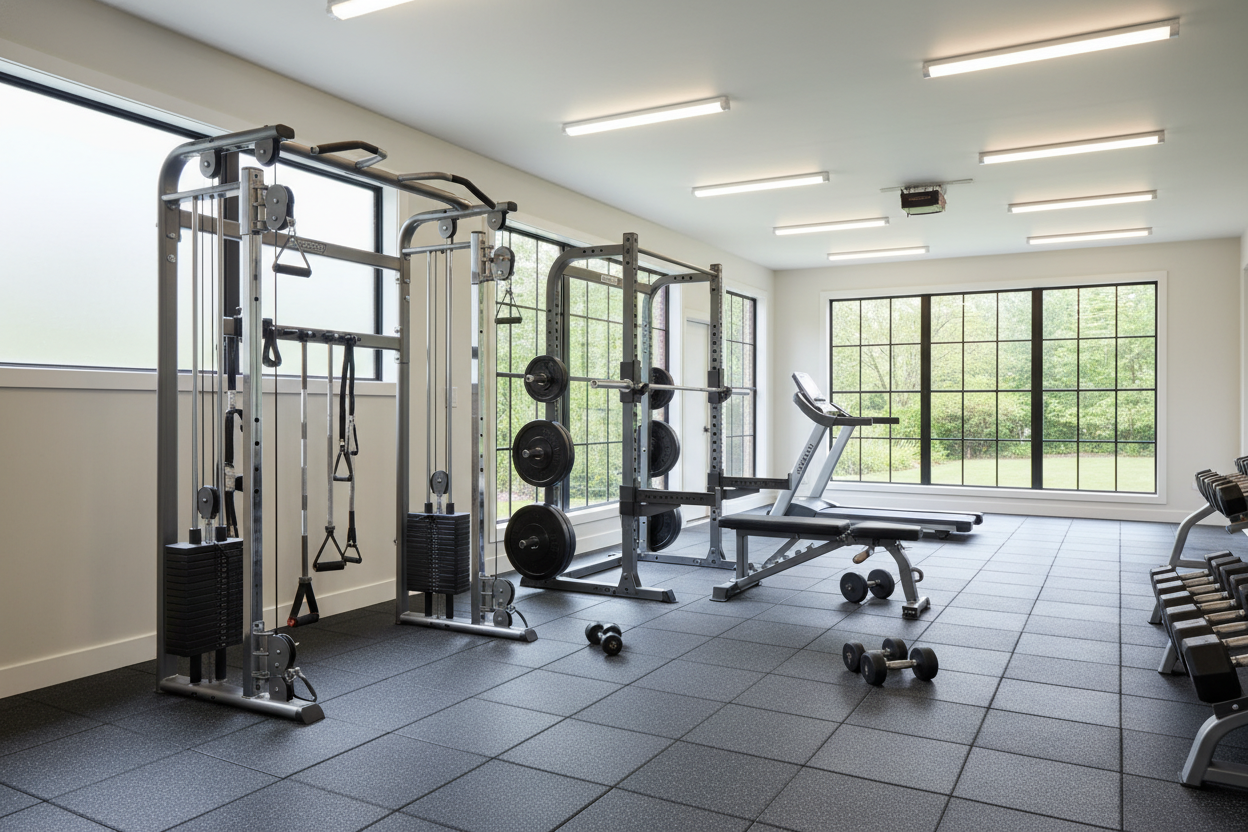
I have spent more Sunday nights than I care to admit scrolling through local listings, convinced I have found a diamond in the rough. Most of the time, it is just a rusted piece of scrap metal that someone wants $800 for because it says 'commercial' on the side. When you start hunting for weight machines for sale, it is incredibly easy to let the excitement of a new toy cloud your judgment on mechanical reality.
Quick Takeaways
- Frayed cables are a safety hazard, not a 'minor repair'—factor in the cost of replacement immediately.
- Commercial weight stacks often exceed residential floor load limits; check your joists.
- Independent lever arms are superior to fixed bars for joint health and muscle symmetry.
- Plate-loaded machines require 'working room' for the plates, not just the machine's footprint.
The Facebook Marketplace Trap (Why Cheap Usually Means Broken)
We have all seen it: the 15-in-1 home gym sitting in a dusty garage for $150. These residential multi-gyms are notorious for having terrible leverage ratios and plastic pulleys that snap the moment you try to move real weight. When I am looking at photos, I zoom in on the cables first. If you see the internal wire through the black plastic coating, that cable is a ticking time bomb.
Check the guide rods for pitting or rust. If those rods are not smooth, the weight stack will 'catch' during the eccentric phase of your lift. This ruins the tension and makes the machine feel like a jerky mess. Most people neglect these machines for years, letting sweat sit on the chrome until it eats through the finish. If the seller didn't care enough to wipe it down, they didn't care enough to maintain the bushings either.
Selectorized vs. Plate-Loaded: What Actually Makes Sense for You?
Selectorized machines (the ones with the pin and the stack) are the peak of convenience, but they are a logistical nightmare for a home gym. I have tested several cheap home weight machines that used plate-loaded carriages, and while they save money, the friction on cheap bushings can be unbearable. A high-quality plate-loaded machine is often better than a mediocre pin-loaded one.
Think about your floor. A 300-lb weight stack plus the frame can easily put 500+ lbs of concentrated pressure on a tiny footprint. If you are in a second-floor spare room, a plate-loaded system allows you to distribute that weight by keeping your plates on a separate rack. Plus, moving a selectorized machine usually involves a complete teardown of the stack, which is a great way to lose a finger or a toe.
The Hidden Cost of Moving a 400-Pound Weight Stack
Never trust a seller who says 'easy to move.' A commercial-grade stack is a beast. You will need a truck with a ramp, a heavy-duty dolly, and likely a buddy who you owe a very expensive dinner. Factor in the cost of a gallon of silicone-based lubricant and potentially new hardware. Old bolts have a habit of stripping the moment you apply a wrench to them after five years of sitting still.
The 'Independent Arm' Rule for Lever Equipment
If you are looking at a chest or shoulder press, look for 'iso-lateral' or independent arms. Older machines often use a single rigid bar. This forces your body to follow a path that might not fit your limb length, which is a fast track to shoulder impingement. I always look for a chest press machine with independent arms because it allows your dominant side to work without compensating for the weaker one.
The holy grail is a converging or diverging path. This means the handles move closer together or further apart as you push, mimicking the way your muscles actually function. If the machine just moves in a straight, robotic line, you are better off sticking to dumbbells.
Space Check: The Footprint Lie Most Sellers Tell You
Sellers love to give you the base dimensions—the part that touches the floor. That is a lie. You need to account for the 'wingspan' of the machine. If a plate-loaded leg press is 48 inches wide, you actually need about 7 feet of clearance to safely slide 45-lb plates onto the pegs without hitting your power rack or the wall.
Always measure the full range of motion. A cable crossover might look slim against a wall, but once you pull those handles out to the side, you have effectively taken over the entire room. I like to tape out the footprint on my floor before I even go to look at a machine. If the tape overlaps with my deadlift platform, the machine stays at the seller's house.
When You Should Just Keep It Simple
Sometimes the best machine is no machine at all. If you are struggling to find a piece of gear that isn't a rusted heap, consider if you are just trying to fill space. A heavy-duty adjustable weight bench combined with a solid set of dumbbells can replicate almost every movement a bulky machine offers, and it won't require a structural engineer to check your floor joists.
Machines are great for isolation, but they are a luxury. If you don't have the square footage for a dedicated leg extension or a functional trainer, don't force it. A cramped gym is a gym you won't want to train in.
Personal Experience: My $500 Mistake
A few years back, I bought a used commercial hack squat for a 'steal.' I didn't measure my garage door height. I spent three hours disassembling it in the rain, only to realize the main frame was a single welded unit that wouldn't clear my 7-foot door. I had to sell it for parts. Now, I carry a tape measure and a level to every pickup. No exceptions.
FAQ
How do I know if a used cable is safe?
Run your hand (carefully) along the cable. If you feel any kinks, 'bird-caging' (where the wires start to unravel), or if the plastic coating is cracked, it needs to be replaced immediately.
What is the best way to clean used gym equipment?
Use a mild dish soap and water for the frame and pads. For the guide rods, use a microfiber cloth to remove old grease, then apply a thin layer of 100% silicone spray. Never use WD-40; it attracts dust and will gum up the works.
Can I put a commercial machine in my garage?
Yes, but check your ceiling height and floor level. Many garages have a slight slope for drainage, which can make a tall machine feel unstable or cause the weight stack to rub against the side of the frame.
Share:
Why the Best At Home Total Body Workout Ignores Muscle Splits
I Finally Brought Commercial Fitness Machines Home (Here's Why)