
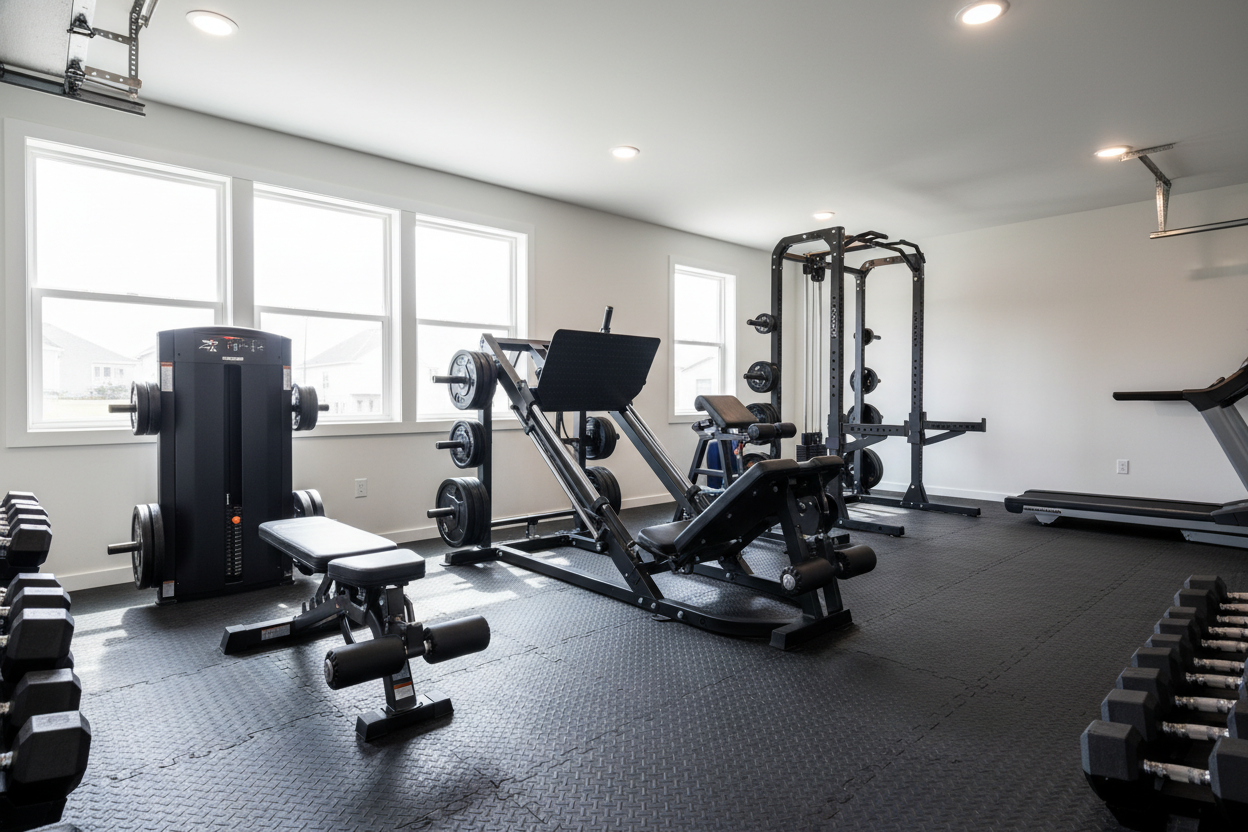
I remember the Tuesday morning I realized my lower back was officially checked out. I was staring at my power rack, dreading a fourth set of heavy back squats, knowing my quads had more to give but my spine did not. That's the moment I stopped being a free-weight purist and started hunting for leg exercises machines that wouldn't require me to build a second story on my garage.
Quick Takeaways
- Prioritize dual-function machines to save precious floor space.
- Linear bearings beat plastic rollers every single time for smoothness.
- Plate-loaded machines are usually better for home gyms than selectorized stacks.
- Always measure your 'working footprint'—you need room to actually load the plates.
Free Weights Are Great, But Let's Be Honest About Fatigue
Barbell squats are the gold standard, but they are also a massive tax on your central nervous system. If you are training for hypertrophy, you eventually hit a wall where your quads aren't the limiting factor—your core or lower back is. This is where a dedicated leg weight lifting machine becomes a necessity rather than a luxury.
By removing the stability requirement, you can take your quads to absolute failure without worrying about a 300-pound bar crushing you. I found that adding a leg weight machine to my routine allowed me to increase my volume by 30% without feeling like I'd been hit by a truck the next morning. It’s about training smarter, not just harder.
Which Pieces Actually Justify Their Massive Footprints?
The biggest hurdle in any garage gym is the 'space-to-utility' ratio. Most commercial leg equipment gym setups are designed for 10,000-square-foot facilities, not a two-car garage shared with a lawnmower. You have to be ruthless. If a machine only does one thing and takes up 25 square feet, it better be the best thing you've ever used.
I’ve tested leg strength machines that felt like they were made of soda cans and others that felt like tanks. In a residential setting, you want leg strengthening machines that offer multiple foot angles and adjustable seats to accommodate different heights. If you can't get a full range of motion because the machine hits a 'stop' too early, it's just a very expensive clothes rack.
The Hack Squat and Leg Press Combo
If you only have room for one big rig, a combo unit is the only way to go. These leg training machines allow you to swap between a 45-degree leg press and a hack squat in about thirty seconds. I personally prefer a compact 30 degree leg press hack squat combo because the angle is a bit more forgiving on the knees while still allowing for massive quad recruitment.
When shopping for these, look at the rail system. Cheap machines use plastic wheels that develop flat spots over time. You want industrial-grade linear bearings. I’ve loaded these with over 600 pounds, and if those bearings aren't high-quality, you’ll feel every tiny vibration in your kneecaps. Not a good feeling.
The Humble Leg Extension and Curl Rig
Isolation is the name of the game for that 'teardrop' quad look. Seated leg machines are usually the first thing people look for, but standalone units are space hogs. A great workaround for smaller shops is a bench with a built-in leg extension curl station. It gives you the functionality of a leg pull machine for your hamstrings without needing a dedicated corner of the room.
The key here is the pivot point. If the machine's axis doesn't line up with your knee joint, it’s going to feel awkward and potentially cause some shearing force. I always tell people to check the padding thickness too. Thin foam is a sign of a cheap leg fitness machines build—you want high-density upholstery that won't bottom out when you're pushing for a PR.
The Smith Machine Trap (And What to Use Instead)
A lot of guys buy a Smith machine thinking it's the ultimate multi-tool for legs. I’m going to be the contrarian here: you should probably ignore the hammer strength smith machine if your primary goal is leg development. The fixed vertical path forces your body into unnatural positions during squats and lunges.
Instead of a Smith, look for dedicated leg fitness machines that allow for a natural arc. Even a simple sissy squat bench or a Bulgarian split squat stand will often provide better quad isolation than a clunky Smith machine ever could. Don't let the 'safety' of the fixed bar fool you into thinking it's the best tool for the job.
Red Flags When You Finally Decide to Buy
When you're ready to shop leg exercise machine options, don't just look at the price tag. Look at the shipping weight. A 150-lb machine is going to wobble the second you put two plates on it. You want steel that’s at least 11-gauge for anything you plan on loading heavy. Also, check the footplate texture. If it’s smooth painted metal, your feet will slip once you start sweating.
I always recommend browsing dedicated leg press and hip thrust machines to see what a proper commercial-grade frame looks like. Look for wide footplates and multiple lockout positions. Safety is everything when you're training alone in a garage.
My Personal Experience
I once bought a budget leg press because I thought 'a sled is a sled.' Big mistake. The carriage was so narrow that my knees felt like they were being pushed together, and the weight pegs were so short I could only fit three plates on each side. I ended up selling it on Craigslist for a $200 loss just to get it out of my sight. Now, I always check the sleeve length and the platform width before I even think about pulling out the credit card.
FAQ
Can I get big legs with just a leg press?
You can certainly build massive quads, but you'll want to supplement with some form of hinge movement like an RDL to make sure your hamstrings and glutes keep up. The leg press is a hypertrophy monster, though.
Are plate-loaded machines better than pin-loaded?
For a garage, yes. They are easier to move, cheaper to ship, and you already own the plates. Pin-loaded (selectorized) machines are great but usually weigh 500+ lbs and are a nightmare to relocate.
How much ceiling height do I need for a hack squat?
Most combos need at least 7 feet of clearance at the top of the stroke. Always check the 'extended height' spec, not just the 'resting height' of the machine.
Share:
Don't Buy a Power Gym Machine Until You Understand This Trade-Off
Stop Wasting Time on the Arm Workout Machines Planet Fitness Promotes