
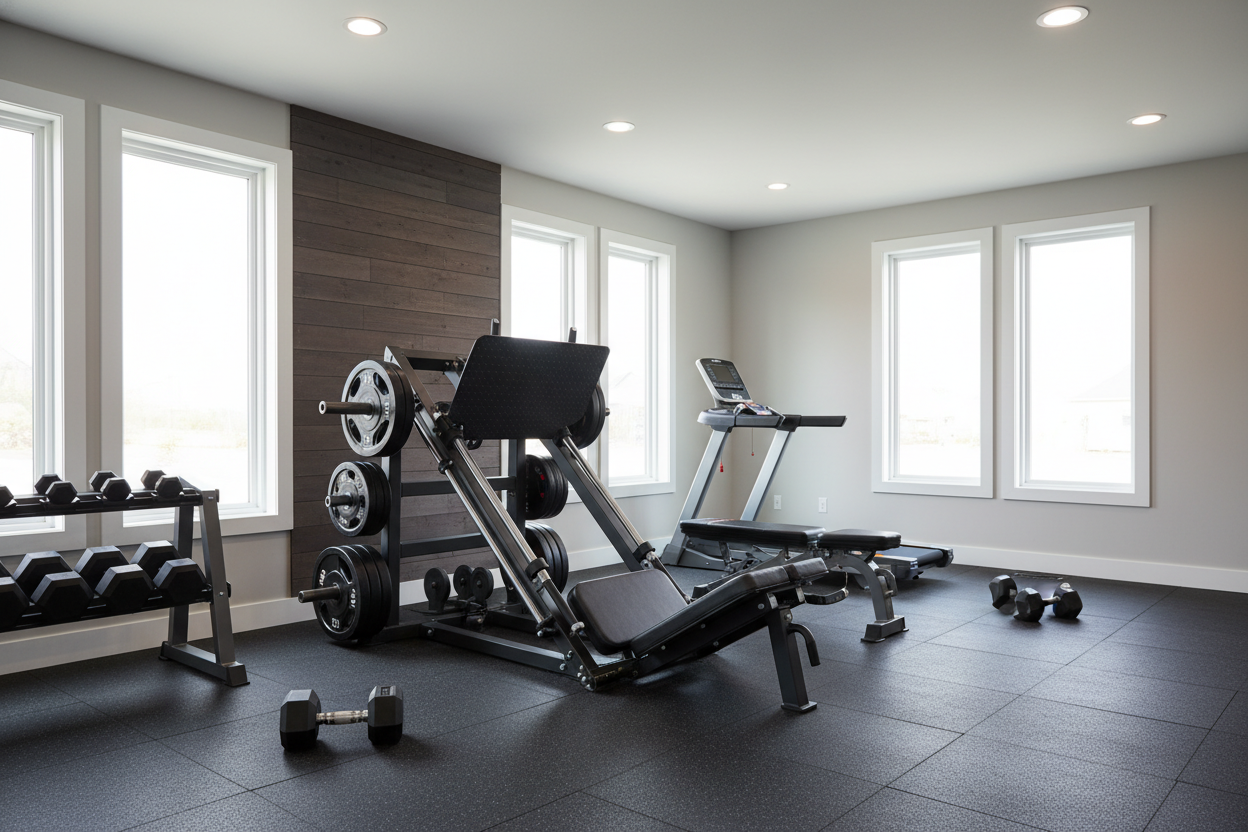
I remember standing in line for the leg press at my old commercial gym, watching some guy scroll through his feed for ten minutes while my quads cooled down. It’s the ultimate motivation to build a basement setup. But the first mistake I almost made was trying to buy every single machine I used at the big box gym. You simply don't have the room, and your floor joists probably won't thank you either.
- Space is Currency: Every square foot must earn its keep.
- Dual-Function Wins: Leg press and hack squat combos offer the most bang for your buck.
- Spec Check: Prioritize linear bearings over cheap plastic rollers.
- The Hybrid Approach: If space is truly tight, a Smith machine is a viable fallback.
The Problem With Replicating a Commercial Leg Day
Commercial gyms have 20,000 square feet to play with. They can afford to have a dedicated machine for every niche angle of the hamstring. When you are outfitting a Home Gym, you have to be more ruthless. Trying to fit five different stations into a garage is a recipe for a cramped, unusable mess. Most people searching for the best leg machines for home realize quickly that the 'one machine, one job' philosophy fails in a residential setting.
You need to think about the 'footprint-to-utility' ratio. If a machine only lets you do one movement, it better be the only movement you ever plan on doing. For most of us, we need variety to keep making gains without hitting a plateau or getting bored out of our minds.
Why I Stopped Looking at Single-Station Setups
I once bought a standalone leg extension machine from a guy on Marketplace. It was a great unit, but it took up a 4x5 foot patch of my garage. For 15 minutes of use once a week, it just sat there taking up space where I could have put a functional trainer or a dumbbell rack. It became an expensive coat rack for my lifting belt. This is the trap many fall into when debating Is There Actually A Single Best Exercise Machine For Home.
Single-station units are built for high-traffic gyms where ten people might use it in an hour. At home, that machine is idle 98% of the time. Unless you’re a competitive bodybuilder with a massive pole barn, the math for single-use leg machines just doesn't add up. You end up sacrificing floor space that could be used for mobility work or a proper deadlift platform.
The Secret to Finding the Best Home Leg Machine
The real 'aha' moment for me was discovering the dual-function sled. A high-quality leg press and hack squat combo is easily the best home leg machine on the market. By swapping a backpad and a footplate, you transition from a heavy leg press to a deep hack squat in about thirty seconds. This gives you the two most effective compound leg movements in the footprint of one.
If you want a prime example of this engineering, look at the Compact 30 Degree Leg Press Hack Squat Combo Machine Lm L5. It uses a 30-degree angle to save on length while still providing that heavy, stable feel you need for high-volume sets. It solves the square footage issue without forcing you to settle for a flimsy, bolt-together toy.
Specs That Actually Matter (And What to Ignore)
Don't get distracted by flashy colors or 'extra' attachments you'll never use. When hunting for the best home gym leg machine, look at the bearings. If it uses plastic rollers on a square tube, it’s going to feel like dragging a sled across sandpaper. You want industrial-grade linear bearings on solid steel chrome rods. That’s what gives you that 'floating on air' feeling even when you’ve got four plates on each side.
Check the steel gauge too. 11-gauge steel is the gold standard for a reason—it doesn't flex when you're repping out heavy weight. Also, look at the footplate size. A tiny footplate limits your stance options. You want enough room to go wide for inner thigh focus or high for more glute and hamstring involvement. If the plate is too small, your heels will be hanging off the edge, which is a one-way ticket to knee pain.
Can a Smith Machine Do the Job Instead?
Sometimes, even a combo sled is too big for a tiny spare bedroom or a crowded apartment corner. In those cases, a Smith Machine Home Gym Station is a legitimate alternative. While it's not a dedicated leg sled, it allows for heavy squats, lunges, and calf raises with a built-in safety net. For some lifters, this is actually the best leg exercise machine for home because it handles upper body movements too.
The downside? You lose that specific 45-degree or 30-degree push angle that makes a leg press so effective for quad isolation. But if you’re choosing between a Smith machine and no leg machine at all, the Smith wins every time. It’s all about working with the space you actually have, not the space you wish you had.
How much floor space do I really need for a leg press combo?
Most combo units require at least an 8-foot by 4-foot area. You also need to account for the space to load plates on the sides. If you’re tight on room, look for 'space-saving' or 'compact' designs that use a steeper angle to reduce the overall length of the track.
Are home leg machines safe to use alone?
Yes, provided they have physical safety stops. Any decent leg press or hack squat will have multiple lockout positions. Always test the safety catch with an empty sled before you start loading plates to make sure you can reach the handle comfortably at the bottom of your range of motion.
Will a leg machine ruin my garage floor?
A loaded leg press can easily weigh over 800 lbs. If you’re putting this on bare concrete, you risk cracking it over time. I always recommend at least 3/4-inch rubber stall mats. It protects the floor and helps dampen the noise when you rack the weight.
Share:
What Pinterest's Best Home Exercise Room Pictures Get Completely Wrong
Can You Trust an Affordable Leg Press Machine With 500 Lbs?