
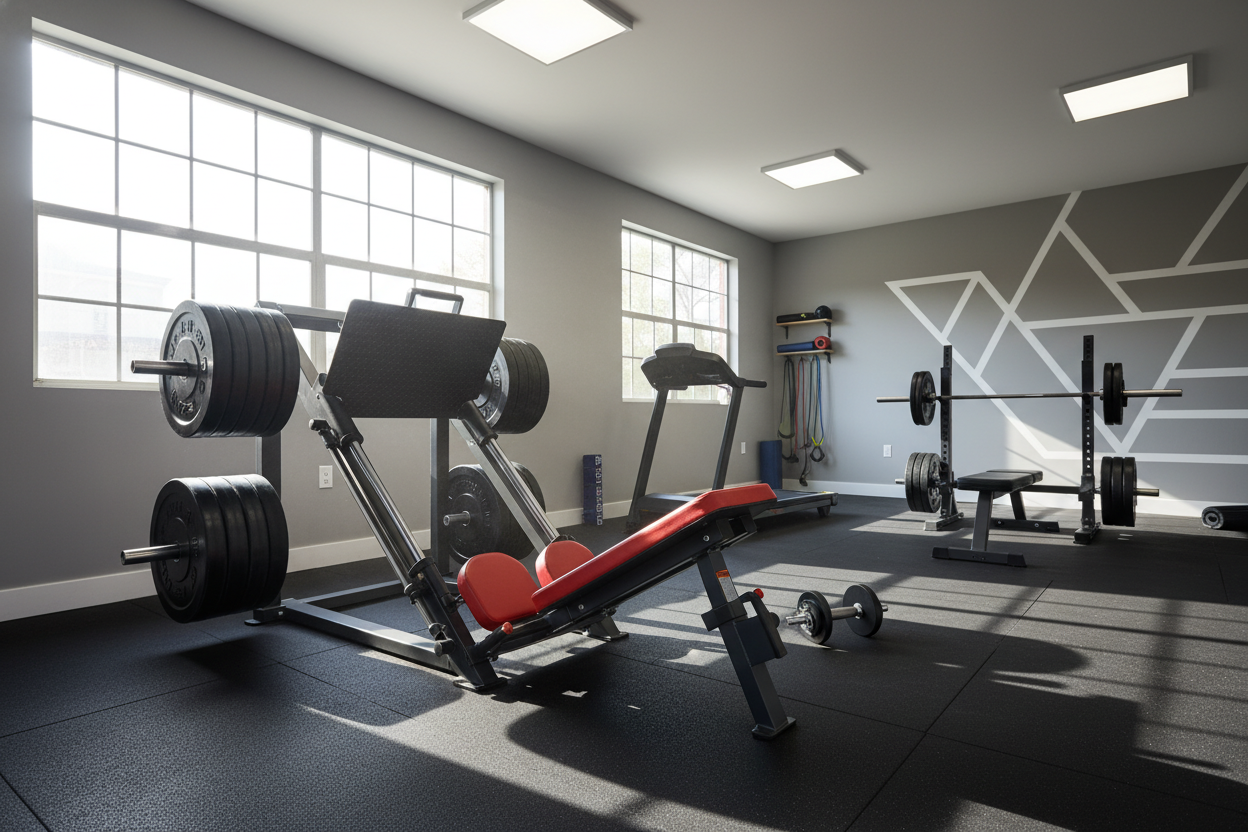
I remember the first time I loaded four plates on a budget sled in a buddy's garage. As I uncradled the weight, the frame groaned in a way that made my insurance deductible flash before my eyes. We all want those tree-trunk quads, but nobody wants to be the guy featured in a gym fail compilation because their affordable leg press machine folded like a lawn chair.
The reality is that commercial leg presses cost five grand for a reason. They use massive 7-gauge steel and industrial bearings designed to survive a nuclear blast. When you're looking for an affordable leg press for your own space, you aren't just looking for a low price—you're looking for the bare minimum engineering required to keep you out of the hospital.
Quick Takeaways
- Check the steel gauge: 14-gauge is for clothes racks; look for at least 11-to-12 gauge for heavy lifting.
- Linear bearings are non-negotiable if you want a smooth stroke that won't hitch midway through a rep.
- Safety catches must be redundant and made of solid steel, not thin hollow tubing.
- Combo machines offer better value and stability for small footprints.
Why Loading Heavy on Budget Steel Terrifies People
Most people see a $600 leg press online and think they've found a steal. Then they realize the shipping weight is only 150 lbs. If the machine weighs less than the plates you're putting on it, you have a physics problem. A light frame will tip, shimmy, and flex under heavy loads, which is the last thing you want when you're pinned at the bottom of a deep eccentric.
The sticker price of a Life Fitness or Hammer Strength machine is enough to make a home gym owner weep. This drives us toward budget alternatives, but the 'budget' label shouldn't mean 'suicide sled.' You need to know which specs are marketing fluff and which ones keep the sled from crashing onto your chest.
Where Budget Brands Cut Corners (And What Actually Matters)
The first thing to go on a cheap machine is steel thickness. Manufacturers love to use 14-gauge steel because it's light and cheap to ship. In my experience, 14-gauge is fine for a plate tree, but it's sketchy for a leg press. You want 11-gauge steel in the main support pillars.
Also, take those '1,000-lb weight capacity' claims with a massive grain of salt. Often, that's a static weight rating—meaning the machine won't collapse if you gently set 1,000 lbs on it. It doesn't mean it can handle the dynamic force of 1,000 lbs moving at speed. If you plan on actually training heavy, look for a machine that feels overbuilt for its rating.
Nylon Rollers vs. Linear Bearings
Cheap sleds use nylon wheels that ride on the outside of the frame. Within six months, those wheels develop flat spots from sitting under load. Your once-smooth leg press will start to feel like you're pushing a shopping cart over gravel. It’s jerky, loud, and ruins your mind-muscle connection.
Spend the extra money on a machine with linear bearings. These ride on solid steel guide rods and provide that 'buttery' feel. If the product description doesn't explicitly mention linear bearings or high-end bushings, assume it’s using cheap plastic wheels that will fail you in a year.
Flimsy Safety Catches Will Haunt You
I’ve seen safety catches on budget machines that were held in place by a single, thin weld. If you hit failure and have to dump the weight, you are relying on that weld to save your spine. You need multi-tier lockout handles that are easy to reach even when your legs are shaking.
The best machines have a physical 'dead stop'—a heavy-duty block of steel or a thick pin that prevents the sled from traveling past a certain point. If your machine doesn't have a secondary safety stop, don't load it heavy. Period.
Why Combo Machines Are the Real Home Gym Hack
Unless you live in a literal warehouse, dedicated leg presses are space killers. They take up a 4x7 foot footprint and only do one thing. That’s why I usually steer people toward dual-purpose units. A compact 30-degree combo machine gives you the leg press feel without eating your entire floor plan.
By combining the hack squat and leg press, manufacturers can beef up the frame because they know the machine has to handle different angles of force. If you have the budget, a 3-in-1 hack squat combo is the ultimate move. It’s more stable than a standalone budget sled because the base is wider and the engineering is inherently more robust to accommodate multiple exercises.
What If You Just Use Your Smith Machine Instead?
You’ve probably seen people lying on the floor of a Smith machine, pushing the bar up with their feet. I’ve tried it. It’s awkward, the balance is weird, and if you slip, there is nothing stopping that bar from crushing your pelvis. A leg press Smith machine setup is a decent 'emergency' workaround, but it’s not a long-term solution for heavy hypertrophy work.
The biomechanics are just off. Without a fixed backrest at the right angle, you end up with massive spinal rounding (butt wink). If you can't afford a real sled yet, stick to high-rep Bulgarian split squats rather than risking a Smith machine floor press disaster.
How to Buy a Sled Without Buyer's Remorse
Before you hit 'buy,' check the box for these three things: 11-gauge steel, linear bearings, and a weight over 250 lbs. If it meets those, it’s probably a solid piece of kit. I’ve wasted enough money on 'bargain' gear that ended up on Facebook Marketplace three months later. Don't be that guy.
If you're ready to stop guessing, browse a curated list of leg press and hip thrust machines that actually pass the 'won't-crush-you' test. Your quads (and your lower back) will thank you.
Personal Experience: The 300-lb Creak
Early in my garage gym days, I bought a no-name sled for $400. It looked great in photos. The first time I loaded 315 lbs, the guide rods started to bow outward. The friction was so bad I had to 'kick' the sled to get it moving. I ended up selling it for $100 just to get it out of my sight. Now, I won't touch a machine unless it has chrome-plated solid steel rods and a frame that doesn't wiggle when I shake it.
FAQ
Is a 500-lb capacity enough for a leg press?
For most people, yes. But remember that 500 lbs on a 45-degree leg press feels lighter than 500 lbs on a squat due to the angle. If you're already squatting 315+, you'll hit that 500-lb limit on a leg press faster than you think.
How much space do I really need?
Budget at least 8 feet of length. You need room for the machine itself plus space to actually load the plates on the sides without hitting your power rack or the wall.
Can I use standard plates on an affordable leg press?
Most budget machines come with 1-inch posts but include 2-inch Olympic adapters. Just make sure those adapters are bolted on tight, or your plates will rattle like crazy during your set.
Share:
Why a Combo Unit Is Actually the Best Home Leg Machine You Can Buy
I Built 4 Rigs to Find the Best Smith Machine for a Garage Gym