
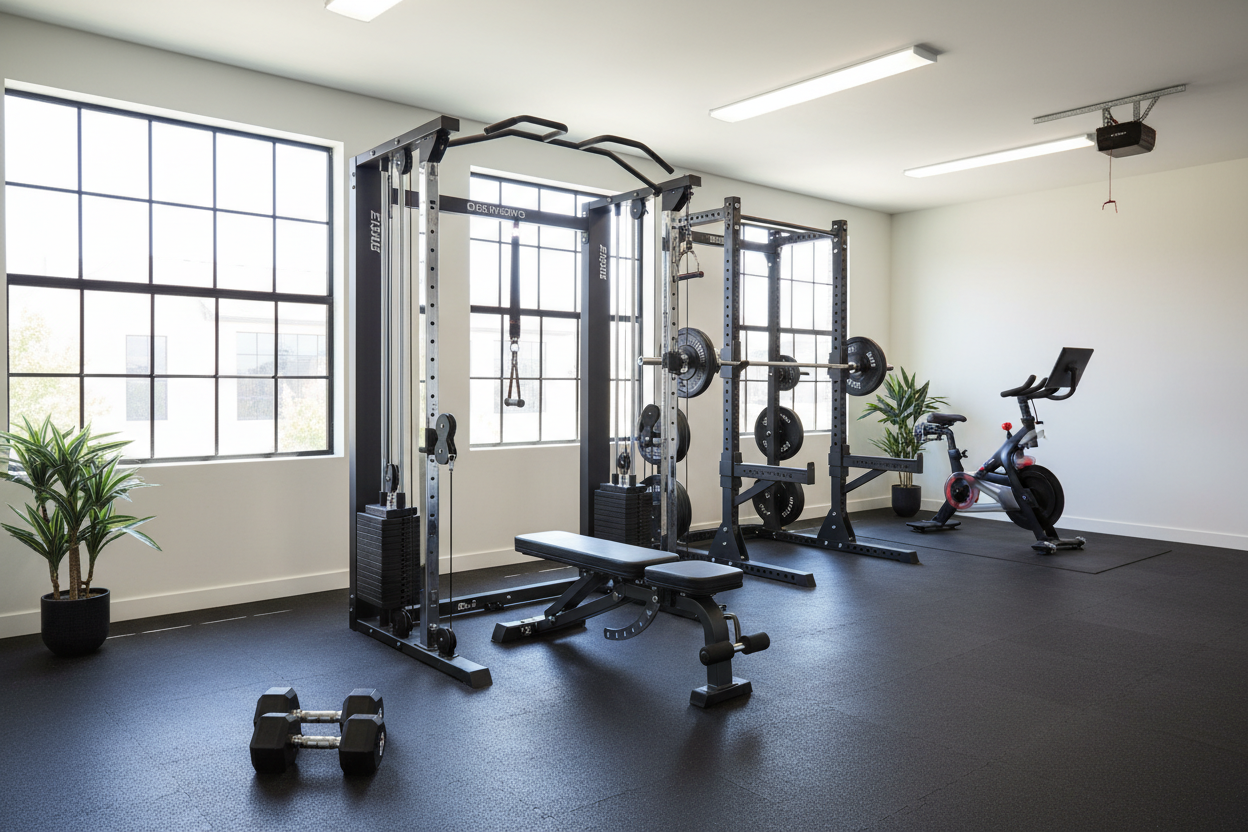
I remember the night I almost pulled the trigger on a Tonal. The marketing was slick, the screen looked like something out of a sci-fi movie, and I was tired of tripping over dumbbells. Then I saw the fine print: a mandatory monthly subscription that costs more than my actual gym membership. I realized I was about to pay three grand for the privilege of being told what to do by a screen.
Instead, I went back to basics. I looked at my garage floor and decided that a heavy-duty weight lift machine was the better play. I wanted iron, not an iPad. I wanted something that wouldn't become a brick the moment the company’s servers went down or my Wi-Fi flickered.
Quick Takeaways
- Plate-loaded machines offer higher weight capacities (often 500+ lbs) than digital motors.
- No monthly subscriptions or software updates to worry about.
- Fixed-path movements allow for safer training to absolute failure without a spotter.
- Resale value for steel and iron remains high; tech depreciates to zero.
The Problem With Plugging Your Gym Into the Wall
Digital fitness is a trap for the unwary. These smart mirrors and cable machines are essentially computers that happen to have some resistance attached. If that screen cracks or the internal motor fries, you are looking at a very expensive piece of wall art. Worse, the hidden cost of buying a smart weight lifting machine means you are never truly done paying for your equipment.
Traditional weightlifting machines don't require an internet connection. They don't track your data to sell it to advertisers. They just sit there, built from 11-gauge steel, waiting for you to load them up. When you buy a piece of analog gear, you own it forever. No one can turn off your ability to do a chest press because your credit card expired.
Why Fixed-Path Iron Actually Builds More Muscle
There is a weird elitism in the lifting community that says if it is not a barbell, it is not worth doing. I used to believe that until I tore my pec slightly on a heavy bench set. Suddenly, the stability of a machine looked a lot more attractive. A dedicated gym lifting machine provides a fixed path of motion that isolates the target muscle without forcing your stabilizers to do all the heavy lifting.
This stability is exactly why an assisted weight machine is the ultimate solo lifting hack. When I am training alone at 6:00 AM, I can push my quads or chest to absolute mechanical failure. If I can't finish the last rep, the machine just stops. I don't have to worry about a 315-lb bar pinning me to the floor while my neighbors are still asleep.
Plate-Loaded vs. Selectorized: What Makes Sense at Home?
If you are building a home gym, you have a choice: selectorized (weight stacks with pins) or plate-loaded. Weight stacks are convenient, but they are incredibly heavy to ship and usually cap out at 200 lbs. That might be fine for tricep extensions, but for a weight lift machine designed for leg presses or chest work, you will outgrow that stack fast.
Plate-loaded gear is the smarter move for most garage setups. It utilizes the Olympic plates you already own, which saves you hundreds of dollars on raw materials. It also keeps the machine's footprint lighter and easier to move if you ever need to reorganize your space. Plus, there is something satisfying about the clank of real iron that a pin-stack just can't replicate.
The Magic of Independent Arm Movements
One of the biggest issues with cheap home equipment is the single-bar design. If one arm is stronger than the other, it will take over the lift, and you will end up with a lopsided physique. Modern home gear has finally caught up to commercial standards by offering iso-lateral movement. Using a chest press machine with independent arms ensures that each side of your body has to carry its own weight.
I have found that iso-lateral machines are better for my joints, too. They allow for a more natural converging or diverging path of motion. Instead of being locked into a rigid straight line, the arms move in an arc that mimics how your muscles actually function. It is the feel of dumbbells with the safety of a machine.
How to Fit Heavy Leverage Gear in a Two-Car Garage
You don't need a 2,000-square-foot commercial space to house a gym lifting machine. The trick is modularity. I recommend starting with a heavy-duty adjustable weight bench as your foundation. A good bench can be the 'docking station' for various leverage attachments or stand-alone machines.
Look for equipment with a footprint of roughly 4 feet by 5 feet. You can tuck a leverage row or a squat machine into a corner and still have plenty of room to park the car or store your lawnmower. If you plan your layout on graph paper first, you will realize you can fit a full circuit of weightlifting machines in a standard 10x10 area if you are smart about it.
Personal Experience: My $400 Mistake
A few years ago, I bought a budget-tier cable crossover from a big-box store. It looked fine in the photos, but the moment I loaded it with more than 100 lbs, the frame started to bow. The plastic pulleys felt like they were filled with sand. I ended up selling it for fifty bucks on Marketplace just to get it out of my sight. Now, I only buy gear with steel pulleys and a minimum 11-gauge steel frame. It is cheaper to buy the right weight lift machine once than to buy a cheap one three times.
FAQ
Do weight machines build as much muscle as free weights?
Yes. Your muscles don't have eyes; they only respond to tension. As long as you are hitting the target muscle with enough load and intensity, a machine can be just as effective—and sometimes more effective for hypertrophy because of the added stability.
How much maintenance do these machines need?
Very little. Unlike digital gyms that need firmware updates, an analog machine just needs the guide rods wiped down with a little silicone spray once a month. Keep the bolts tight, and it will outlive you.
Can I use standard plates on an Olympic machine?
Usually not without an adapter. Most high-quality machines use 2-inch Olympic sleeves. If you have 1-inch standard plates, you'll need to look for specific entry-level gear or buy some Olympic plates, which is a better long-term investment anyway.
Share:
Are the Weight Benches Academy Sells Actually Worth Buying?
Why the Best At Home Exercise Equipment for Women Isn't Pink