
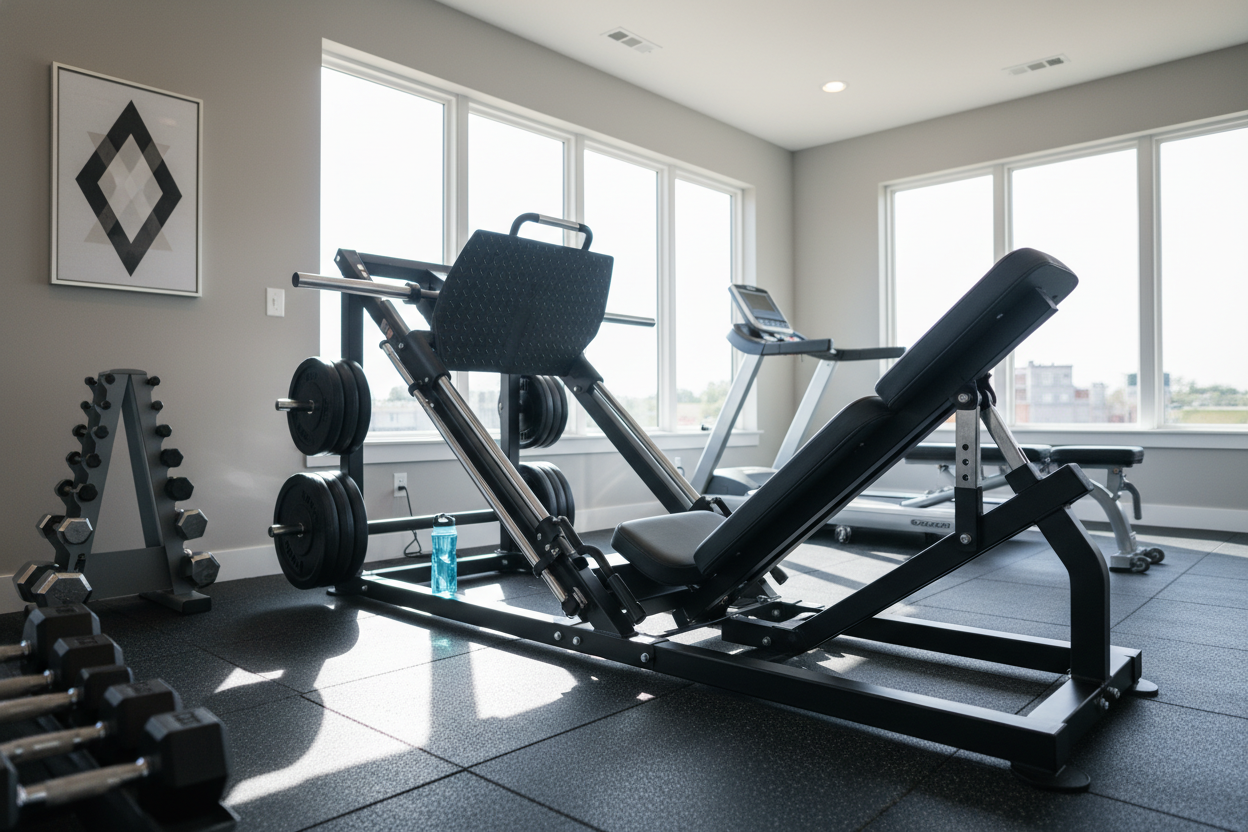
I remember the morning I decided my relationship with the heavy barbell squat was officially 'complicated.' My knees felt like they were filled with crushed glass, and my lower back was throbbing before I even finished my warm-up sets. I love the squat, but my ego was writing checks my joints couldn't cash anymore.
That’s when I stopped listening to the 'hardcore' purists and bought a 45 degree leg press machine. It wasn't about being lazy; it was about survival. If you want to move massive weight without feeling like you've been in a car wreck the next day, the 45-degree sled is the gold standard for a reason.
Quick Takeaways
- Spares your spine by removing axial loading.
- Provides a stable, fixed path that allows for 100% focus on quad recruitment.
- Requires a massive footprint—usually 8 feet of length at minimum.
- The 45-degree angle offers the best balance of mechanical advantage and resistance.
Why the 45-Degree Angle Is the Undisputed King of the Gym Floor
Physics doesn't care about your feelings, and the physics of a 45 degree leg press are beautiful. In a vertical press, you're fighting 100% of gravity, which sounds cool until the safety catch fails. In a horizontal press, the resistance curve is often inconsistent because you're relying on cables or short-travel cams. The 45-degree incline is the 'Goldilocks' zone.
At 45 degrees, you're moving roughly 70% of the actual weight on the sled due to the incline. This allows you to stack more plates, which isn't just for Instagram—it provides a consistent, heavy tension throughout the entire range of motion. Because the sled is on a fixed track, usually with high-end linear bearings, you don't have to waste energy stabilizing the load. You just drive. It’s the most efficient way to achieve mechanical tension in the quads without your balance being the limiting factor.
Squats vs. Sleds: Why Your Lower Back Wants You to Switch
The biggest lie in fitness is that you 'must' squat with a barbell to get big legs. If you have a herniated disc or even just general 'old man back,' the axial loading of a barbell is a ticking time bomb. Every pound you put on that bar is compressing your vertebrae. On a leg press 45, that weight is supported by the machine’s frame, and your back is pinned against a padded seat.
By using leg press and hip thrust machines, you effectively take the lumbar spine out of the equation. You can reach absolute muscular failure—the kind where your legs are shaking like a leaf—without worrying about your form collapsing and snapping your back. For those of us over 30, that's a massive win for longevity.
The Brutal Math of Putting a Commercial Sled in Your Garage
Before you pull the trigger on a 45 degree leg press, get your measuring tape out. These things are absolute beasts. A standard commercial-grade sled is going to be about 80 to 100 inches long. But it’s not just the frame; you need 'plate clearance.' If the machine is 60 inches wide, you need another 18 inches on each side just to slide the 45-lb plates onto the horns.
If you have the room, I always recommend a heavy-duty 3-in-1 combo unit. If you’re going to give up 30 square feet of floor space, you might as well get a machine that handles hack squats and calf raises too. I’ve seen guys buy a cheap, narrow press 45 only to realize they can't even fit their wide-stance squat on the footplate. Don't be that guy. Check the footplate dimensions before you buy.
What to Do If You Just Don't Have the Floor Space
If your garage is already packed with a rack and a car, a full-sized leg press 45o might be a pipe dream. I’ve been there—trying to park a truck around a piece of steel that doesn't move. In those cases, you have to look at vertical options or steeper inclines. A compact 30-degree leg press combo can save you about 2 feet of depth while still giving you that 'pushed into the seat' feeling that a horizontal machine lacks.
The trade-off is usually the weight capacity. Compact machines often use smaller carriage wheels instead of industrial linear bearings. They work for hypertrophy, but they won't feel as 'glass-smooth' as the massive sleds you find at a powerhouse gym. If you're a 600-lb presser, the compact units might feel a bit chintzy.
Can You Hack It With a Barbell Instead?
I see people on social media trying to do a reverse leg press on a Smith machine or laying on their back and pushing a barbell into the air. Please, stop. It’s a recipe for a disaster. If you already own a Smith machine, a leg press Smith machine setup with a dedicated floor plate is a safer 'hack,' but it still doesn't replicate the 45-degree angle.
The 45 leg press machine is a specific tool for a specific job. There are no shortcuts to that smooth, linear travel. If you can't afford the space or the cash for a real sled, stick to Bulgarian split squats. They suck, but they won't drop a barbell on your face.
My Honest Experience
I once bought a budget 45-degree press that used nylon wheels instead of bearings. I thought I was being smart and saving $500. Within three months, the wheels developed flat spots from being parked with weight on them. Every rep felt like I was pushing a shopping cart over gravel. I eventually sold it for a loss and bought a real linear bearing unit. If you're going to buy a 45-degree sled, buy the one that weighs more than you do. Mass matters here.
FAQ
Is the 45 degree leg press better than a horizontal one?
Yes. The angle allows for a deeper stretch at the bottom of the movement and provides a more natural strength curve. Plus, most horizontal machines are plate-loaded or cable-driven in a way that feels 'light' at the start and 'heavy' at the end.
How much does a 45 degree leg press sled weigh?
Most empty sleds weigh between 75 and 125 pounds. Always check your machine's manual before you start counting your 'total weight'—that starting weight counts!
Does a leg press 45 build the glutes?
It can, but it’s primarily a quad-builder. If you want more glute involvement, move your feet higher on the footplate. This increases hip flexion and brings the glutes and hams into the fight.
Share:
Stop Treating a Smith Barbell Like a Regular Olympic Bar
The 3 Rules I Follow When Buying Olympic Barbells and Plates