
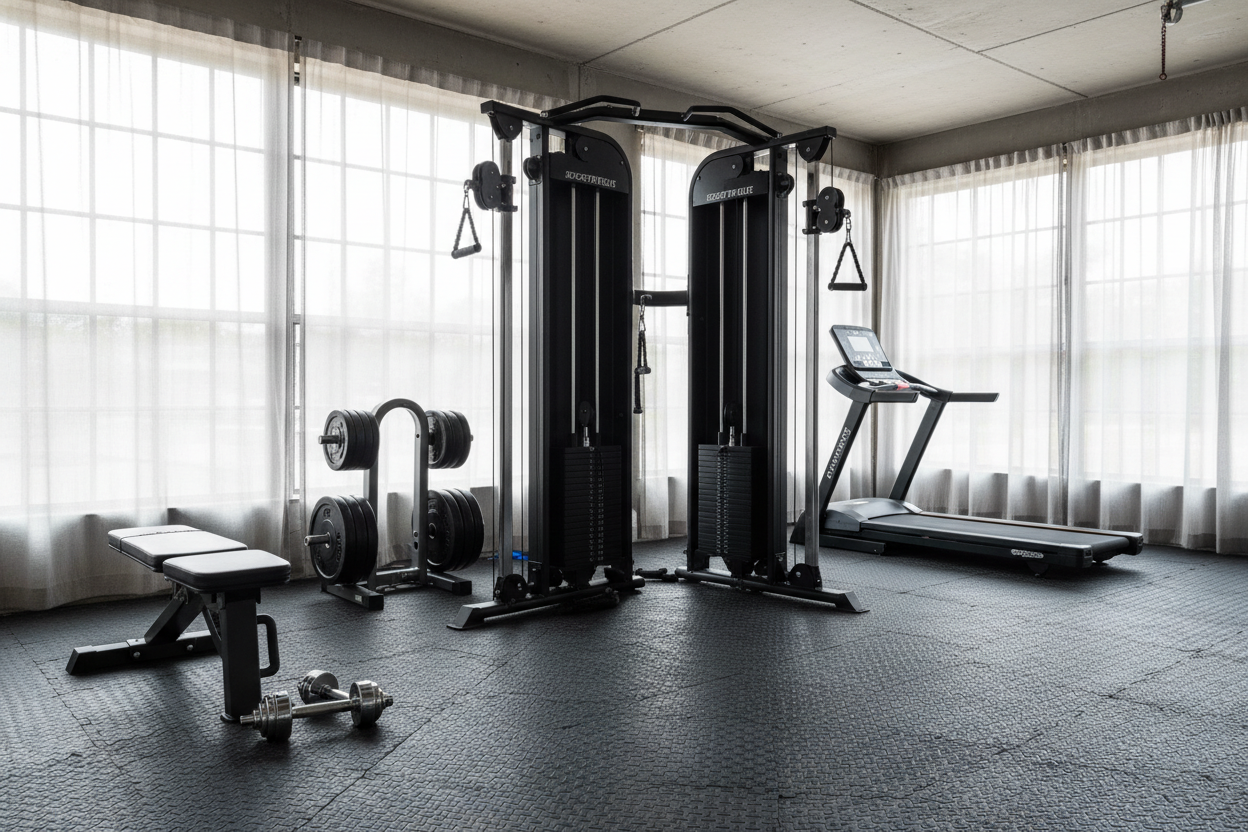
You just crushed a 225-lb bench press for reps and feel like a beast. Then you hop over to a seated chest press, slide the pin into the 200-lb gym machine weight plate, and suddenly you can barely move the handles. Or, conversely, the stack flies up like it is made of cardboard. It is a ego-bruising reality check that every lifter faces eventually.
The truth is that the numbers printed on those stickers are often little more than a suggestion. Between pulley ratios, cable friction, and the mass of the weight carriage itself, the math you use for a barbell does not apply here. If you are trying to compare your cable fly to your dumbbell fly, you are chasing ghosts.
Quick Takeaways
- Most cable machines use a 2:1 or 4:1 pulley ratio, meaning you only feel a fraction of the actual stack weight.
- The physical weight of the plate is rarely what you are actually lifting.
- Friction in the cables and pulleys can add or subtract up to 10% of the perceived resistance.
- Consistent tracking on the same machine matters more than the specific number on the plate.
Stop Doing Barbell Math on Selectorized Stacks
When you load up traditional cast iron weight plates on a bar, the math is simple. Gravity is a constant, and 45 pounds is 45 pounds. But the second you move to a selectorized stack, that logic dies. I have seen guys get genuinely frustrated because they can pull the whole stack on one row machine but struggle with half the stack on another brand.
Asking 'how much is each plate on a weight machine' is usually the wrong question. Even if each physical plate weighs exactly 10 pounds, the resistance at the handle is a different story. You are not just fighting gravity; you are fighting a mechanical system designed to make weight feel 'manageable' or 'smooth,' which often means 'lighter than advertised.'
The Sneaky Physics of Pulley Ratios
This is where the deception really happens. Most modern equipment uses pulley ratios to save space and provide a smoother range of motion. If a machine has a 2:1 ratio, it means for every two inches the cable moves, the weight stack only moves one inch. The trade-off? You only feel half the weight. A 200-lb stack with a 2:1 ratio effectively provides 100 lbs of resistance.
Take a look at a cable station with a 140lbs weight stack. If that unit is geared at 2:1, you are actually working against 70 lbs of resistance at the handle. If it is a 4:1 ratio—common in functional trainers—that 140-lb stack feels like a measly 35 lbs. Manufacturers do this so you can have a longer cable travel for movements like lunges or crossovers, but it makes the weight machine plate numbers look like a lie.
So, How Much Do Cable Machine Plates Weigh?
In most commercial gyms, the individual plates in a stack are usually 10, 15, or 20 pounds. You can usually tell by the thickness. A standard 10-lb plate is about an inch thick, while the heavy-duty 20-lb plates are chunky blocks of cast iron. However, the 'weight machine plate numbers' on the stickers often account for the pulley ratio already—but not always.
You also have to account for the weight of the top plate and the selector rod. That assembly usually weighs anywhere from 5 to 15 pounds on its own. This is why the first '10 lb' jump on a machine often feels significantly heavier than the jump from 10 to 20. You are finally engaging the full mass of the carriage and the friction of the entire cable run.
The Brand Variance: Why Every Setup Feels Different
Different brands have different philosophies on labeling. Some, like Life Fitness or Hammer Strength, try to label the 'effective' resistance. Others just label the raw weight of the iron. Then you have the synergy weight machines plate weight issue, where some older or specialized lines use arbitrary numbers like 1 through 20. In those cases, the numbers are just difficulty levels, not pounds or kilos.
I once tested two different lat pulldown machines side-by-side. One used a direct 1:1 pull with a single pulley, and the other used a complex 2:1 system with four pulleys. Even though both stacks were labeled up to 250 lbs, the 1:1 machine felt nearly twice as heavy. This is why you cannot take your 'max' from one gym and expect it to translate to the one down the street.
How to Actually Track Progressive Overload on Machines
If the numbers are lies, how do you track progress? Simple: stop caring about the absolute value and focus on the relative change. If you did 'Level 8' for 10 reps last week and 'Level 9' for 10 reps this week, you got stronger. It does not matter if Level 9 is 90 lbs, 45 lbs, or 112.4 lbs of actual tension.
It is the same logic as figuring out how much weight a Smith machine takes off. You are dealing with a fixed-path tool that uses counterweights or guide rods to alter the load. My advice? Log the specific machine brand and the number you used. If you switch gyms, spend one session recalibrating your numbers instead of trying to force your old logbook to make sense in a new environment.
Personal Experience: The YMCA Ego Check
I remember visiting an old-school YMCA that had a leg press machine with a stack that went up to 400. I was used to my commercial gym where I could easily max out the 400-lb stack. I pinned the bottom plate, confident as ever, and I could not budge it. It turned out my home gym used a 2:1 ratio with a massive carriage, while this old beast was a direct 1:1 pull with greased-lightning guide rods. I had to drop to 200 lbs and swallow my pride. It was a clear lesson: the cable is a middleman, and the middleman always takes a cut.
FAQ
How much weight is on a cable machine if there are no labels?
Assume it is a 2:1 ratio unless it feels incredibly heavy. Most functional trainers and dual-adjustable pulleys are 2:1. If the cable is very long and easy to pull, it might even be 4:1.
Why does the same weight feel heavier on different machines?
Friction and pulley count. Every time a cable goes around a pulley wheel, friction is added. More pulleys usually mean a smoother feel but a more 'deceptive' weight stack.
Do gym machine weight increments always go up by 10?
Usually, yes, but many machines have 'adder weights'—those small 2.5 or 5-lb weights you can slide onto the rod. Use them. Jumping 10 lbs on a 20-lb lateral raise is a 50% increase, which is way too much for most people.
Share:
5 Red Flags to Look For in Any Exercise Machine Home Gym
I Raided a Massive Exercise Outlet (Here's What I Scored)