
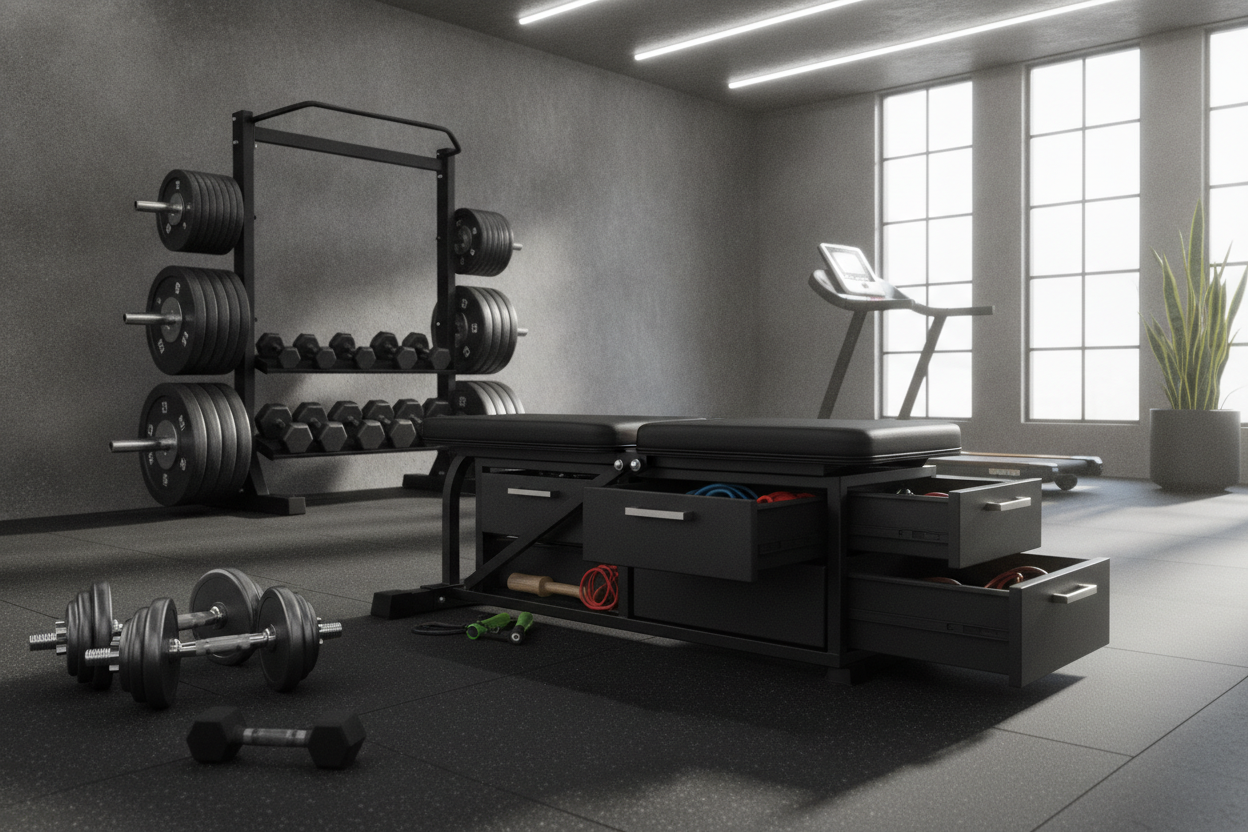
I spent three hours last night measuring my floor for the fifth time, trying to figure out how to fit a rack, a bench, and a set of dumbbells into a 10x10 spare room without losing my mind. It is the classic home gym struggle: the 'Tetris' phase of equipment shopping. That is when the weights bench with storage starts looking like a stroke of genius. You see the photos of neatly tucked dumbbells and think you have solved the floor space puzzle, but there is a massive catch most people miss until they are mid-set with a heavy bar over their throat.
- Space Efficiency: Combines two footprints into one, saving roughly 4-6 square feet.
- The Leg Drive Trap: Most under-bench racks physically block your feet from proper positioning.
- Stability Issues: Budget models often sacrifice frame thickness to make room for the storage tray.
- Better Alternatives: Vertical dumbbell trees paired with a standalone bench usually perform better.
The All-In-One Appeal (And The Immediate Problem)
The temptation is real. When you are cramming a gym into an apartment or a tight garage corner, every inch of rubber flooring is prime real estate. A standard weight bench usually requires a separate rack for your weights, which effectively doubles the footprint of your lifting station. An exercise bench with storage promises to kill two birds with one stone by utilizing the 'dead space' directly under the seat.
On paper, it is a win. You get your dumbbells off the floor and your bench in one tidy unit. But here is the reality: that 'dead space' is actually where your feet are supposed to go. Most manufacturers design these for people who sit perfectly upright and do bicep curls, not for anyone planning to actually press heavy weight. If the rack prevents you from planting your heels, you are not just losing power—you are losing stability.
Why Leg Drive Hates Built-In Dumbbell Racks
If you have ever watched a powerlifter, you know the bench press is a full-body movement. You need to tuck your feet back, drive your heels into the floor, and create tension through your glutes and quads. This 'leg drive' is what keeps your shoulders pinned and your spine protected. When you use a weights bench with storage, there is often a steel tray or a row of 25-lb dumbbells right where your heels need to be.
I have tested units where the storage rack extends so far forward that you are forced into a 'feet-forward' position. This turns the bench press into a core-stability nightmare. Without that solid anchor to the floor, your power output drops significantly. You end up shimmying on the pad because your base is compromised. It is a biomechanical trade-off that most lifters realize too late.
How to Spot a Flawed Exercise Bench With Storage
Before you drop cash on an exercise bench with storage, look at the clearance between the floor and the underside of the bench. If the storage tray is bolted directly to the center of the frame and sits lower than 10 inches from the ground, your feet will hit it. You want a design where the storage is shifted toward the head of the bench, leaving the area under your hips completely clear.
Watch out for the 'all-in-one' kits sold at big-box retailers. Often, a cheap adjustable bench with weights uses thin 14-gauge steel to keep costs down, then adds a flimsy rack to the bottom to make it look like a 'pro' setup. These frames flex under load. If you are 200 lbs and pressing 50-lb dumbbells, you do not want a frame that rattles because it was hollowed out to fit a storage tray.
Space-Saving Setups That Actually Let You Lift Heavy
If you are truly tight on space, there are better ways to manage your gear. I usually recommend a heavy-duty adjustable weight bench that stands on its own. These are built with thicker steel and have a tripod or narrow-front design that stays out of your way. For the dumbbells, look at a vertical A-frame tree. It takes up about 1.5 square feet and keeps your weights accessible without ruining your lifting mechanics.
Another option is a bench that folds and stands upright when not in use. This clears the entire floor for other movements like deadlifts or jump rope. It is a much more versatile solution than a bulky storage bench that is heavy to move and awkward to use. You want equipment that adapts to your training, not equipment that forces you to change your form to accommodate its design flaws.
The Final Verdict: Clever Hack or Gym Gimmick?
If you are doing light accessory work—think seated overhead presses or lateral raises—a storage bench is fine. It keeps the room tidy and the weights are right there. But if you plan on getting strong, it is a gimmick. You will eventually outgrow the limited weight capacity and get frustrated by the lack of foot room. Invest in a bench combo you won't outgrow by prioritizing the bench quality first and the storage second.
Personal Experience: My First Garage Setup
I bought a combo unit three years ago because I thought I was being 'efficient.' The first time I tried to hit a heavy set of five, I kicked a 30-lb dumbbell mid-rep. It threw off my balance, and I nearly dumped the bar. I ended up removing the storage tray entirely and bolting it to the wall, which defeated the whole purpose. Don't make the same mistake—prioritize your foot placement over your floor space.
FAQ
Can I remove the storage rack if I don't like it?
Usually, yes. Most are bolted on. However, some budget models use the rack as a structural cross-member. If you remove it and the bench feels 'wobbly,' put it back on immediately and find a better bench.
What is the maximum weight capacity for these benches?
Most exercise benches with storage are rated for 300 to 500 lbs. Remember, that includes your body weight plus the dumbbells you are holding. If you weigh 200 lbs, you only have 100-300 lbs of 'lifting' capacity left.
Are there any storage benches that actually work for leg drive?
Look for 'high-clearance' models or benches where the rack is located only under the head-end of the bench. If the area under the seat is open to the floor, you are good to go.
Share:
Can a Sport Essentials Adjustable Workout Bench Handle 300 Lbs?
Why Good Weight Benches Actually Cost More Than Your Barbell