
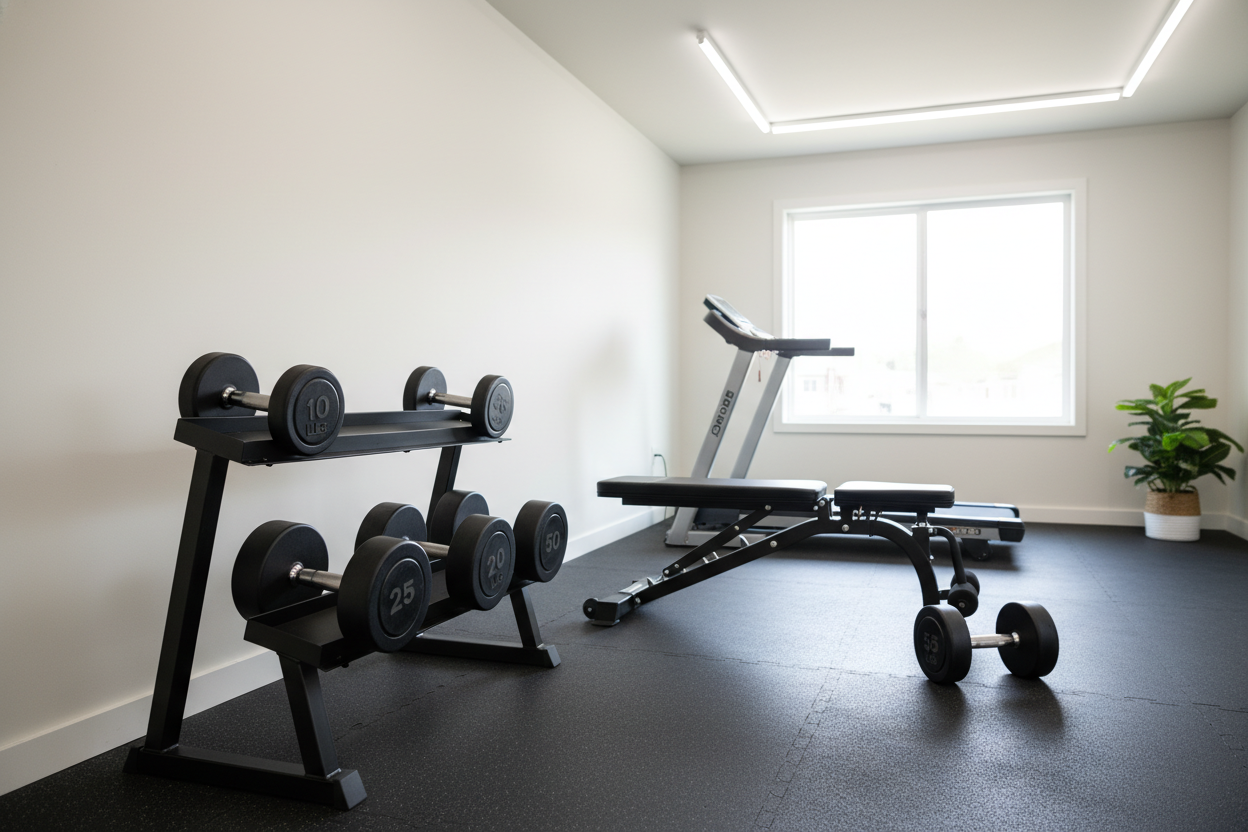
I remember staring at a 5-to-100lb dumbbell rack at my local commercial gym and thinking, 'I need that in my garage.' Then I checked the price tag and the shipping costs. It turns out, when you buy home weights, you aren't just paying for the iron; you're paying for the floor space and the massive logistics of moving a literal ton of metal into your driveway.
The truth is, most home lifters are buying for an idealized version of themselves that doesn't exist yet. You don't need a wall of chrome and rubber to get strong. You need a strategy that prioritizes utility over aesthetics.
Quick Takeaways
- Skip the full 5-50lb rack; it's a waste of 30 square feet and roughly $1,000.
- Focus on three specific weight tiers: Light, Medium, and Heavy.
- Prioritize rubber hex dumbbells for durability and floor protection.
- An adjustable bench is non-negotiable for a complete home setup.
The Commercial Gym Trap (And Why It Costs You)
We’ve all been there—scrolling through marketplace listings or equipment sites, convinced that we need a complete 5-50lb set in 5lb increments. It feels professional. It looks like a 'real' gym. But the reality of buying weights for home is that you will rarely use the 5s, 10s, 25s, or 45s.
In a commercial setting, those increments exist to accommodate hundreds of people with different strength levels. In your garage, you only need to accommodate you. Buying 10 pairs of dumbbells means you're paying for eight pairs that will likely sit in a rack and collect dust. It’s much smarter to pick a weight set for home that targets your specific working ranges rather than trying to mimic the local Gold's Gym.
The 'Big Three' Strategy for Your Iron
If you want to build a high-performance at-home free weight set without breaking the bank, you only need three specific increments. I call this the 'Big Three' strategy. It covers about 95% of the movements you actually need to do.
First, grab a Light Pair (typically 12.5lb or 15lb). These are for your isolation work: lateral raises, rear delt flies, and high-rep curls. Second, get a Medium Pair (25lb to 35lb). These are your workhorses for overhead presses, lunges, and rows. Finally, invest in a Heavy Pair (45lb to 55lb). These are for your primary movers like goblet squats and chest presses.
By jumping 15-20lbs between pairs, you force yourself to adapt. If the 35s feel light for rows, you move to the 50s and fight for fewer reps. That’s how you actually get strong, rather than coasting on a 2.5lb increase every six months.
Stop Pressing on the Floor (Get a Real Bench)
A home workout weight set is only as good as the foundation you use it on. I see guys spending $800 on dumbbells and then trying to do chest presses off a literal rug on the floor. You’re cutting your range of motion in half and leaving gains on the table.
You need an adjustable weight bench to unlock incline and decline work. Without that angle change, your chest training will plateau within three months. If you’re tight on space, at least look for a sturdy weight bench with a high weight capacity—aim for something rated for at least 600 lbs total (user plus weights). A cheap bench that wobbles when you’re holding 50lb dumbbells is a recipe for a shoulder injury.
What About Those Expensive Dial-a-Weight Systems?
When looking at in home weights, the 'dial-a-weight' or selectorized systems are tempting. They save massive amounts of space, usually packing 5lb to 52.5lb into the footprint of two dumbbells. If you live in a 700-square-foot apartment, they’re a necessity.
However, if you have a garage, I still prefer fixed rubber hex dumbbells. Adjustable systems have plastic internal components that can crack if you drop them. And let’s be honest: when you’re hitting a PR, you’re going to drop them. Fixed weights are bulletproof, have no moving parts to rattle, and feel much more balanced during explosive movements like snatches or cleans.
When You Finally Outgrow Your Starter Iron
Eventually, those 50lb men's free weights are going to feel like toys for your chest press. When that happens, you have two choices: buy 70lb dumbbells that are awkward to kick up into position, or pivot your equipment strategy. For many lifters, adding more heavy iron isn't the most efficient use of space.
I’ve found that once you hit a certain strength threshold, a dedicated chest press machine is actually safer and more effective for hypertrophy. It allows you to push to failure without worrying about a dumbbell crushing your face. In fact, after years of strictly using iron, I eventually traded free weights for a full-body machine for my heaviest sets. It saved my joints and allowed for a level of intensity I couldn't get with just three pairs of dumbbells.
Personal Experience: My $400 Mistake
When I first started my home gym, I bought a 'complete' set of cheap, 1-inch diameter standard plates and handles. I thought I was being frugal. Within a month, the threaded collars kept coming loose mid-set, and the clanking noise drove my neighbors insane. I ended up selling them for half what I paid and buying three pairs of quality rubber hex dumbbells. Learn from me: buy the right iron once, or you'll buy it twice.
FAQ
What are the best weights to buy for home workout beginners?
Start with a pair of 15s and a pair of 30s. This allows you to perform basic movements like goblet squats and overhead presses while having a lighter option for arm work and lateral raises.
Should I buy iron or rubber-coated dumbbells?
Always go rubber-coated (hex style) if you can. They won't rust, they're quieter on your floor, and they won't roll away when you set them down between sets.
How much space do I need for a dumbbell setup?
You can get a world-class workout in a 6x6 foot area. As long as you have enough room to lie on a bench and move your arms out to the side, you have enough space.
Share:
Is the TAG Smith Machine Bar Weight Actually 45 Pounds?
Lower Back Pain on RDLs? Try This Smith Machine Hamstring Fix