
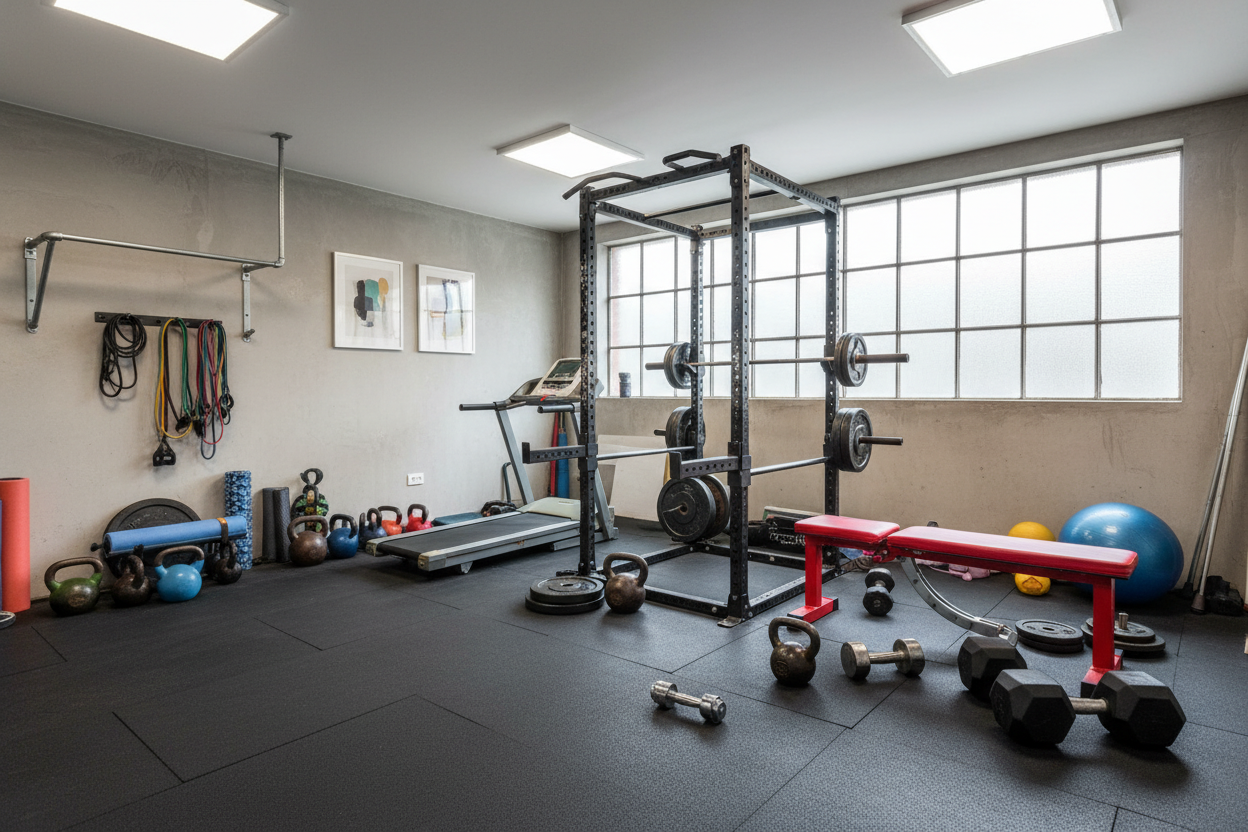
I remember staring at my first garage setup with a mix of pride and pure frustration. I had a rusted bench from a yard sale, a set of plastic-coated plates that leaked sand, and a barbell with knurling so dull it felt like a wet pool noodle. I thought I was being savvy by hunting for deals, but I spent more time wrestling with exercise home gym equipment that didn't fit together than I did actually getting under the bar.
Quick Takeaways
- Standardize your rack dimensions (3x3 or 2x3) early to ensure attachments actually fit.
- A cohesive ecosystem allows for faster supersets and better floor space utilization.
- Prioritize 11-gauge steel and fixed-dimension gear over cheap, adjustable 'Amazon specials.'
- Sell off the redundant clutter to fund one high-quality foundational piece.
The Frankenstein Trap: When 'On Sale' Costs You Gains
We've all done it. You see a 'stuff for home gym' clearance sale and pull the trigger on a cable crossover without measuring your ceiling height. Or you grab a cheap rack that uses 2x2 uprights, only to realize later that every cool attachment on the market is built for 3x3 frames. This is the Frankenstein Trap. You end up with a room full of gym equipment for home workouts that technically functions but feels like a cluttered obstacle course.
When your gear doesn't flow, your motivation dies. If you have to move three pairs of dumbbells and a folding bench just to setup for a deadlift, you're going to skip the deadlift. A mismatched gym isn't just an eyesore; it's a friction point that makes training harder than it needs to be. You need a unified plan, not a collection of impulse buys.
Why 'Equipment Ecosystems' Matter More Than Individual Pieces
Think of your gym as a single machine rather than a pile of parts. A heavy-duty home gym relies on synergy. Your rack, bench, and barbell need to speak the same language. For example, if you buy a rack with Westside hole spacing (1-inch gaps through the bench zone), but your bench is too tall to let you hit those holes correctly, you've wasted the feature.
Standardizing your ecosystem means sticking to a specific upright size and hole diameter. Most high-end brands use 3x3 inch steel with 5/8-inch or 1-inch holes. Once you commit to one, every J-cup, spotter arm, and dip station you buy for the next decade will fit perfectly. No more 'close enough' setups that wobble under a 300-lb load.
The Core Four: Starting With the Foundation
Before you buy a single accessory, you need to lock in the bare minimum equipment for a home gym that actually performs. This foundation consists of a power rack, an Olympic barbell, iron or bumper plates, and an adjustable bench. Everything else is just seasoning on the steak.
I always tell people to over-spec the rack. You can get away with a cheaper bench for a while, but a flimsy rack is a safety hazard and a dead end for upgrades. Look for 11-gauge steel. It’s the industry standard for a reason—it doesn't flex when you rack a heavy squat, and it won't tip over if you perform pull-ups. Once you have this foundation, you can stop looking at random at home equipment and start looking at specific tools that fill a gap in your programming.
Stop Buying Plug-In Machines First
The biggest mistake I see beginners make is dropping $2,000 on a motorized treadmill or a fancy screen-based bike before they even own a set of dumbbells. Motorized gear has a shelf life. Sensors fail, screens become obsolete, and they take up a massive footprint for a single-use movement. The best equipment for home gym gains usually doesn't require an outlet.
Mechanical, non-motorized gear gives you a much better ROI. A set of adjustable dumbbells or a solid kettlebell collection provides infinitely more training variety than a treadmill that eventually becomes an expensive clothes rack. If you want cardio, go for a rucking pack or a simple jump rope until your strength foundation is bulletproof.
Upgrading Smart: When to Add a Specialized Machine
Once you've spent a year or two with the basics, you'll know where your weaknesses are. This is the time to look at specialized fitness equipment for home workout goals. If you're chasing hypertrophy but find that your joints are taking a beating from constant free-weight movements, a Smith machine home gym station can be a brilliant addition. It offers a fixed path that allows you to push to failure safely without a spotter.
The key is to ensure the new piece doesn't just duplicate what you can already do with a barbell. If you have a rack and a landmine attachment, you probably don't need a dedicated T-bar row machine. Buy pieces that unlock new movements, not just different versions of the ones you're already doing.
How to Audit Your Current Setup (And What to Sell)
Be ruthless. Go into your gym today and look for anything you haven't touched in three months. That weird ab-roller from 2018? The 'as seen on TV' resistance bands? Get rid of them. Selling three or four pieces of junk on Facebook Marketplace can often fund one high-quality piece of gear that actually improves your training.
My personal rule: if it doesn't fit the 'ecosystem'—meaning it doesn't attach to my rack or use my existing plates—it has to justify its floor space every single day. If it doesn't, it's gone. A clean, cohesive space with three high-quality tools is always better than a crowded room full of mediocre stuff.
Personal Experience: The 2x2 Mistake
I once bought a 2x2 rack because it was $200 cheaper than the 3x3 model I actually wanted. I figured I'd save the cash for more plates. Two months later, I wanted to add a plate storage attachment. Every single one I found was designed for 3x3 or 2x3 uprights. I ended up having to drill my own holes in the frame, which compromised the structural integrity and looked like garbage. I eventually sold it for half what I paid and bought the 3x3 rack anyway. I lost $300 and a lot of time just to learn that 'cheap' usually means 'limited.'
FAQ
Is 11-gauge steel really necessary for a home gym?
If you're lifting heavy or want a rack that doesn't move when you do dips, yes. 14-gauge is fine for light weights, but 11-gauge is the 'buy once, cry once' choice that lasts a lifetime.
How do I know if an attachment will fit my rack?
You need three specs: the upright size (e.g., 3x3 inches), the hole diameter (e.g., 5/8-inch or 1-inch), and the total width of the rack. If those don't match, don't buy it.
What is the best flooring for a garage gym?
Skip the 'fitness' foam tiles. They compress and slip. Go to a farm supply store and buy 3/4-inch rubber horse stall mats. They are indestructible, heavy, and provide the best surface for lifting.
Share:
I Stripped 4 Bolts: Why Your Smith Machine and Tool Setup Matters
Stop Guessing Your Planet Fitness Smith Machine Barbell Weight