
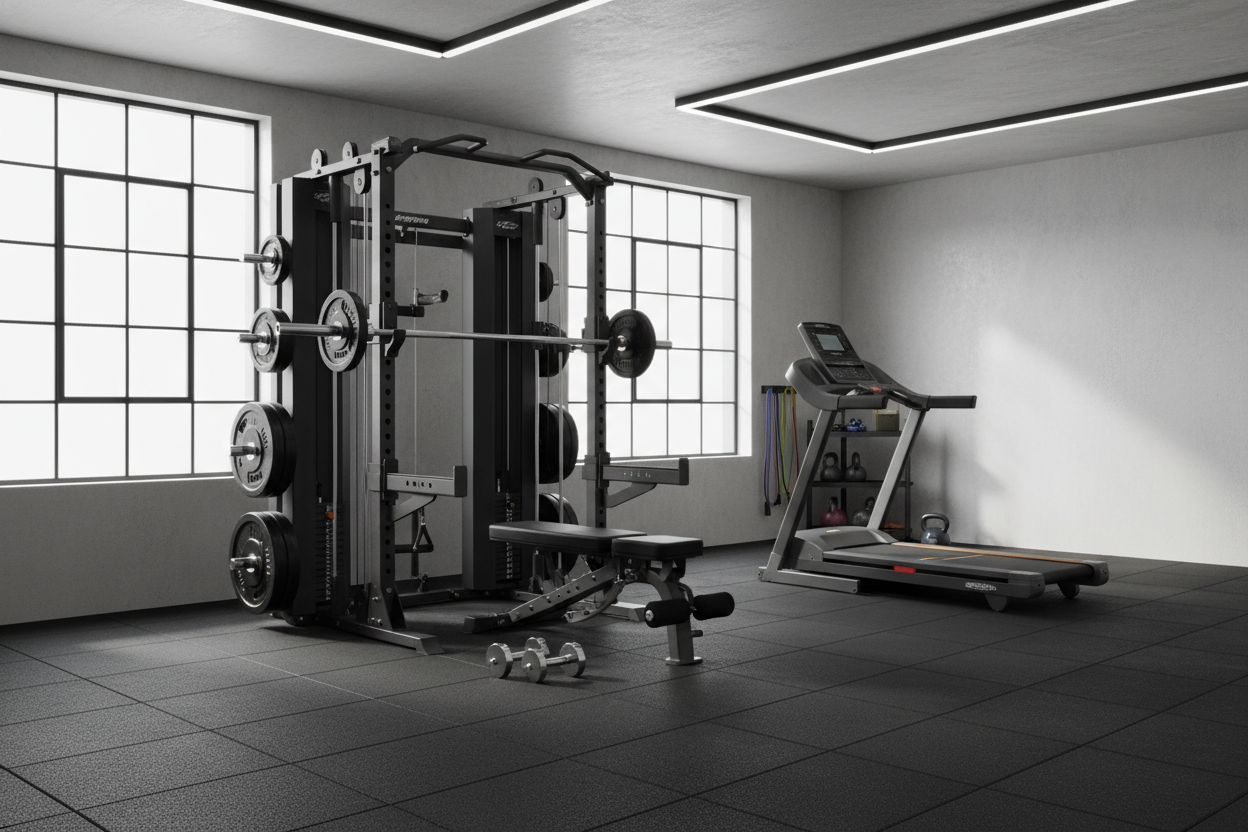
I spent a decade telling anyone who would listen that if you weren't training in a 3x3 steel power rack bolted to the concrete, you weren't really lifting. But then life happened. My garage became a graveyard of half-finished DIY projects, and my massive rack started to feel like a space-hogging relic. Finding the best home multi gym isn't about giving up on your strength goals; it's about realizing that a single, well-engineered footprint can often do more than a room full of scattered iron.
Quick Takeaways
- Footprint: Look for units that fit within a 6x7 foot area to keep your floor usable.
- Steel Quality: 11 or 12-gauge steel is the standard for zero-wobble sets.
- Pulley Ratio: A 2:1 ratio is king for smooth, long-travel cable movements.
- Safety: Integrated Smith machines are a lifesaver for heavy solo sessions.
My Problem With Most All-in-One Machines
Most of the stuff you see in big-box retail stores is, quite frankly, garbage. I’ve tested machines where the frame flexes during a basic chest press. That’s a dealbreaker. If the steel is thin and the bolts are flimsy, you’ll never feel confident loading it heavy. You end up holding back on your intensity because you're afraid the machine might tip or snap.
The trap of buying from a high street shop is that those machines are built for the casual user who might lift once a month. For us, the cable starts fraying and the plastic pulleys start screaming within weeks. I want equipment that feels like it belongs in a commercial facility, not a toy store.
The Specs You Actually Need in the Best Multi Gym for Home
When you are hunting for the best multi gym for home use, you have to look past the shiny paint. Check the weight capacity first. If a machine caps out at 150 lbs, you’re going to outgrow it on lat pulldowns in six months. I look for units that can handle at least 300 lbs on the cables and even more on the integrated bars.
Switching to serious home gym equipment means paying attention to the guide rods. They should be solid steel, polished to a mirror finish. If they’re hollow or textured, your weights will stutter on the way down. I also check the footprint—most of us are working with a single-car garage or a spare bedroom. You want a machine that maximizes vertical space rather than eating up the whole floor.
Why Pulley Smoothness Makes or Breaks the Rig
Nothing kills a pump faster than a jerky cable. Cheap plastic pulleys develop flat spots over time, making every rep feel like you're dragging a sled through gravel. I always look for aluminum pulleys with sealed bearings. They provide a frictionless glide that rivals the smoothness of a high-end smith machine home gym station.
Good cables should be aircraft-grade and coated to prevent snapping. When you’re doing high-rep face pulls or heavy cable rows, that internal tension needs to be consistent. If the cable has too much 'stretch,' you lose the mind-muscle connection at the peak of the contraction.
Putting the Full Body Multi Training Station DM01 to the Test
I recently spent some quality time with the Full Body Multi Training Station DM01 to see if it could actually handle a real powerlifting-style workout. I loaded 350 lbs onto the Smith bar for some close-grip benching. To my surprise, the frame didn't groan or shift an inch. The linear bearings on the Smith bar are surprisingly quiet, which is a huge plus if you’re training while the rest of the house is asleep.
The cable crossover system is the real star here. Most all-in-ones have cables that are too close together, making chest flies feel awkward. The DM01 has enough width to get a full stretch. One honest downside? Assembly is a beast. It took me nearly five hours with a socket wrench. Don't try to rush it, or you'll end up with a leftover bolt that haunts your dreams. But once it's bolted together, it's a tank.
The Final Verdict: Should You Ditch Your Free Weights?
You don't have to choose between a rack and a multi-gym if you pick the right machine. A high-end all-in-one gives you the safety of a Smith machine and the versatility of a functional trainer in one spot. If you’re a competitive powerlifter, you’ll still want a dedicated squat rack. But for the guy or girl looking to stay jacked without turning their garage into a cluttered mess, this is the way to go.
FAQ
How much space do I really need?
You want at least 7 feet of ceiling height and a 7x8 foot floor area to account for the bar width and your own movement around the machine.
Are plate-loaded machines better than weight stacks?
Plate-loaded machines are usually cheaper and allow you to use the plates you already own. Weight stacks are faster for drop sets but much more expensive to ship.
Can I do heavy squats on a multi-gym?
Yes, if it has a built-in Smith machine or a front-mounted rack. The DM01 handles heavy squats easily, providing safety catches that are essential for solo lifting.
Share:
Should You Actually Buy Home Gym Machine Setups This Year?
Stop Doing Standard Reps: 4 Different Squats on Smith Machine