
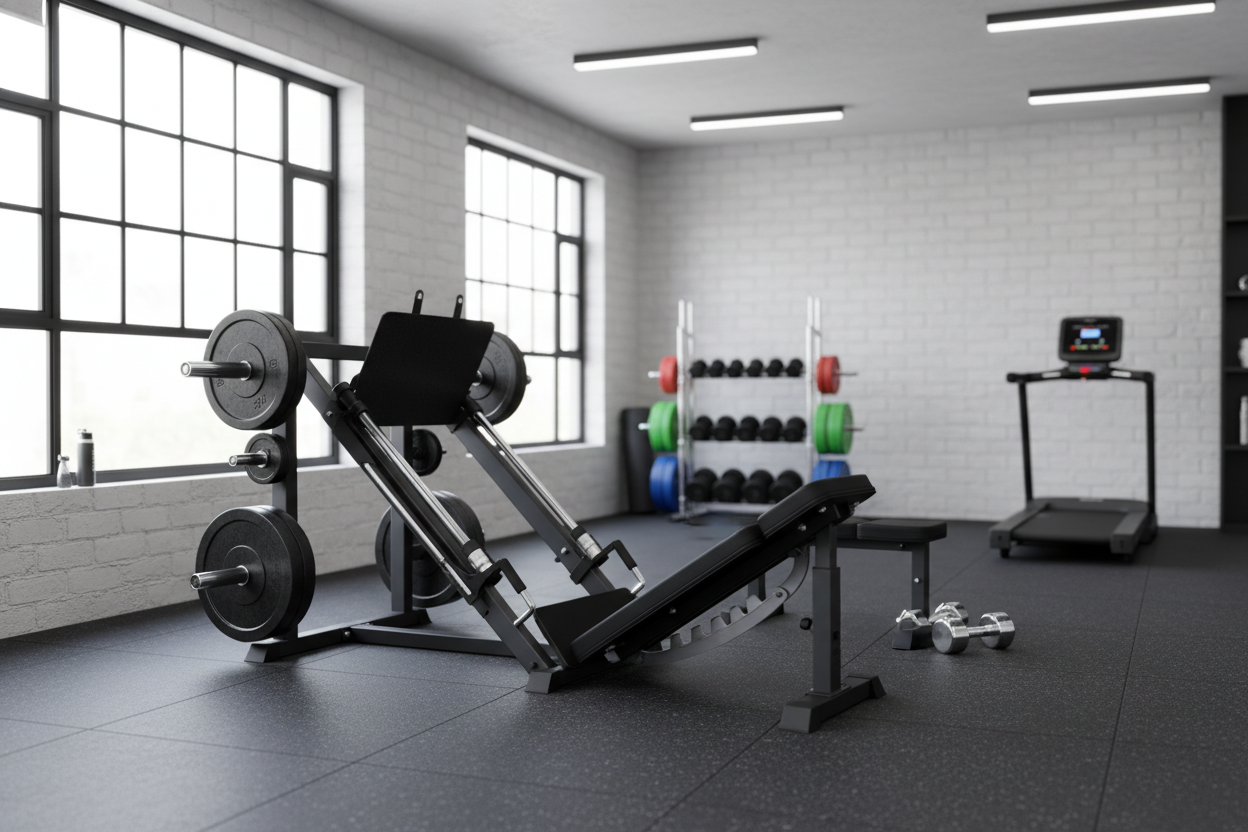
I remember standing in a big-box sporting goods store, staring at a 210-lb weight stack that looked like it belonged in a NASA facility. I thought I’d finally found the holy grail: a single machine that could replace my squat rack and my leg day dread. But after three reps on that home gym equipment with leg press, I realized the truth. My knees were screaming, the weight felt like nothing, and the seat wobbled like a loose tooth.
Quick Takeaways
- Most integrated leg presses use a 2:1 pulley ratio, meaning your 200-lb stack only provides 100 lbs of actual resistance.
- Fixed footplates often force your ankles into unnatural angles, limiting your range of motion.
- Commercial-grade units require linear bearings; if it’s just plastic rollers on steel, it will eventually drag.
- A Smith machine or a dedicated sled usually offers better muscle activation than a bolt-on attachment.
The 'All-In-One' Illusion (And Why It Fails Your Quads)
The marketing for a home gym system with leg press usually shows a professional athlete getting a deep, satisfying burn. In reality, most of these machines are designed to fit in a 4x4 corner, which is the first red flag. To make a leg press work, you need a long travel path. When a manufacturer tries to cram a chest press, a lat pulldown, and a leg press into one footprint, the leg station is always the first thing to get compromised.
You end up with a pivot point that doesn't align with your hips. Instead of a true press, you're doing a weird, horizontal leg extension that puts massive shear force on your patellar tendon. If the machine doesn't let you adjust the seat angle and the footplate independently, you aren't training your quads—you're just testing your joint durability. A real system needs dedicated engineering for the lower body sled, not just a cable hooked to a flip-down plate.
Cable Ratios: Are You Really Pushing 300 Pounds?
Here is the math they don't put on the sales page. Most home weight machine with leg press setups use a series of pulleys to redirect the weight stack. Every time that cable loops around a wheel, you’re likely losing mechanical advantage. I’ve tested machines labeled with 300-lb stacks that felt like I was pushing a grocery cart. This is because of the 2:1 or even 3:1 pulley ratios common in residential gear.
If you're an experienced lifter, you’ll max out the machine in a month. Even worse is the 'slop' in the line. Cheap pulley systems have a dead zone at the start of the movement where there is zero tension. It’s one of the main reasons why your weight machine leg press feels terrible at home compared to the plate-loaded monsters at the local powerhouse gym. You want a 1:1 ratio, or at least a high-quality bearing system that doesn't eat 40% of the resistance through friction.
Footplate Angle vs. Range of Motion
Range of motion is the king of hypertrophy. If you can't get deep, you aren't growing. Most compact machines use a small, fixed-angle footplate. If you have any lack of ankle mobility, your heels will lift off the plate the second you try to go deep. This shifts the load entirely onto your toes and knees, which is a fast track to an ACL appointment.
I look for footplates that are at least 20 inches wide with an adjustable tilt. You need to be able to shift your foot position to target different parts of the leg—high for hamstrings, low for quads. If the machine forces you into one 'correct' position, it’s not designed for your body; it’s designed for the manufacturer’s shipping budget.
When a Smith Machine Setup Makes More Sense
If you are tight on space but want heavy leg days, I often tell people to skip the seated multi-gym and look at a Smith machine home gym station instead. Why? Because a Smith machine allows you to perform vertical presses, lunges, and squats with a safety catch. You get the stability of a guided track without the biomechanical mess of a poorly designed seated lever arm.
A Smith machine also scales better. You can add Olympic plates as you get stronger, whereas a weight stack machine has a hard ceiling. I’ve found that I can get a much better quad pump doing 'feet-forward' Smith squats than I ever could on a $1,500 all-in-one unit with a cramped leg attachment. It’s about versatility. The Smith machine handles your chest, shoulders, and legs without needing five different cable attachments that you'll eventually lose under the couch.
Specs That Prove a Machine Is Actually Worth Buying
If you have your heart set on an integrated unit, don't buy based on the photos. Look at the spec sheet. You want 11-gauge steel—anything thinner will flex when you start moving heavy loads. Look for linear bearings on the sled. These are the same high-end ball bearings used in industrial machinery; they provide that 'glass-smooth' feel that doesn't hitch or stutter mid-rep.
Check the weight of the actual unit. If the whole home gym weighs less than you do, it’s going to slide across the floor when you kick off. You want a unit with a heavy base and adjustable back pads. Being able to change the seat depth is the only way to ensure your lower back stays glued to the pad instead of rounding under load. Plan your home gym layout carefully; a good leg press needs at least 7 feet of clearance to account for the seat and the leg extension arc.
The Only Multi-Station Rigs I Actually Recommend
I’ve spent years breaking equipment so you don’t have to. Most of the stuff you find at a local department store is a 'toy'—it’s fine for a few months, but the cables will fray and the pulleys will squeak. When you move into the semi-commercial tier, the quality jump is massive. You start seeing chrome-plated guide rods and aircraft-grade cables that don't stretch under 400 lbs of pressure.
After testing dozens of configurations, I finally found an all-in-one home gym with leg press worth the space and the four-figure investment. It’s about finding that balance where the leg station feels like a primary feature, not a marketing afterthought. Don't settle for a machine that makes you hate leg day.
Personal Experience: My 300-lb Mistake
Early in my lifting career, I bought a budget multi-gym because it had a 'leg press' station. The first time I tried to go heavy, the nylon pulley wheel literally melted from the friction of the cable. The sled got stuck halfway up, and I had to wiggle out from under it like a trapped crab. It taught me that when it comes to leg presses, you either buy quality or you buy twice. I now refuse to use anything that doesn't have a solid steel frame and reinforced pivot points.
FAQ
Is a seated leg press as good as a squat?
It’s different. A squat builds more overall stability and core strength, but a leg press allows you to isolate the quads and go to absolute failure without worrying about your balance or your lower back giving out.
How much weight stack do I need for a leg press?
If the machine has a 2:1 ratio, you want at least a 200-lb stack. For a 1:1 ratio, 150 lbs is a solid starting point for most people, but advanced lifters will want 300 lbs or more.
Can I add a leg press to my existing power rack?
Yes, many companies now make 'leg press plates' that attach to your rack's safety bars. It's a great space-saving hack, though it takes a few minutes to set up and tear down each time.
Share:
Let's Settle This: Does Smith Machine Bench Count as a PR?
How I Fit a Real Functional Trainer for Home Gym in a 1-Car Garage