
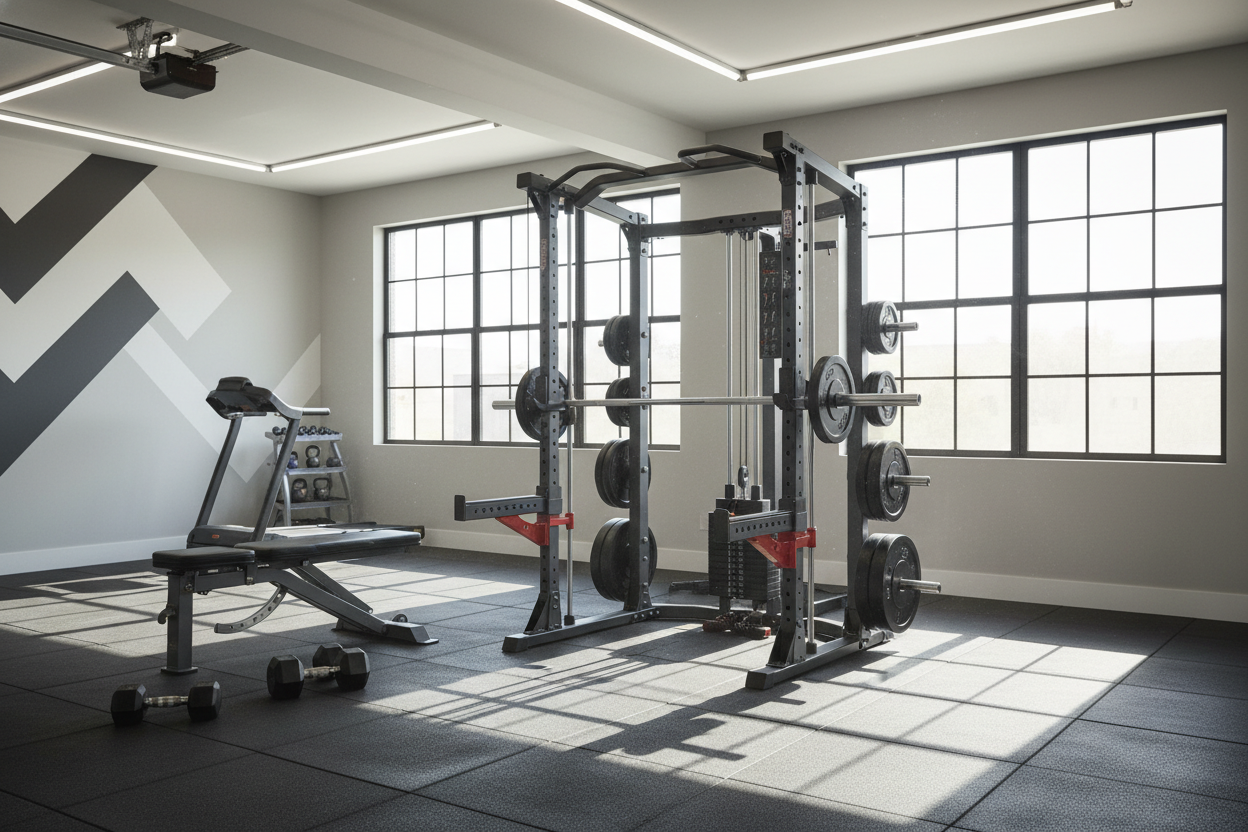
I remember staring at my garage floor six months ago, feeling more like a warehouse manager than a lifter. I had a budget squat rack that wobbled if I breathed on it too hard, a standalone lat tower taking up a 4x4 footprint, and a pile of plates that made it impossible to actually park a car. I was spending twenty minutes of every hour just moving gear around to make room for my next set. That is when I finally stopped buying cheap 'add-ons' and invested in a real powerhouse gym machine.
Quick Takeaways
- One heavy-duty rig can reclaim up to 40% of your floor space by consolidating cables and racks.
- Look for 11-gauge steel and linear bearings; if it uses plastic bushings, it is not commercial grade.
- Safety is the biggest win for solo garage lifters—integrated catches save lives.
- The math actually works: one high-end machine is often cheaper than three mid-tier specialized units.
The Problem With 'Budget' Multi-Station Rigs
Most home multi-gyms you see on Amazon are, quite frankly, junk. They look great in the photos, but once you get 200 pounds on the cable, the frame starts to groan and the pulleys feel like they are filled with sand. I have been down that road. I once traded free weights for a full body workout machine I found on clearance, and it was the biggest mistake of my training life. The cables were thin, the weight stack was uneven, and the whole thing rattled so loud my neighbors complained.
Budget rigs use thin 14-gauge steel that flexes under load. This is not just annoying; it is dangerous. When you are pushing for a PR, you need a frame that feels like it is bolted into the Earth's core. A real powerhouse workout machine does not move. It does not rattle. It just performs, allowing you to focus on the contraction rather than whether or not the uprights are going to fold.
What Actually Makes a Rig a Powerhouse Workout Machine?
If you are shopping for a serious rig, ignore the marketing fluff and look at the spec sheet. You want 11-gauge steel. This is the industry standard for commercial gyms. It is thick, heavy, and handles thousands of pounds without flinching. Then, look at the pulleys. High-quality machines use aluminum pulleys with sealed bearings. If you see plastic wheels, keep scrolling. The difference in 'travel'—how the weight feels as you pull—is night and day.
A powerhouse workout machine is only as good as the heavy-duty adjustable weight bench you pair it with. I have seen guys spend three grand on a rack and then use a $50 bench that wobbles during a chest press. That is a recipe for a shoulder injury. You need a bench with a high weight capacity and zero gap between the seat and backrest to truly maximize a multi-station rig. I personally use the heavy-duty adjustable weight bench because it handles 1,000 pounds and does not budge when I am driving my heels into the floor.
The Guided Path vs. Free Weight Debate
I love a raw barbell as much as the next guy, but training alone in a garage at 6:00 AM is a different beast. This is where a Smith Machine Home Gym Station shines. It is not about 'cheating' the movement; it is about safety and hypertrophy. When you are pushing to absolute failure on a heavy incline press, having those integrated safety catches is a massive mental relief. You can go harder because you are not worried about the bar pinning you to the bench. Plus, the fixed path allows you to isolate specific muscle groups in a way that free weights sometimes struggle to do when fatigue sets in.
The 3 Movements Your Setup Must Handle Flawlessly
Your powerhouse weight equipment is just an expensive clothes rack if it cannot handle the big three: heavy presses, lat pulls, and squats. For the press, the movement needs to be buttery smooth. It should mimic the resistance profile of a high-end chest press machine with independent arms. If you feel a 'catch' or a hitch at the bottom of the rep, the bearings are cheap. Independent movement is also a huge plus because it forces your weaker side to keep up, preventing those annoying muscle imbalances.
For lat pulls, you need a high-quality cable ratio. A 1:1 ratio is ideal for heavy work, while a 2:1 ratio is better for functional movements. If your machine tips forward when you are doing heavy pulldowns, it is either poorly designed or too light. My current setup stays dead-still even when I am pulling the full stack, which is exactly what you should expect from professional-grade gear.
Did Consolidating Actually Save Me Money?
Let’s talk numbers. A decent power rack is $800. A functional trainer with dual stacks is another $2,000. A dedicated lat pulldown tower is $600. You are already at $3,400, and you have filled up your entire garage. By buying one commercial-grade powerhouse workout equipment unit that combines all three, I actually saved about $1,200. More importantly, I saved my sanity. I no longer have to trip over a dozen different frames just to get to my water bottle. The ROI on floor space is just as important as the cash in your bank account.
My Final Verdict on Going All-In on Heavy Steel
Ditching the clutter for one massive, reliable rig was the best decision I ever made for my home gym. It changed the way I program my sessions. Instead of dreading the setup time, I just move a pin and I am ready for the next lift. It makes it much easier to build a machine workout that doesn't suck because you aren't fighting your equipment the whole time. If you are serious about lifting and tired of the 'budget' trap, go big. Get the heavy steel. Your joints and your garage floor will thank you.
FAQ
Is 11-gauge steel really necessary for a home gym?
If you plan on lifting heavy or want the machine to last more than two years, yes. Thinner steel flexes and the bolt holes can ovalize over time under heavy stress.
Can I do real squats on a multi-station machine?
Absolutely. Whether you use the rack portion for free squats or the Smith bar for high-volume hack squats, a heavy-duty machine is more than capable of handling leg day.
How much floor space do I actually need?
Most powerhouse machines require about a 7x8 foot area to account for plate loading and bench movement. Always measure your ceiling height too—lat towers are often taller than they look in photos.
Share:
I Traded My Squat Rack for a Leg Machine Press (No Regrets)
How to Pick a Gym Machine for Upper Body That Doesn't Feel Cheap