
I remember the exact moment I realized my commercial gym membership was a dead end. They hiked the monthly dues again, the only squat rack was perpetually occupied by someone doing bicep curls, and the air smelled like old socks and broken promises. I spent that night scrolling through elite-tier racks, realizing I did not have five grand to drop on a home setup.
But here is the truth: you do not need a massive budget to build a serious training space. After months of testing, dropping weights, and measuring steel gauges, I have put together the best home gym setup under 1000. This is not a collection of flimsy Amazon specials; it is a heavy-duty blueprint for people who actually lift.
Quick Takeaways
- Prioritize a 2x2 or 3x3 steel power rack over a cheap squat stand for safety.
- A high-quality flat bench is always better than a wobbly, cheap adjustable bench.
- Invest in a barbell with at least 190,000 PSI tensile strength.
- Skip the fancy machines; use bands and DIY pulleys for isolation work.
- Cast iron plates are your best friend for staying under budget.
Stop Believing You Need $5K to Start Lifting at Home
Social media has ruined our perception of what a gym should look like. You see influencers in 2,000-square-foot garages filled with custom-color rigs and motorized treadmills. It makes building a home gym under 1K feel impossible, but that is a total myth.
When you are planning a home gym 1000 budget, you have to embrace the 'utility' mindset. You are not building a showroom; you are building a laboratory for strength. I stopped looking at functional trainers and started looking at the basics: can I squat, bench, and pull safely? If the answer is yes, the rest is just fluff.
The Core Investment: Your Rack and Bench Strategy
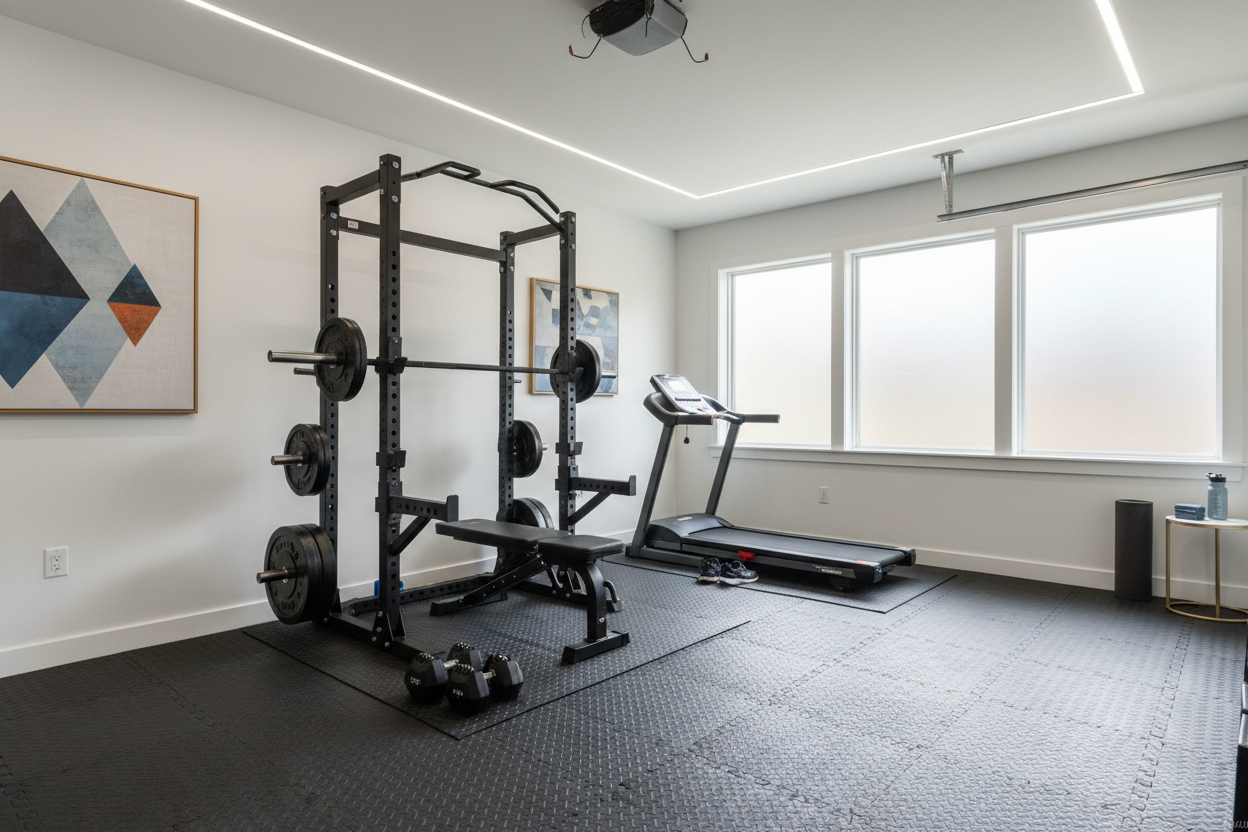
Fifty percent of your budget should go toward foundational home gym equipment like your rack and bench. If these fail, you get hurt. I opted for a solid power rack with 2x2-inch 14-gauge steel. It has a 700-lb capacity, which is more than enough for 99% of us.
The biggest mistake I see? People buy cheap adjustable benches that wobble the second you lay down with 50-lb dumbbells. For a home gym for 1000, skip the adjustable feature. A rock-solid flat utility bench with high-density foam and a wide footprint will feel safer and last decades. It is the difference between focusing on your chest press and worrying if the bench pin is going to snap.
Hunting Down Heavy Iron Without Paying Freight
Weight plates and bars are where the shipping costs usually kill your budget. To keep a garage gym under 1000, you need to be smart about the iron. I chose a 20kg workhorse bar with decent knurling and bronze bushings. It does not have the whip of an Olympic weightlifting bar, but it is stiff enough for heavy pulls and squats.
For plates, skip the fancy urethane-coated sets. Standard gray cast iron plates weigh the same as the pretty ones. I found that buying a 300-lb starter set (which usually includes a basic bar you can use as a backup) is the most cost-effective way to get bulk weight into your garage without paying $300 in shipping fees.
Cheap Hacks for Cables and Accessories
You do not need a $2,000 cable crossover to do tricep pushdowns or lat pulldowns. I rigged up a simple loading pin and a pulley system that loops over the top crossmember of my rack. It cost me about $40 and handles 200 lbs without a hitch.
Add a set of gymnastic rings for $30. They are the ultimate accessory for dips, pull-ups, and rows. When you are on a tight budget, versatility is king. One pair of rings replaces three different machines and takes up zero floor space. These small wins are how you keep the total cost down while keeping the training variety high.
The Final Tally: My Exact $1,000 Blueprint
Here is how the math actually shook out for my build. I spent $320 on a power rack with a pull-up bar, $150 on a heavy-duty flat bench, $190 on a 190k PSI barbell, and $340 on 300 lbs of iron plates. Total: $1,000 on the dot. I even managed to squeeze in a few horse stall mats for flooring by shopping at a local farm supply store.
The best part? This entire setup consists of brand-new gear with warranties. I wrote a whole piece on how I avoided the used market because I was tired of people selling rusted, 20-year-old weights for retail prices. You can get a high-quality, heavy-duty setup without scouring Craigslist for months.
My Personal Lesson Learned
I once tried to save $50 by buying a barbell from a local 'big box' sporting goods store. The first time I loaded 315 lbs for deadlifts, the bar took a permanent set. It looked like a literal banana. I learned the hard way that 'cheap' iron is a liability. Now, I always check for a minimum 190,000 PSI tensile strength. It is the gold standard for a bar that will actually survive a home gym environment.
FAQ
Do I need special flooring for a garage gym?
Yes. Do not drop weights on bare concrete; you will crack it. Go to a farm supply store and buy 3/4-inch rubber horse stall mats. They are way cheaper than 'gym flooring' and virtually indestructible.
Is a 700-lb rack capacity enough?
For most people, absolutely. Unless you are an elite powerlifter squatting 600+ lbs, a rack rated for 700-800 lbs provides a massive safety margin for your daily training.
Should I buy bumper plates or iron?
If you are doing Olympic lifts (cleans, snatches) and dropping the bar from overhead, get bumpers. If you are doing powerlifting (squat, bench, deadlift), iron is cheaper and allows you to fit more weight on the bar.
Share:
The Best Full Body Machine Workout If You Hate Jumping Around
The Best Weight Machine for Abs Isn't a Late-Night TV Gimmick