
I remember the day my 'backpack kettlebell' finally gave out. I was doing goblet squats in my kitchen, and the strap snapped, sending 40 pounds of textbook-weighted canvas onto my big toe. That was the moment I realized that trying to rely on household fitness equipment—or rather, the stuff I had rigged together—wasn't just annoying; it was a plateau waiting to happen.
- DIY weights lack the precision needed for progressive overload.
- Handles on household items are rarely designed for high-tension repetitions.
- A few specific DIY moves, like towel sliders, actually provide great accessory work.
- Consolidating your gear into one multi-purpose machine saves more space than a pile of random jugs.
The Romance vs. Reality of Lifting Your Furniture
We all had that gritty, 'Rocky' phase. You saw the videos of guys benching their couches or doing curls with laundry detergent. In the beginning, it feels hardcore. Using household items to workout gives you a certain sense of resourcefulness that a commercial gym membership just doesn't offer.
But the romance dies fast. It dies when the detergent leaks on your carpet or when your grip fails because a plastic handle is digging into your palm like a dull knife. Household items aren't balanced for human biomechanics. They shift, they leak, and they break. If you're serious about your physique, you'll eventually realize that fighting the equipment is taking more energy than the actual lift.
Why You Max Out Fast When You Workout With Household Items
The biggest issue with trying to exercise with household items is the math of progressive overload. To grow, you need to add weight in small, manageable increments—usually 2.5 to 5 lbs at a time. A backpack full of books is either too light or impossibly awkward once you add that one extra volume of an encyclopedia.
Once you can do 20 reps with your heaviest duffel bag, you're no longer building strength; you're just doing cardio with a weirdly shaped object. I struggled with cheap at-home workout equipment and DIY hacks for months before realizing my squat numbers hadn't moved. I couldn't micro-load a water jug, and my progress stalled because I was limited by the volume of a plastic container rather than my own muscle capacity.
The Smart Way to Buy Household Fitness Equipment
When you're ready to stop playing MacGyver, don't just buy the first 'as-seen-on-TV' gadget you see. You need foundational pieces. Start with a pair of adjustable dumbbells or a solid kettlebell. These offer a high ceiling for growth without taking up half your living room.
There is a definite line when shopping for inexpensive exercise equipment. If a rack looks like it is made of thin-walled soda cans, skip it. You want steel, high-density rubber, and honest weight capacities. Buy the heaviest thing you can safely handle and grow into it, rather than buying five different sets of light, plastic-coated weights that you'll outgrow in a month.
The Few Times It Actually Makes Sense to Exercise With Household Items
I am not saying you have to throw everything in the trash. You can still exercise with household items for specific accessory work. For example, if you have hardwood or tile floors, a pair of old kitchen towels makes for incredible hamstring curls or mountain climbers. They provide a smooth glide that actually rivals some professional sliders I've used.
Stairs are another win—they are essentially a free, high-intensity climber. However, if you are looking for consistent, low-impact zone 2 cardio that doesn't involve tripping over the cat, a foldable upright exercise bike is a much safer bet. It gives you a controlled environment where you can actually track your heart rate and resistance levels properly.
Stop Tripping Over Clutter and Consolidate Your Setup
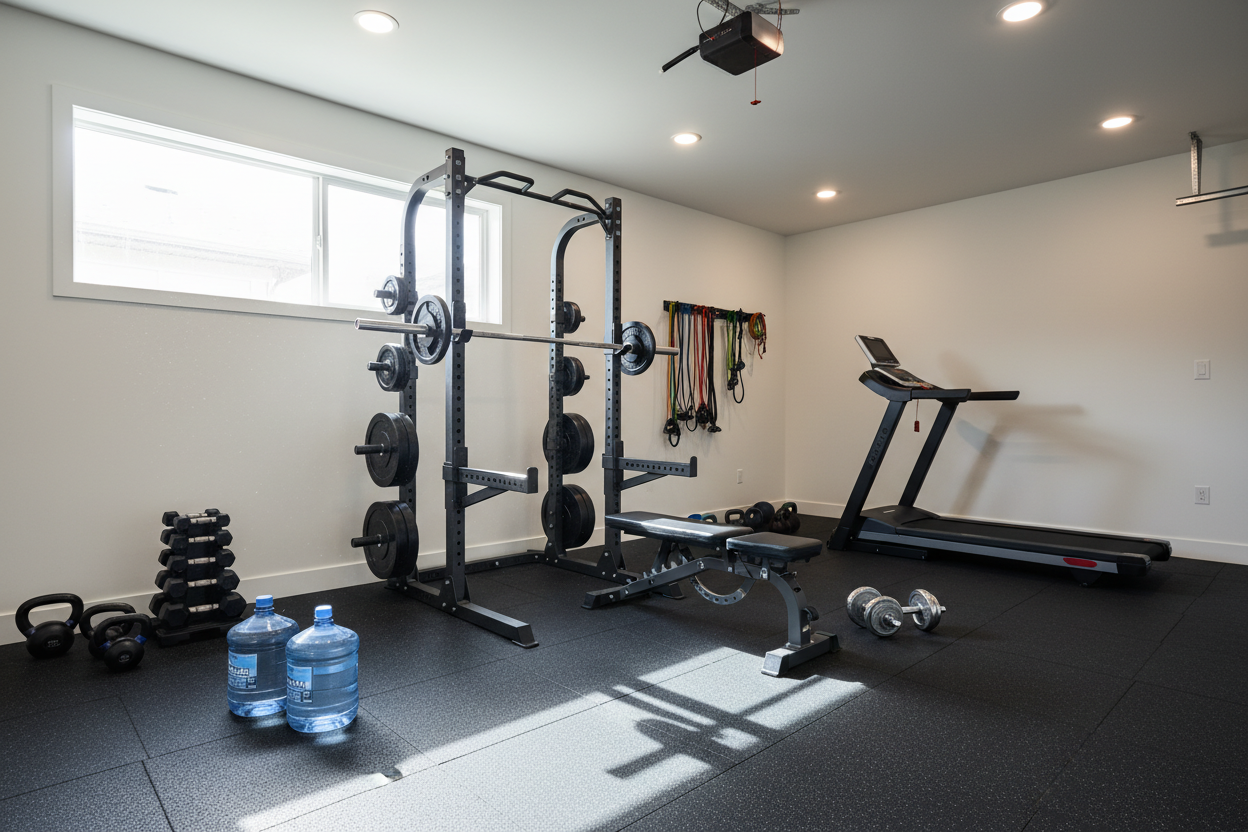
Eventually, your spare room or garage starts to look like a junkyard of bands, odd-sized plates, and sandbags. That is the signal to consolidate. Instead of five different DIY stations that barely work, one heavy-duty piece can do the job of ten. It is about reclaiming your floor space while finally being able to move real weight without fear of a strap snapping.
An all-in-one Smith machine takes up the footprint of a small desk but replaces your bench, squat rack, and cable tower. When you move to this level of gear, the 'household' element refers to where it sits, not what it's made of. You get the stability of a commercial gym with the convenience of being ten feet from your fridge.
What is the safest household item to use as a weight?
Water jugs with reinforced handles are the safest bet, but even they have a shelf life. Use them for high-rep lunges or lateral raises, but never for overhead work where a leak or a break could cause a serious injury.
How do I know when I've outgrown my DIY weights?
If you are hitting 15-20 reps with perfect form and don't feel a 'burn' or significant fatigue, you've outgrown the resistance. At that point, you're just maintaining, not building.
Can I build a real chest using just chairs for dips?
You can build a decent base, but chairs are notoriously unstable. If one slides, you're looking at a torn rotator cuff. A dedicated dip station or a power rack is a much smarter investment for your long-term health.
Share:
A Workout Bench Isn't a Real Bench for Weight Lifting
The 6 Home Gym Machine Exercises I Actually Use Every Week