
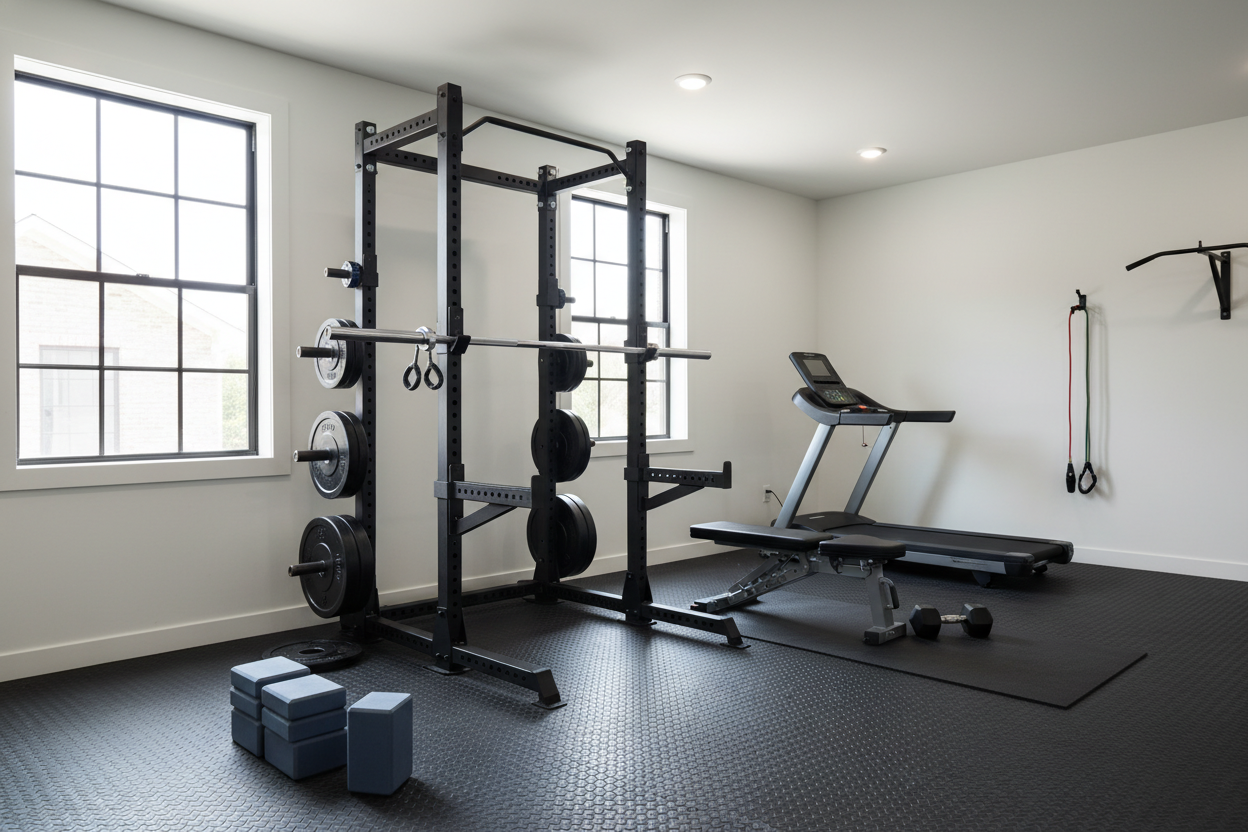
I’ve spent the last decade turning my garage into a personal torture chamber, and I’ve learned one expensive lesson: most gear is junk. I remember scrolling through Amazon at midnight, convinced that a set of plastic-coated dumbbells and a folding bench would be enough to build a physique. Three months later, the bench was creaking like a haunted house and the dumbbells were leaking sand on my floor. That’s when I realized most home workout essentials marketed to us are just plastic waste waiting for a landfill.
Quick Takeaways
- Prioritize loadable weight (dumbbells or barbells) over high-repetition gimmicks.
- A wobbly bench is a safety hazard; look for 11-gauge steel and a 1,000-lb capacity.
- Adjustable dumbbells save massive amounts of floor space in a standard 10x10 room.
- Avoid subscription-based screens if you just want to lift heavy things.
The Problem With Most Influencer Fitness Gear
Walk into any big-box retailer and you’ll see aisles of 'booty bands,' vibrating foam rollers, and ab sliders that look like they were designed by a toy company. These are often sold as at home workout essentials, but they lack the one thing required for muscle growth: progressive overload. You can’t build a serious back or legs by just stretching a piece of latex until it snaps.
The fitness industry loves these items because they are cheap to ship and easy to market with a 30-second clip. But if you want to actually change your body composition, you need resistance that challenges your central nervous system. Most of the 'essentials' pushed on social media are just clutter that will end up in a garage sale within six months. Real results come from moving iron, not playing with rubber bands.
Foundation First: The Non-Negotiable Iron
If you have $500 to spend, put $450 of it into weight. A quality set of adjustable dumbbells—like the ones that go from 5 to 50 lbs or even up to 80 lbs—is the undisputed core of a home gym. I personally prefer the ones with a metal cradle and a satisfying 'clink' when you change settings. If you’re trying to run a program like 5/3/1 or Starting Strength, you need plates that go down to 1.25 lbs for those incremental wins.
For those with a bit more space, a 7-foot Olympic barbell and a set of bumper plates are the gold standard. I’ve dropped 300-lb deadlifts on cheap concrete, and I can tell you: the knurling on a high-quality bar makes a massive difference in your grip. Don’t settle for a 1-inch standard bar that bends the moment you put two plates on it. Get a 28mm or 28.5mm bar with a decent whip and you’ll never need to buy another one.
Space-Saving Stability: The Heavy-Duty Bench
A bench is one of the most overlooked essentials for working out at home. People think they can just use a sturdy coffee table or the floor. Try doing a heavy incline press on a wobbly $60 Amazon special and you’ll quickly realize how much your brain limits your strength when you don’t feel safe. I look for a bench that is roughly 17 inches from the floor to meet competition specs and has a footprint that doesn't slide during leg drive.
If you’re tight on space, get a flat bench that can be stored vertically. If you have the budget, an adjustable bench (FID: Flat, Incline, Decline) opens up hundreds of variations for chest and shoulders. Just make sure the gap between the seat and the back pad isn't so wide that it swallows your lower back during a heavy press. Safety isn't just about the weight on the bar; it's about the platform underneath you.
When Does It Make Sense to Consolidate?
Eventually, you might get tired of tripping over loose plates and having dumbbells scattered across your mats. This is the point where you should consider upgrading your home gym setup. When you move from a few pieces of iron to a dedicated power rack or a functional trainer, your workout efficiency skyrockets. You stop hunting for the 25-lb plate and start actually lifting.
For some, the answer isn't more racks, but smarter machines. If you’re working in a tight 6x8 ft corner, you might find yourself trading free weights for a full body machine to reclaim your floor space. These all-in-one units use cables or digital resistance to mimic a full commercial gym footprint. It’s a trade-off: you lose some of the 'raw' feel of iron, but you gain back your garage for parking the car.
The 'Nice-to-Haves' vs. True Necessities
You do not need a 24-inch 4K touchscreen to get a good workout. I’ve always been vocal about paying extra for an at-home workout screen that forces you into a $40-a-month subscription. Your phone and a cheap tripod are more than enough to follow a program or record your form. Put that money into better flooring—3/4-inch horse stall mats are the secret weapon of every serious garage gym owner.
True necessities include things like a solid jump rope for conditioning, a set of gymnastic rings for pull-ups and dips, and maybe a single heavy kettlebell for swings. These items take up zero floor space but offer massive ROI. Everything else—the fancy massage guns, the infrared saunas, the smart water bottles—is just noise. Focus on the tools that allow you to lift more weight over time.
How to Audit Your Own Training Space
Take a look at your current setup. If you haven't touched a piece of gear in 30 days, it's not an essential; it's a distraction. Use this checklist to decide your next move:
- Does this piece of gear allow for progressive overload?
- Can I safely use this alone without a spotter?
- Does it fit the footprint of my space without making it unusable?
- Is the build quality 11-gauge steel or better?
If the answer is no, don't buy it. Start with a heavy set of weights and a solid bench, and only add gear when your current equipment literally cannot support your progress anymore.
My Honest Mistake
I once bought a 'space-saving' folding power rack that was so poorly machined I had to use a rubber mallet to get the pins in every single time I wanted to squat. It turned a 45-minute workout into a 90-minute frustration session. I eventually sold it for half what I paid and bought a stationary 4-post rack. The lesson? If a piece of equipment makes you dread your workout because of the setup time, it's garbage—no matter how much space it saves.
FAQ
Do I really need a power rack?
If you plan on squatting or benching heavy alone, yes. The safety pins are your only insurance policy. If you prefer dumbbells, you can skip the rack and stick to a heavy bench.
Are adjustable dumbbells better than a full rack of weights?
For most home users, yes. A full rack of dumbbells takes up 10-12 feet of wall space. A pair of adjustables takes up two square feet and usually costs a third of the price.
What is the best flooring for a home gym?
Skip the 'puzzle piece' foam mats. They tear and slide. Go to a farm supply store and buy 3/4-inch rubber stall mats. They are indestructible, dampen sound, and protect your foundation.
Share:
What Is That Lower Back Machine Gym Name? (Mystery Solved)
How I Found the Best Budget Cardio Machine for Under $300