
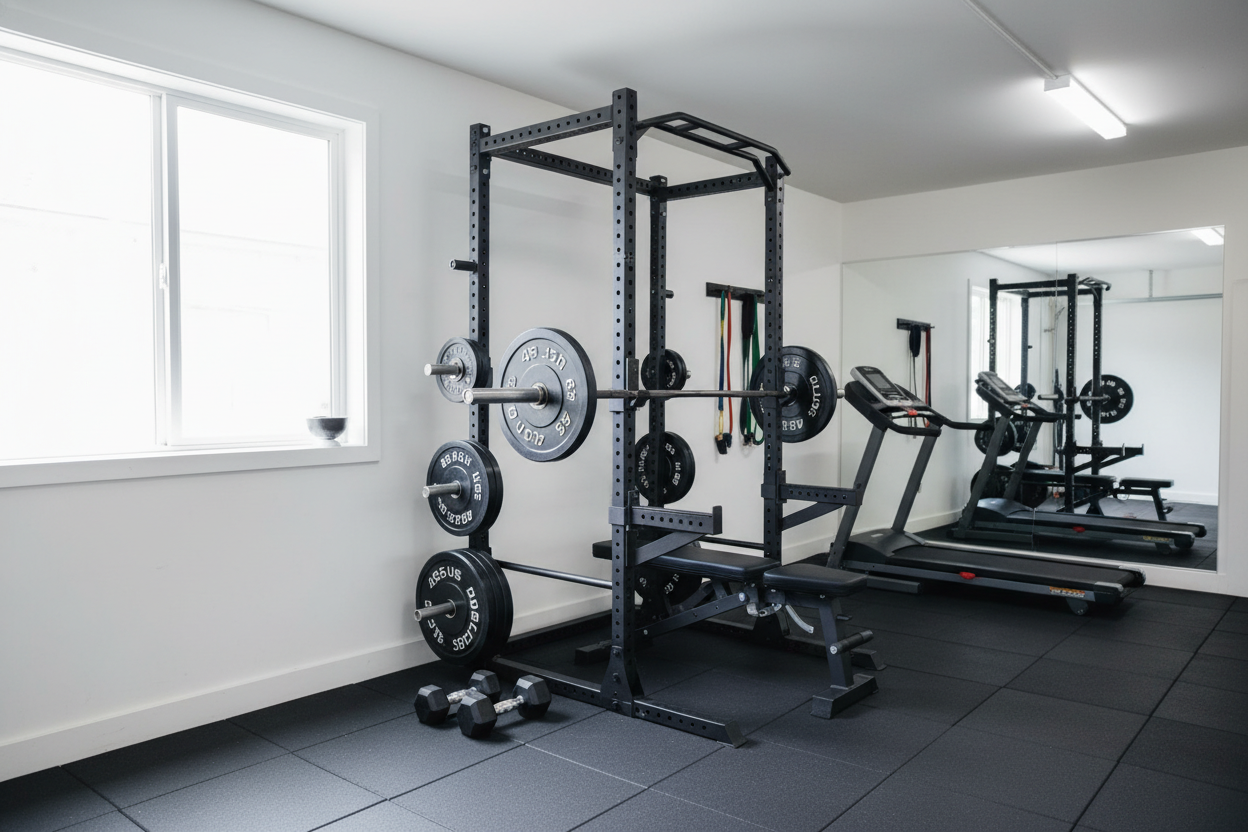
I remember the exact moment I decided to quit my commercial gym. I was standing in a puddle of someone else's sweat, waiting twenty minutes for a squat rack that had a 'broken' pin held together by a literal rusted bolt. That night, I went home and started searching for the best garage gym equipment. I quickly realized that most of the advice out there is garbage. It’s written by people who have never actually tried to fit a full power rack and a car into a standard two-car garage.
Quick Takeaways
- Prioritize a 3x3 11-gauge steel rack; it’s the only thing that won't wobble when you're repping out.
- Spend the extra $100 on a quality barbell with decent knurling—your calloused hands will thank you.
- Skip the fancy isolation machines early on unless you have a dedicated 20x20 space.
- Horse stall mats are the only flooring that actually protects your concrete from dropped deadlifts.
Why Most 'Must-Have' Gear Lists Are Complete BS
Most fitness influencers want you to believe that your garage isn't a 'real' gym unless it looks like a CrossFit affiliate. They push reverse hyper machines, specialized GHDs, and $500 cable attachments because those items carry high commissions. I’ve seen guys buy a $1,000 belt squat machine before they even own a set of 45-lb plates. It’s a trap.
The reality of finding the best garage workout equipment is much more boring. You don't need a specialized machine for every muscle group. You need gear that allows you to move heavy weight safely without a spotter. Most of the 'innovative' gear you see on Instagram ends up as a very expensive coat rack within six months. Stick to the basics that have built muscle since the 70s.
The Foundation: Building Around the Power Rack
Your rack is the heart of the operation. If you buy a cheap, bolt-together rack from a big-box store, you’ll regret it the first time you try to rack a heavy set of squats. I look for 11-gauge steel and 3x3-inch uprights. Why? Because the weight of the rack itself provides stability. You don't want to feel the whole frame shifting when you're doing pull-ups.
When building a functional home gym, pay attention to hole spacing. Westside spacing (1-inch gaps through the bench zone) is a lifesaver. It allows you to set your safety pins at the perfect height so you can bench to failure without the fear of being pinned. A 48x48 inch footprint is standard, but make sure you account for the bar width—you need at least 10 feet of total width to load plates comfortably.
Barbell and Plates: Where You Should Actually Spend Money
The barbell is your primary interface with the weight. A cheap bar will have 'mushy' knurling that slips the moment your palms get sweaty, and the sleeves might not even spin. I’ve used bars that permanent-bent after one 400-lb deadlift session. Look for a bar with at least 190,000 PSI tensile strength. It should have a snappy whip but enough rigidity for heavy pressing.
As for plates, the debate between cast iron and bumpers is simple: do you care about the noise? Iron is thinner, meaning you can fit more weight on the bar, and it has that classic 'clink' sound. But if you’re training at 5 AM and don't want the neighbors calling the cops, go with crumb rubber bumpers. They bounce, they’re quiet, and they won't shatter your garage floor if you miss a lift.
Do You Even Need Machines?
Machines are often seen as a luxury in a garage, but they offer a level of safety you can't get with free weights when training solo. If you’re pushing for hypertrophy, you need to reach technical failure. Doing that on a barbell bench press alone in a dark garage is a recipe for a 911 call. This is where deciding between cables and a Smith machine becomes a critical choice for your floor plan.
I’ve personally tested multiple garage gym Smith rigs and found that a high-quality linear bearing system makes all the difference. If the bar sticks or chatters, you won't use it. Cables offer more versatility for face pulls and tricep work, but a Smith machine allows for heavy, stabilized pressing and squats that target the quads without the stability tax of a barbell. If you have the budget and the 7-foot ceiling height, a functional trainer is the ultimate accessory piece.
The Best Garage Workout Equipment for Tight Spaces
Not everyone has a three-car palace. If you’re working in a corner of a shared garage, you have to be surgical with your choices. Adjustable dumbbells are the gold standard here. A single pair of high-quality adjustables can replace a 5-to-50 lb rack of fixed dumbbells, saving you about 8 linear feet of wall space. Pair those with a heavy-duty flat bench—one that’s rated for at least 800 lbs so it doesn't creak under load.
If you’re really cramped, look into an all-in-one Smith machine home gym station. These units combine a rack, a Smith bar, and a pulley system into one footprint. It’s the most efficient way to get a full-body workout without tripping over gear. Just make sure the pulley ratio works for your strength level; a 2:1 ratio is great for functional movements, but a 1:1 ratio is better if you plan on doing heavy lat pulldowns.
Three Pieces of Gear I Wish I Never Bought
First, a cheap 'speed' jump rope. It tangled every three jumps and the plastic handles cracked within a month. Second, a vertical leg press machine. It sounded like a space-saver, but the loading angle was awkward and it felt like it was crushing my lower back rather than hitting my quads. It sat in the corner for two years until I sold it for half what I paid.
Third, and most painfully, I bought a set of cheap 'cement-filled' plastic weights during a supply shortage. They were bulky, leaked sand after a few months, and were actually 3 lbs lighter than advertised. It taught me a hard lesson: buy once, cry once. If you can't afford the good iron yet, save up until you can. The best garage gym equipment is the stuff that stays with you for a decade, not the stuff you have to replace in six months.
FAQ
How do I stop my gear from rusting in a humid garage?
Avoid decorative chrome. Go with black zinc or stainless steel for your barbells. For the rack, a powder-coat finish is standard, but you should still wipe it down with a light coat of 3-in-1 oil once a season if you live in a coastal or humid area.
Is 3/4 inch plywood enough for a lifting platform?
Not on its own. You want a sandwich of two layers of 3/4 inch plywood topped with a layer of rubber stall mats. This 'deadlift platform' distributes the force so you don't crack the concrete slab underneath your house.
Can I use a standard 7-foot bar in a small garage?
You can, but you need 10 to 11 feet of clearance to actually load the plates. If you're really tight on space, look for a 'shorty' bar, which has a standard-width grip area but shorter sleeves. Just know you won't be able to fit as many plates on it.
Share:
I Pushed a Cheap Exercise Machine Until It Broke (Here's Why)
Why I Lift With a $400 Barbell and Cheap Exercise Weights