
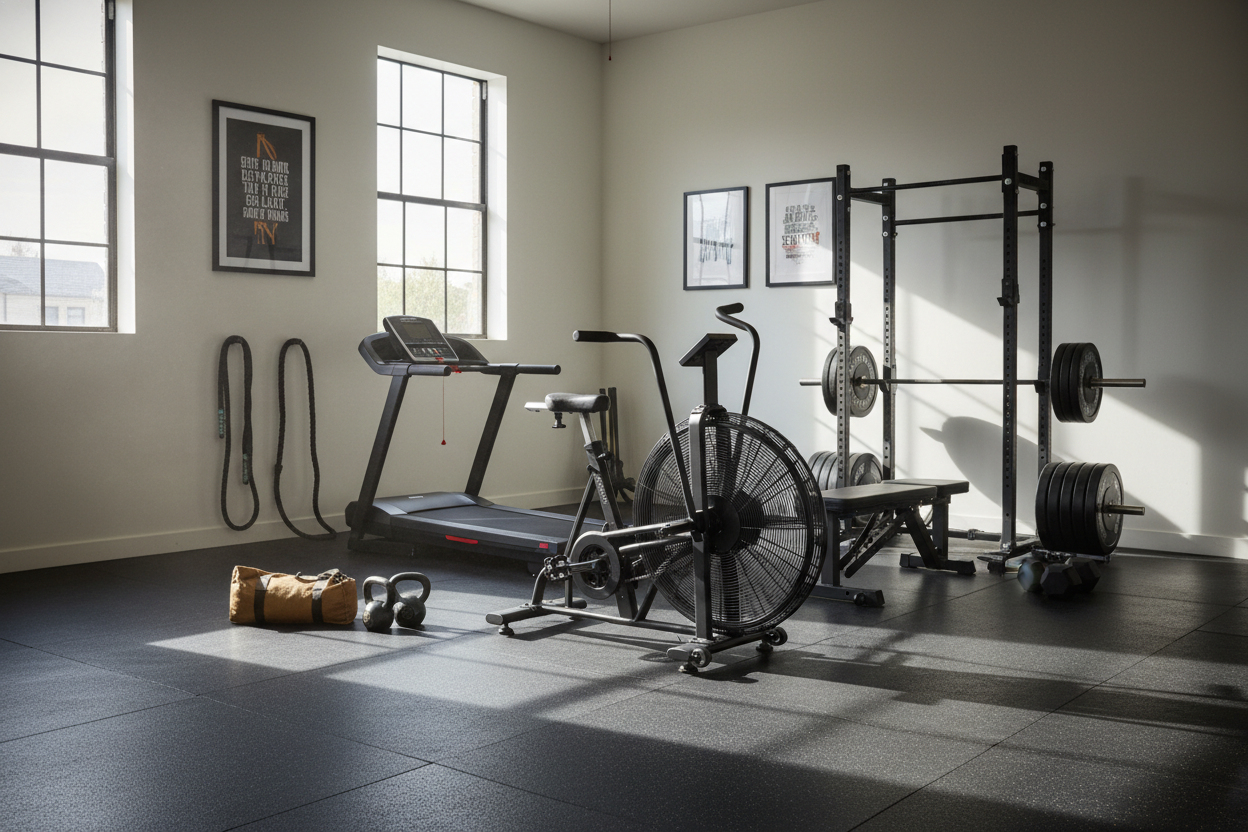
I remember my first treadmill. It was a $600 'deal' from a big-box store that promised the world. Within three months, the motor smelled like burning hair every time I pushed past 6 mph. That was the day I realized the best home aerobic machine isn't something you plug into a wall; it's something you power with your own grit and a heavy-duty flywheel.
Quick Takeaways
- Motorized treadmills are a ticking time bomb of circuit board failures and belt slips.
- Self-powered machines like air bikes and rowers scale resistance to your effort.
- Mechanical simplicity equals a 10-year lifespan versus a 2-year 'maybe' for electric gear.
- Non-motorized equipment forces better posture and higher caloric output.
Why Your First Motorized Treadmill Will Probably Break
Most residential treadmills are built with cheap DC motors that simply aren't designed for the heat generated by a 200-pound human running for 30 minutes. The marketing says '3.0 HP,' but that's peak, not continuous. Once that motor gets hot, the torque drops, the belt stutters, and you're left with a very expensive clothes rack.
It’s not just the motor, either. It’s the console. If the proprietary tablet on your fancy $2,000 treadmill glitches out after the warranty expires, you’re looking at a $500 repair bill for a machine that shouldn't have needed a screen to begin with. I’ve seen more 'out of order' signs on home treadmills than I’ve seen successful marathons finished on them. If it has a power cord, it has a shelf life.
The Brutal Truth About the Best Home Aerobic Machine
The beauty of a fan or a flywheel is simple physics. There is no speed limit. When you are building a functional home gym, you want gear that respects your floor space and your wallet. A machine like a Concept2 Rower or a Rogue Echo Bike doesn't care if the power is out or if your Wi-Fi is down. It just waits for you to suffer.
The resistance on these machines is exponential. On an air bike, the harder you pedal, the more air the fan has to displace. It creates a 'wall' of resistance that motorized machines can't replicate. This makes it the ultimate tool for scalable fitness. Whether you're a pro athlete or just trying to lose the office chair spread, the machine meets you exactly where your current capacity ends.
Air Bikes vs. Rowers: Picking the Best Cardio for Home Gym Conditioning
If you're tight on space, the air bike is king. It occupies a tiny 4’ x 2’ footprint and delivers a soul-crushing full-body stimulus. You use your arms to push and pull while your legs drive the pedals. It’s low impact, meaning your knees won't feel like they're being hit with a hammer, unlike a treadmill session.
Rowers are the gold standard for posterior chain engagement, but they require about 8 feet of linear space. If you want cardio equipment at home that actually gets used, the bike usually wins because the barrier to entry is lower. You just sit down and start moving. There’s no complex technique to master before you can actually get your heart rate into the red zone.
How to Program the Best Home Gym Cardio Without Quitting
Stop doing 45-minute steady-state slogs while staring at a wall. That is the fastest way to turn your equipment into a dust collector. This is why your gym home workout feels like cardio instead of actual conditioning—you're likely moving too slow for too long without a plan.
Instead, try a 10-minute EMOM (Every Minute on the Minute). Aim for 10 or 12 calories on the bike, then rest for the remainder of the minute. By round eight, you’ll understand why self-powered machines are superior. It’s efficient, measurable, and it builds a level of mental toughness that a motorized belt just can't touch.
Maintenance Checks Before You Swipe Your Card
Before you buy, look at the drive system. Chain drives (like on the AssaultBike) are noisy and require regular lubing, but they feel 'raw' and are easy to fix with a standard wrench. Belt drives are nearly silent and maintenance-free, but they can feel slightly disconnected if the tension isn't dialed in perfectly.
I always suggest checking the cardio manuals online before you buy. See if the manufacturer requires specialized tools for basic adjustments. If you can't fix it with a socket set and some 3-in-1 oil, you’re buying a headache, not a piece of gym equipment. Look for a warranty that covers the frame for at least five years.
Personal Experience: My $400 Lesson
I once bought a used fan bike from a guy on Craigslist for $50. I thought I was a genius until I realized the monitor was fried and the left pedal was cross-threaded into the crank arm. I spent three weeks trying to hack it back together before realizing the 'savings' weren't worth the frustration. Now, I buy the overbuilt stuff. My current air bike has survived three moves, two garage floods, and thousands of sprints. It still sounds like a jet engine, and I still hate every second I'm on it. That's how I know it's working.
FAQ
Which machine is better for fat loss?
The air bike. Because it involves the upper and lower body simultaneously and offers infinite resistance, your caloric burn per minute is generally higher than on a rower or treadmill.
Are these machines loud?
Yes. A fan bike will drown out a TV at normal volume. If you have roommates or live in a thin-walled apartment, look for a magnetic resistance rower or a belt-driven bike to keep the peace.
Do I need a floor mat?
Absolutely. Not just to protect your floors, but to keep the machine from 'walking' across the room during high-intensity sprints. A 3/4-inch stall mat is the gold standard.
Share:
Why Free Weight At Home Gyms Best The Expensive Smart Rigs
Why I Refuse to Lift on the Most Popular Amazon Weights Bench