
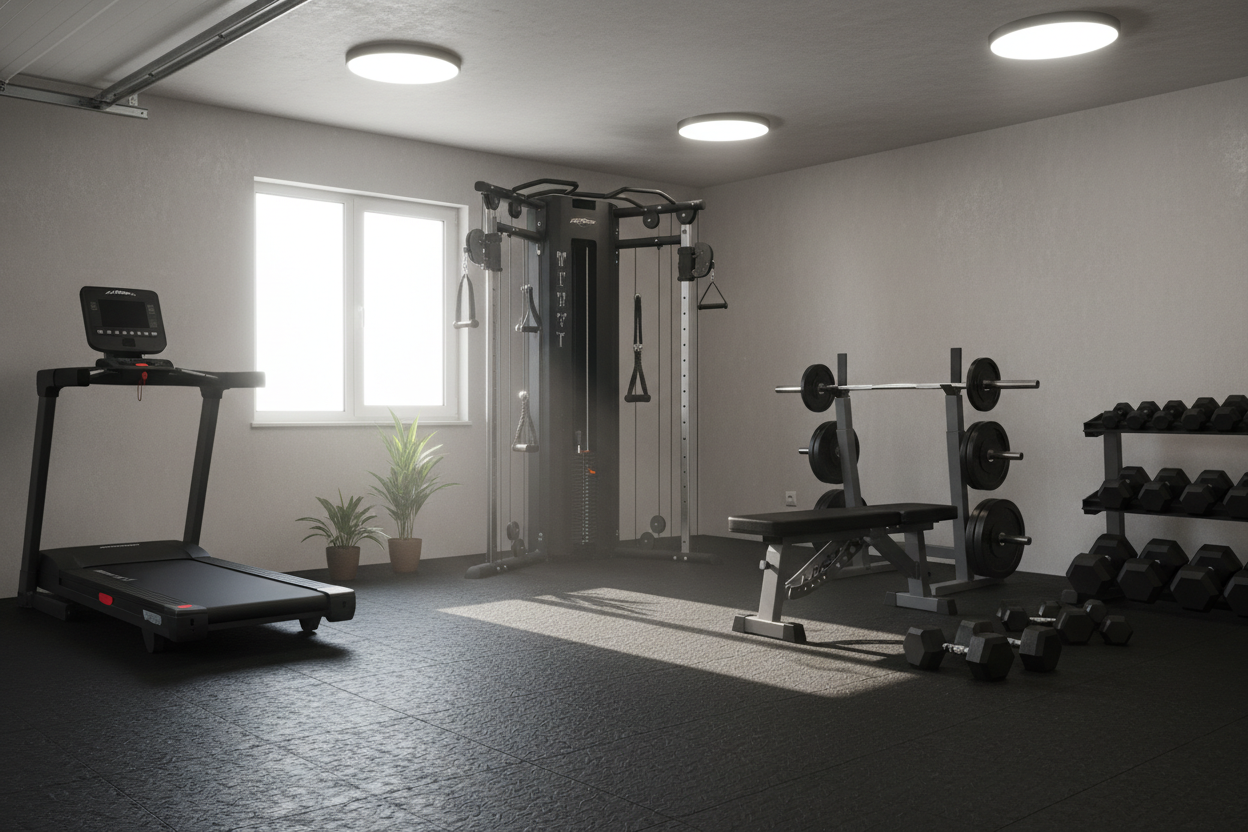
I’ve spent way too many Friday nights scrolling through local listings, convinced I’m one purchase away from never needing a commercial gym membership again. You see it: a massive, dusty universal weight machine for sale for $150. It looks like a steal, but usually, it is a trap designed to steal your Saturday and your sanity.
- Budget for a truck rental and a second set of hands; you cannot move these alone.
- Check the cable coating for ‘bird-nesting’ or internal fraying before paying.
- Verify that the weight stack moves smoothly without sticking at the bottom.
- Consider if a modular bench and dumbbells would save more space.
The Lure of the $200 All-In-One Rig
The psychology of the used universal weight machine for sale is simple: it promises a total-body workout in a single footprint. We’ve all seen the ads for 1990s-era Parabody or Weider units gathering dust in a garage. For $200, it feels like the ultimate home gym hack. You imagine hitting chest, back, and legs without ever swapping a plate.
But these machines are often the ‘Swiss Army Knives’ of the gym world. They do a dozen things, but they rarely do any of them particularly well. The fixed motion paths are built for a generic body type, and if you don’t fit that mold, your joints are going to feel it. Before you jump on that ‘universal gym equipment for sale’ listing, realize you’re often buying someone else’s abandoned coat rack.
Red Flag #1: The Disassembly and Transport Nightmare
I once spent four hours in a damp basement with a rusted adjustable wrench and a prayer trying to take apart an old multi-station rig. These things weren't meant to be moved once they were bolted together. You will lose bolts. You will find rusted joints that require a blowtorch to budge. And you will realize that your SUV isn't nearly big enough for the 7-foot main frame.
By the time you rent a U-Haul and buy a pizza for the friend you tricked into helping you, that $200 bargain is now a $400 headache. If the seller says ‘you must disassemble,’ bring a camera. Take a photo of every single bolt placement, or you’ll have a pile of scrap metal in your garage that never quite functions again.
What Actually Breaks on Used Multi-Station Gyms
The biggest failure point is the cable system. If you see the plastic coating peeling off, that cable is a ticking time bomb. Replacing custom-length cables is a massive pain and often costs more than the machine is worth. You need to read the spec sheets and assess materials like the gauge of the steel and the pulley housing before you hand over cash.
Check the nylon pulleys. Over time, these crack or develop flat spots if the weight sat in one position for years. A cracked pulley will shred your cables in a week. Also, look for stripped selector pins. If the owner lost the original pin and shoved a screwdriver in the stack instead, the internal rod is probably gouged, leading to a jerky, frustrating lift.
The 5-Minute Function Test (Before You Hand Over Cash)
Never buy a machine without seeing the weight stack move. Pull the pin, set it to 50 lbs, and perform a full rep. It should feel like butter. If you feel a ‘catch’ or hear a grinding sound, the guide rods are either bent or bone-dry. Sometimes a little silicone spray fixes it; sometimes the rods are warped from being moved improperly.
Check the upholstery. A small tear is fine, but if the foam is compressed to the board, your back will feel every bolt during a chest press. Listen to the bearings. If the pulleys squeal like a stuck pig, they’re shot. A machine that doesn't feel smooth at 50 lbs will feel dangerous at 200 lbs.
When You Should Skip Used and Build Modular Instead
Sometimes, a massive, fixed-path machine is just a bad use of your limited square footage. Modern home gym design has moved toward independent movements. Instead of a cramped multi-press, look at independent arm chest press systems. These allow for unilateral training and better biomechanics, ensuring your dominant side doesn't do all the heavy lifting.
For the same footprint as a dusty universal rig, you could fit a heavy-duty adjustable bench and a set of dumbbells. This setup covers 90% of what that big machine does but with infinitely more variety. If you’re serious about progress, you want equipment that adapts to you, not a machine that forces you into a rigid, awkward movement path.
The Final Verdict: Is It Worth the Hassle?
Is a used universal rig ever worth it? Only if it’s a high-end brand like commercial-grade Life Fitness or Nautilus, and only if you have the floor space to spare. If it’s a budget-tier machine from a big-box store that’s been sitting in a humid garage for a decade, keep scrolling. Your time and your joints are worth more than a cheap stack of iron.
FAQ
How much ceiling height do I need for a universal gym?
Most require at least 84 inches, but you need an extra 6-12 inches of clearance to actually get the cables over the top pulleys during assembly.
Can I replace the cables myself?
Yes, but you’ll need to measure the exact length and ensure the terminal ends match the original specs. It’s a tedious afternoon project.
Is a weight stack better than plate-loaded?
Weight stacks are faster for drop sets, but plate-loaded machines are easier to move and cheaper to repair if something breaks.
Share:
How to Judge Weight Machine Cost Without Getting Ripped Off
I Switched Racks: Is Smith Machine Easier Than Free Weights?