
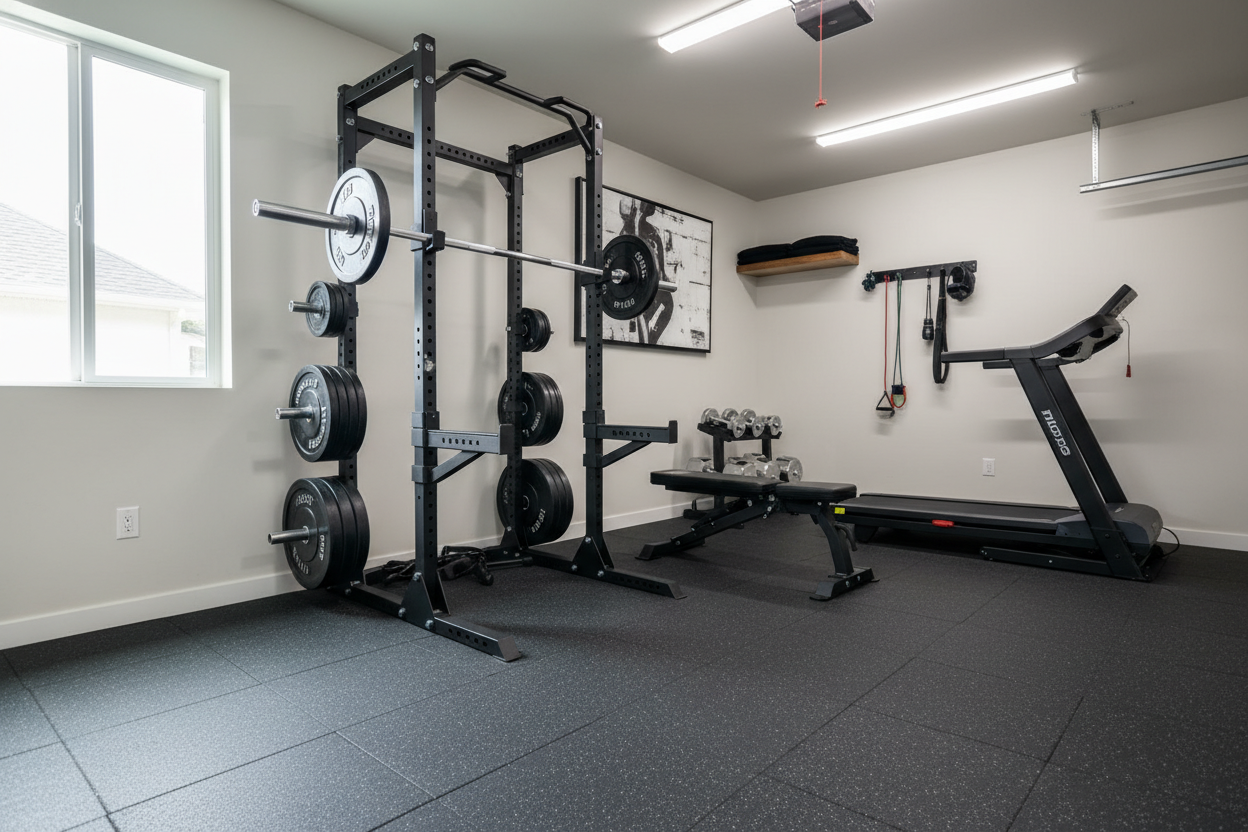
I remember the day my local commercial gym hiked their rates to $80 a month just as they replaced their only decent power rack with a row of plastic-shrouded ellipticals. I went home, cleared a 6x8 patch of oil-stained concrete in my garage, and started hunting for a weight set that wouldn't force me to park my truck in the driveway forever.
Quick Takeaways
- Prioritize vertical storage to keep your floor clear for actual lifting.
- Thin iron plates beat bulky bumpers when you are working in a tight footprint.
- A heavy-duty rack and bench can handle 95% of your training needs.
- Avoid 'all-in-one' machines that promise everything but deliver mediocre resistance.
Why a Tiny Garage Is Actually the Perfect Lifting Space
Small spaces force a specific kind of discipline. When you only have a few dozen square feet to work with, you can't fit a pec deck, a seated calf raise machine, or three different types of leg curls. You are forced to focus on the big movers: squats, presses, and pulls. This constraint actually builds a better athlete because you stop wasting time on 'filler' exercises that don't drive real strength.
A minimalist garage setup turns your training into a high-efficiency operation. You aren't walking 50 feet between the cable crossover and the dumbbell rack. Everything is within arm's reach. I found that my workouts got faster and more intense once I stopped 'wandering' around a commercial gym and started focusing on a single, high-quality barbell.
Building a Heavy-Duty Weight Kit Without Wasting Space
For a weight set in a one-car garage, plate thickness is your biggest enemy. If you buy cheap, thick crumb-rubber bumper plates, you will run out of room on the barbell sleeves by the time you hit 405 lbs. More importantly, those fat plates take up twice the storage space in your corner. I always recommend machined iron plates for tight spaces; they are thinner, more accurate, and they sound like real work when they clink.
A standard 300-lb weight kit is the perfect baseline. It usually includes a 45-lb bar, two 45s, two 35s, two 25s, two 10s, four 5s, and two 2.5s. If you’re deadlifting heavy, you’ll eventually need more 45s, but this core kit covers everything from overhead presses to heavy rows without cluttering the floor with unnecessary duplicates.
The One Piece of Gear You Can't Skimp On (Your Bench)
If you buy a cheap, lightweight bench from a big-box store, you will regret it the first time you try to bench your body weight. It will slide on the mats, or worse, tilt when you're trying to get into position. In a cramped garage, you don't have the luxury of 'bailing' easily to the side if things go wrong. You need a rock-solid foundation.
I personally went with a heavy-duty adjustable weight bench because it offers the most versatility per square foot. It allows for incline work, seated overhead presses, and even supported rows without needing three different pieces of furniture. Look for something with a high weight capacity—at least 600 lbs—so you never have to worry about the frame flexing when you're under a heavy load.
Why Most Multi-Station Machines Are a Massive Trap
Don't get seduced by those sprawling all-in-one 'home gyms' that promise 50 different exercises. They look like they save space, but they actually have a massive, awkward footprint and often use subpar pulleys that feel 'mushy' rather than smooth. I actually dissected a budget weight machine set once, and the internal components were frighteningly thin.
Stick to free weights. A barbell and a rack don't have cables that snap or plastic pulleys that melt under friction. If you want cable work, get a small wall-mounted pulley system that takes up zero floor space. Keep your main area dedicated to the gear that will actually last a lifetime.
Protecting Your Concrete Without Losing an Inch of Headroom
Standard 3/4-inch horse stall mats are the gold standard for garage gyms. They are dense enough to stop a heavy deadlift from cracking your foundation, and they don't have the 'squish' of cheap foam tiles that can make your ankles feel unstable during squats. If you are worried about the noise or the smell of rubber, you can look into how people build an apartment weight set for similar low-profile, high-density flooring solutions.
Just be careful with the height of your platform. If your garage ceiling is only 8 feet high, building a 4-inch thick lifting platform is a mistake. You will end up smacking your knuckles on the rafters during pull-ups or overhead presses. Keep the flooring thin but dense to maximize your overhead clearance.
Personal Experience: My 'Standard' Mistake
Early in my lifting career, I bought a set of 'standard' 1-inch plates because they were half the price of Olympic ones. It was the biggest mistake of my training life. I couldn't find a decent barbell that didn't feel like a pool noodle, and the plates were constantly rattling. I ended up selling the whole lot for a loss two months later. Buy 2-inch Olympic-sized gear once, and you will never have to buy it again. It is worth the extra $100 to have equipment that actually feels professional.
FAQ
How much space do I really need for a full weight set?
A 4x8 foot area is the absolute minimum for a bar and a bench, but an 8x8 foot square is the 'sweet spot' that allows you to move around the bar safely without hitting the walls.
Are iron plates too loud for a residential garage?
Only if you are being reckless. If you use controlled eccentrics and high-density rubber mats, the noise is minimal. Your neighbors will likely hear your music more than the weights.
Can I skip the power rack if I'm short on space?
I wouldn't recommend it. If you want to squat or bench heavy, you need safety spotter arms. If a full rack is too big, look into a wall-mounted folding rack or high-quality independent squat stands.
Share:
Why That Cheap Workout Exercise Machine Feels Like Garbage
Don't Buy a Power Gym Machine Until You Understand This Trade-Off