
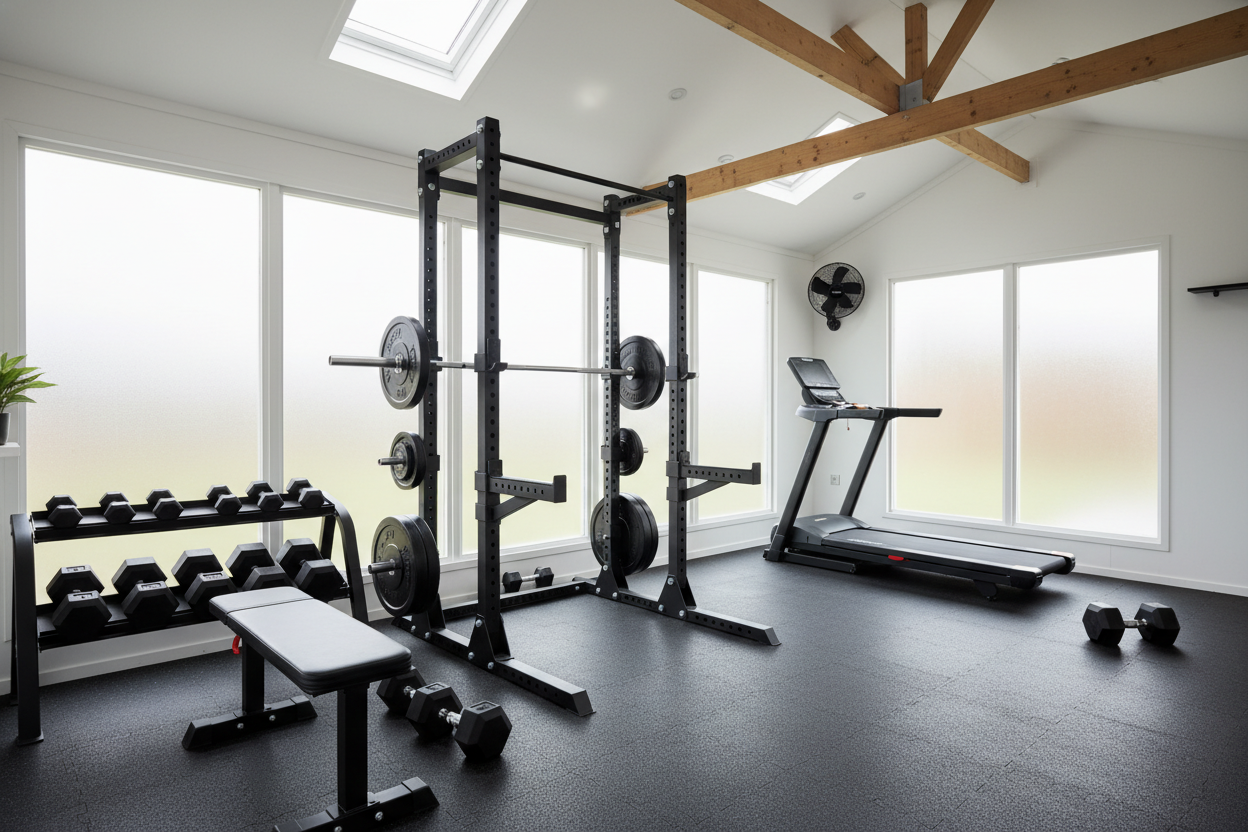
I spent five years playing Tetris with a lawnmower and a squat rack in a cramped two-car garage. Every time I wanted to pull a heavy deadlift, I had to back the SUV into the driveway. If it was raining, my plates got wet. If it was July, I was sweating on the floor before my first warm-up set. I finally hit a breaking point when I clipped a joist during an overhead press and decided it was time to look into dedicated home gym buildings.
Quick Takeaways
- Concrete is King: Never trust a standard wooden shed floor with a 400-lb squat rack.
- Climate Control: Without insulation and an AC unit, your expensive bars will be covered in rust within a season.
- Power Matters: You need a dedicated sub-panel, not an extension cord from the kitchen.
- The Cost: Expect to spend as much on the building and site prep as you did on your entire equipment collection.
Why I Finally Kicked My Squat Rack Out of the Garage
There is a specific kind of mental friction that comes with training in a shared space. When your gym is also your laundry room, your workshop, and your car's bedroom, you never truly feel 'in the zone.' I wanted a sanctuary. I wanted to be able to leave my chalk on the floor and my plates on the bar without my spouse asking when the car could come back inside.
The decision to build a real gym at home in a separate building was about more than just square footage. It was about the commute—even if that commute was only twenty feet across the backyard. That physical separation creates a psychological boundary. When I step into my shed, I am there to work. There are no distractions, no strollers to move, and no oil stains under my bench.
However, the transition wasn't as simple as buying a pre-fab shed from the local hardware store and dragging my rack inside. I quickly learned that most backyard structures are designed to hold rakes and bags of mulch, not 11-gauge steel power racks and half a ton of iron. If you want a space that lasts, you have to build it like a fortress, not a closet.
The Foundation Mistake That Will Ruin Your Shed Gym Build
If you are planning a shed gym build, stop looking at the walls and start looking at the ground. Most people buy a shed with a pressure-treated wood floor and think a few stall mats will save it. They won't. I have seen 3/4-inch plywood floors turn into splinters after six months of heavy cleans. Even if the wood doesn't snap, the vibration from a dropped 315-lb barbell will rattle the entire structure, eventually loosening the fasteners in your walls and roof.
You need a concrete slab. I went with a 4-inch thick pour of 4,000 PSI concrete, reinforced with #3 rebar on a 12-inch grid. This is the non-negotiable first step. A slab provides a perfectly level surface—which is rare in a garage—and it absorbs the energy of a dropped weight rather than vibrating like a drum head. If you’re dropping weights from overhead, you might even consider a 6-inch pour in the landing zones.
Don't forget the vapor barrier under that concrete. Without it, moisture will wick up through the slab, creating a humid microclimate under your rubber mats. That moisture trapped between the rubber and the concrete is a recipe for mold and a funky smell that no amount of air freshener will kill. Do the ground work right, or you'll be tearing the whole thing down in three years.
How to Build an Outdoor Gym Shed That Doesn't Feel Like a Sauna
The biggest shock for most lifters is the temperature. A shed is essentially a wooden box that sits in the sun. Without proper intervention, your how to build an outdoor gym shed project will result in a 110-degree oven by mid-afternoon. I learned this the hard way during my first August session when my knurling was too hot to touch.
You need spray foam insulation. Don't mess around with fiberglass batts; they settle over time and don't provide the same air seal. Closed-cell spray foam adds structural integrity and keeps the heat out. Once the shell is sealed, a mini-split AC unit is your best friend. It provides both cooling and dehumidification, which is vital for protecting your durable home gym equipment from the creeping death of oxidation.
Rust is the silent killer of outdoor gyms. Even high-end cerakote bars have limits. If you let the humidity spike, you'll see orange spots on your sleeves within weeks. I keep a small hygrometer on the wall and aim for 40-50% humidity. It keeps the air crisp and the iron dry. If you can't afford a mini-split yet, at least install a heavy-duty exhaust fan and a dedicated dehumidifier, but know that you're just fighting a losing battle against the seasons.
Powering the Iron: Real Electrical Requirements
I see guys running a single orange extension cord from their back porch to their gym, and it makes me cringe. If you're running a treadmill, a space heater, or a decent lighting rig, you are asking for a fire. To build home gym in shed environments properly, you need a dedicated sub-panel. I trenched a line from my main house panel and installed a 60-amp sub-panel in the shed.
This gave me enough juice to run high-output LED shop lights, my HVAC unit, and a sound system without tripping a breaker every time the compressor kicked on. It also means I have plenty of outlets for charging phones or powering a compact Smith machine with integrated cable features that require good visibility for safety. I opted for overhead 4-foot LED strips that put out about 5,000 lumens each; in a small space, shadows are your enemy when you're moving heavy weight.
Trenching is a pain—you'll likely need to go 18 inches deep depending on your local codes—but it’s the only way to make the space feel like a professional facility. Plus, having real outlets every six feet means you aren't tripping over cords while carrying a pair of 70-lb dumbbells. Safety in a small footprint is about organization, and organization requires power.
Is a Backyard Lifting Shed Actually Worth the Money?
Let's talk numbers. A high-quality 12x16 shed shell will run you about $5,000 to $7,000. The concrete slab is another $3,000. Electrical and insulation can easily tack on another $4,000. By the time you're done, you've spent $15,000 before you even buy a single bumper plate. When you budget out a home gym, the building itself is usually the most expensive 'piece of equipment' you'll ever own.
Is it worth it? If you have the backyard space and the garage is a non-starter, yes. It adds value to your property and saves your sanity. But if you're on a tight budget, a garage conversion is almost always the smarter financial move. You already have the slab, the walls, and usually the power. You're just fighting for space with the lawnmower.
For me, the investment paid off in consistency. I don't skip workouts because the garage is too messy or the house is too loud. My shed is my fortress. It's where I go to block out the world. If you're willing to do the sweat equity and handle the site prep correctly, a backyard gym is the ultimate peak of home fitness. Just don't skip the concrete.
FAQ
Do I need a permit for a gym shed?
In most counties, any structure over 100-120 square feet or anything with permanent electrical requires a permit. Check your local zoning laws before you pour concrete, or you might be forced to tear it down.
Can I use a portable AC instead of a mini-split?
You can, but they are far less efficient and take up valuable floor space. Portable units also require a vent hose out the window or wall, which can leak air. A mini-split is quieter and much better at controlling humidity.
What is the best size for a home gym building?
A 12x16 foot space is the 'Goldilocks' zone. It's large enough for a full power rack, a platform, and a functional trainer or cardio piece without feeling like a coffin, but small enough to heat and cool affordably.
Share:
The Best Brand of Exercise Equipment Doesn't Actually Exist
Stop Buying Junk Dumbbell Sets for Beginners (Get These)