
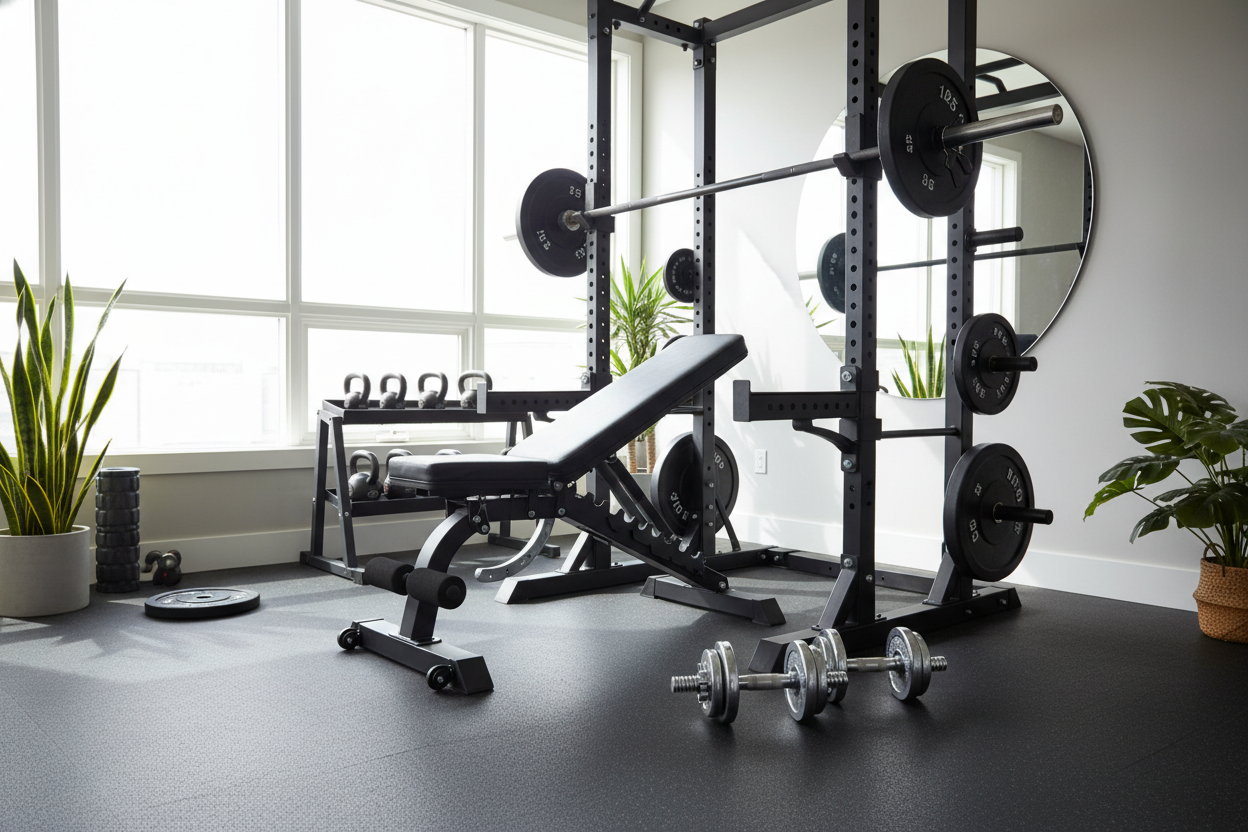
I remember the day I finally quit my $60-a-month commercial gym. I was tired of the crowds and the smell, so I hopped online and ordered the first weights bench and set that looked halfway decent. It arrived in one massive box, and I thought I had hacked the system.
Quick Takeaways
- Fixed-width uprights force your hands into positions that can cause shoulder impingement.
- The bars included in most 'weight set bench' bundles are often non-standard and dangerously thin.
- A modular setup (separate rack and bench) is safer and lasts longer than an all-in-one unit.
- Cheap vinyl pads offer zero grip, causing you to slide during heavy presses.
The All-In-One Illusion: Why We Fall for Starter Combos
It is easy to see why we bite on these deals. When you are looking at weight sets with bench packages, the marketing photos make everything look professional. You see a fit person doing a perfect press, and the price tag is usually less than a few months of gym dues. It feels like a win.
The reality is often a 'weight bench set with weights and bar' that is scaled down for a child. These frames are usually made of thin-walled 14-gauge steel that wobbles the moment you unrack more than 100 pounds. I learned the hard way that buying a weight bench set online requires looking past the glossy photos and checking the actual footprint and steel thickness.
The Biomechanics Problem Nobody Talks About
Lifting on a cheap frame is not just annoying; it is a recipe for a rotator cuff tear. When you use bench press sets with weights from a big-box store, you are at the mercy of the manufacturer's fixed geometry. Most of these units are designed to be compact, which means they are narrow. This narrowness dictates every single move you make.
Your Grip Width is Dictated by Cheap Steel
If the uprights on your weight bench and bar set are only 24 inches apart, your hands are stuck. You either have to grip inside the posts, which turns every chest day into a tricep-heavy close-grip session, or you grip outside. Gripping outside the posts on a narrow frame is a nightmare because your elbows will likely clip the steel on the way down.
I spent three weeks trying to find a 'sweet spot' on a budget weight bench and bar set, only to end up with a nagging pain in my front deltoids. You cannot force your body to adapt to bad engineering without paying a physical tax.
The J-Cups Are Always in the Wrong Spot
Most starter weight benches with weights included use fixed hooks rather than adjustable J-cups. If you have shorter arms, you might find yourself performing a half-rep just to get the bar off the rack. If you have long arms, you are stuck starting your lift from a dangerously deep position. It is sketchy, plain and simple.
The Hollow Barbell Trap
Let's talk about the 'bar' in these weight sets with bench combos. Usually, it is a three-piece threaded bar that feels like a piece of electrical conduit. These are not the 45-pound Olympic bars you see at the local powerlifting gym. They are often 1-inch 'standard' bars that max out at a 200-pound capacity.
I once loaded 150 pounds onto a starter bar and watched it visibly whip as I walked it out. Plus, figuring out true bench press bar weight on these sets is a guessing game. Some weigh 12 pounds, others 17. It makes tracking your progressive overload nearly impossible because the math never stays the same.
What to Buy Instead of a Pre-Packaged Box
If I could go back and talk to my younger self, I would tell him to buy the gym in pieces. Start with a dedicated standalone weight bench that has a high weight capacity and a grippy pad. A standalone bench allows you to adjust your position relative to a rack, rather than being bolted into a fixed, awkward spot.
Separating the bench from the rack also means you can use the bench for dumbbell work or move it out of the way for squats. It is about versatility. A 'weight bench and weights' combo might save you fifty bucks today, but you will be replacing it in six months when you realize it limits your growth.
My Top Picks for a Starter Setup That Won't Snap
If you are dead-set on a combo because space is tight, look for a bench setup with an adjustable barbell rack. This gives you the flexibility to change the height of the bar, which is the bare minimum for safety. It allows you to set a proper 'lift-off' height so you aren't blowing out your shoulders before the set even starts.
For those who want to skip the barbell struggle entirely, an independent arm chest press machine is a massive upgrade. It removes the stability issues of a cheap bar and allows you to focus purely on the muscle contraction without worrying about a wobbly rack collapsing on your chest.
FAQ
Do weight benches come with weights?
Some 'all-in-one' packages do, but they are usually low-quality plastic-coated cement plates. It is almost always better to buy your bench and plates separately so you can get iron or rubber bumper plates that actually last.
Is a 1-inch bar okay for benching?
It is fine for absolute beginners, but most people outgrow a 1-inch 'standard' bar within six months. They have lower weight capacities and don't fit standard Olympic plates, making them a dead-end investment.
How much weight can a starter bench hold?
Cheap combos often cap out at 300 to 400 pounds—and that includes your body weight. If you weigh 200 pounds, you can only safely lift 100 to 200 pounds before you are redlining the equipment's safety rating.
Share:
The Brutal Truth About Why I Reach for a 30 Lbs Dumbbell the Most
Stop Waiting for the Rack: The Actual Best Equipment at the Gym