
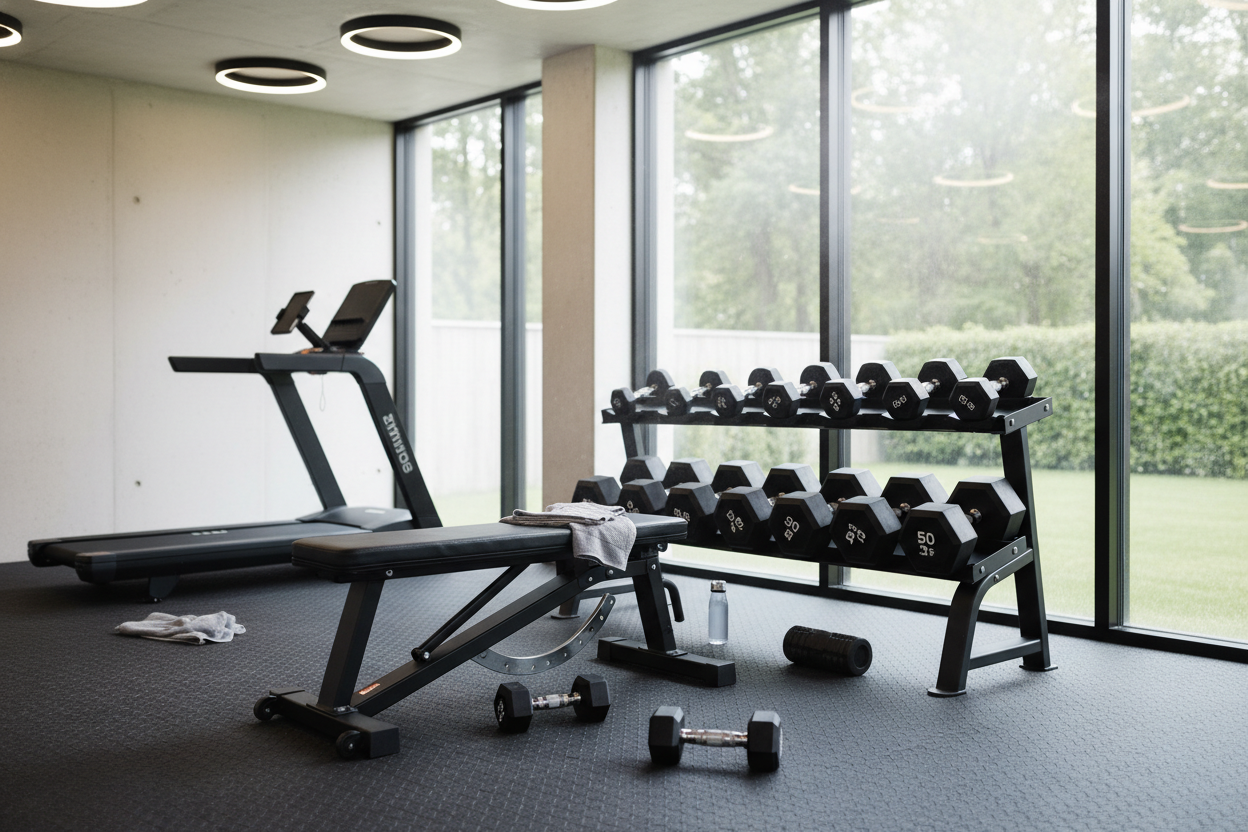
I’ve spent too many mornings tripping over a pair of 5-pounders that haven’t seen the light of day since my wife tried a barre video in 2019. If you’re building a garage gym, space is your most valuable currency, and cash is a close second. Buying a dumbbell set 20 50 is the veteran move that most lifters realize they should have made only after their floor is already cluttered with paperweights.
We’ve been conditioned to think we need the full rack, from the tiny 5s all the way up. But if you can already bench your bodyweight or pull a decent deadlift, those sub-20-pound weights are essentially expensive doorstops. You’re better off putting that money into quality steel and rubber that actually challenges your central nervous system.
- Saves Footprint: A 20-50 set fits on a compact 2-tier rack, leaving room for your rack or rower.
- Cost Effective: You aren't paying shipping costs for light weights you'll outgrow in a week.
- Hypertrophy Focused: This range is the 'Goldilocks zone' for high-volume accessory work.
- Resale Value: Mid-range weights hold their value much better than beginner sets on the used market.
The Expensive Trap of the Traditional 5-50 Rack
The standard 5-50 lb rack is the industry default, but for an intermediate lifter, it’s a waste of about 60 pounds of iron. When you buy the full run, you’re paying for the 5s, 10s, and 15s. That’s three pairs of dumbbells that take up roughly 12 to 15 inches of rack space. Unless you’re doing specific physical therapy movements or very high-rep rear delt flyes, those weights will gather dust.
Think about the logistics. Most commercial-grade racks are 48 to 60 inches wide. By skipping the light stuff, you can fit your entire dumbbell set 20-50 on a single, sturdy tier or a much smaller footprint. I’ve seen guys spend $300 extra just to have a 'complete' looking rack, only to realize they haven't touched a 10-pound weight in three years. That money could have gone toward a better barbell or a few extra 45-pound plates.
Furthermore, shipping is the silent killer of gym budgets. Freight costs for a full 5-50 set are significantly higher than a 20-50 set. You're effectively paying a premium to ship air and light iron that doesn't help you get stronger. Be tactical. Buy the weights you actually use for your work sets, not the ones that just make the gym look symmetrical.
Why the 20 to 50 Pound Range is the Hypertrophy Sweet Spot
If your goal is muscle growth, the 20 to 50 pound range is where the magic happens. For most intermediate lifters, 20s are the starting point for lateral raises and heavy bicep curls. By the time you get to the 50s, you have enough load for high-rep incline presses, weighted lunges, and single-arm rows. It’s the range that covers about 80% of your accessory movements.
When you realize a 50 lbs dumbbell set covers 90% of lifts for accessory work, the 20-50 range becomes the obvious choice. You can use the 25s for overhead tricep extensions, the 35s for Bulgarian split squats, and the 50s for Kroc rows. It forces you to focus on time under tension and mechanical tension rather than just ego-lifting massive weights with poor form.
I’ve found that having 5-pound increments in this range is crucial. Jumping from 30s to 40s is a 33% increase in load—that’s a recipe for a plateau or a shoulder tweak. A proper 20-50 set includes the 25, 35, and 45-pound pairs, allowing for that steady, incremental progress that builds real tissue over time. It’s about being surgical with your training volume.
Wait, What About a Dumbbell Set 15 50?
I’ll give a pass to the dumbbell set 15 50 if you’re coming off an injury or if you really prioritize high-rep isolation work like Lu raises or strict face pulls. Sometimes that 15-pound jump is necessary to warm up the rotator cuffs before you start throwing the 40s around. It’s a solid compromise if you feel 20 is just a bit too aggressive for a starting point.
If you find yourself needing something lighter down the road, you can always look into expanding your dumbbell collection by picking up a single pair of 10s or 12s. But starting with the core 20-50 range ensures your budget is focused on the 'meat and potatoes' of your programming. Don't let the fear of missing out on light weights dictate your initial investment.
Fixed Rubber Hex vs. Adjustables in the Mid-Range
This is the classic debate. In the 20-50 pound range, I almost always lean toward a fixed rubber hex dumbbell set. Why? Because you can drop them. When you’re pushing a set of 50s to failure on a heavy bench press, the last thing you want to worry about is whether the plastic dial on your adjustable is going to shatter when it hits the stall mats.
Fixed dumbbells also have a much better balance. Most adjustable dumbbells are abnormally long, even at lower weights, because the handle has to accommodate the full stack. This makes movements like curls or overhead presses feel clunky and awkward. With a fixed hex set, a 25-pounder feels like a 25-pounder—compact, maneuverable, and indestructible.
The rubber coating is a non-negotiable for me. It saves your floor, it dampens the noise, and it doesn't have that 'old gym' smell of raw cast iron. If you have the space for a small rack, the speed of just grabbing the next pair of weights beats fumbling with a selector pin every time you want to do a drop set.
How to Structure Your Workouts Without the Light Weights
You don't need 5s and 10s to get a world-class pump. If a 20-pound dumbbell feels too heavy for a specific movement, change the mechanics. Use a 'top-down' approach. Instead of traditional lateral raises, try leaning away from a power rack to change the resistance curve, making that 20 feel lighter at the bottom and heavier at the top.
Tempo is your best friend when you’re capped at 50 pounds. If you can smash 50s for 15 reps on the chest press, start using a 4-second eccentric (lowering) phase. I guarantee those 50s will start feeling like 80s real fast. You can also utilize pre-exhaustion. Hit a set of push-ups to failure, then immediately grab the 35s for flyes. You’re getting more 'work' out of less 'weight.'
Personal Experience
When I first built my gym, I bought a beautiful, shiny 5-50 set. I felt like a pro. Six months later, I realized the 5s, 10s, and 15s were literally just collecting spider webs in the corner. I eventually sold them on Craigslist for half what I paid just to make room for a second barbell. It was a rookie mistake. Now, I tell everyone: start at 20. If you can't lift the 20s yet, do more bodyweight work until you can. Your wallet and your floor space will thank you.
FAQ
Is a 20-50 set enough to get big?
Absolutely. If you focus on high volume, short rest periods, and perfect tempo, 50-pound dumbbells are plenty for building significant muscle, especially for upper body accessory work.
What rack size do I need for a 20-50 set?
A standard 2-tier, 40-inch rack will easily hold a 20-50 set in 5-pound increments (7 pairs total). It’s a very compact setup for a small garage.
Should I get 15s later?
Only if you find your accessory form is breaking down. Most lifters can use 20s for almost everything by simply adjusting their range of motion or volume.
Share:
Why I Tell Beginners to Avoid Most Weights and Bench Sets
I Hunted for a Play It Again Sports Weight Bench (Here's What I Found)