
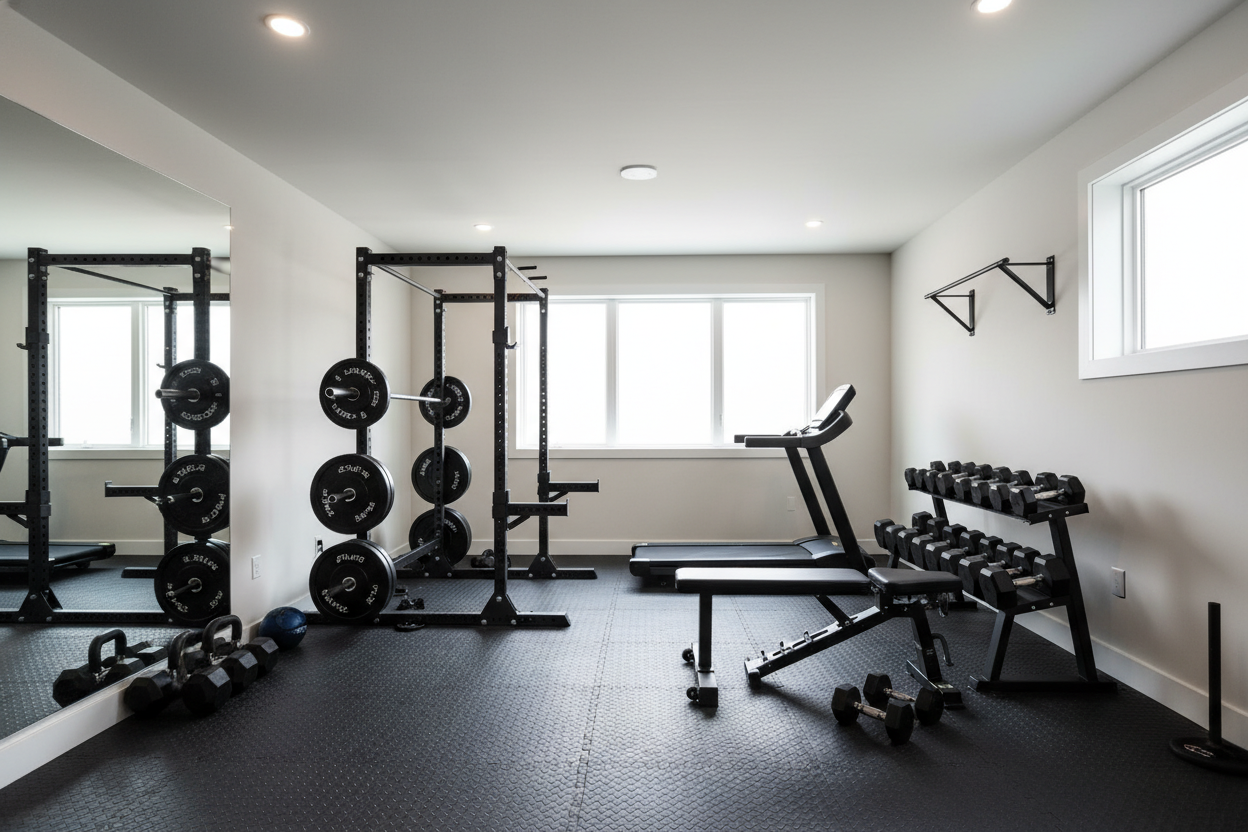
I remember the night I finally quit my local big-box gym. I was waiting ten minutes for a squat rack while some guy in neon spandex did curls in the heavy lifting zone. I went home and immediately started sketching out weight room designs for my garage. I thought I could just shrink down a commercial layout and have a private paradise.
I was dead wrong. Most professional gym setups are designed for volume and liability, not for a single human being trying to get strong in a two-car garage. If you try to copy a commercial floor plan, you will end up with a cluttered mess that kills your motivation before you even finish your warm-up.
- Prioritize the Barbell: Your floor plan should live and die by the 7-foot Olympic bar.
- Avoid Zoning: Dedicated cardio or machine zones are a waste of precious square footage.
- Think Vertically: If you can't press overhead, your weight room setup is a failure.
- Adjustable is King: One pair of adjustable dumbbells replaces an entire wall of fixed iron.
Stop Trying to Build a Mini Gold's Gym
Commercial gyms have thousands of square feet to play with. They can afford to have a 'cardio row' and a 'leg circuit' because they need to keep 50 people busy at once. In a 400-square-foot garage, that logic is poison. When you try to segment your space, you create dead zones that you only use for five minutes a workout.
A proper residential weight room setup should be fluid. You don't need a row of treadmills blocking your path to the power rack. You need a centralized workspace where you can transition from squats to pull-ups to rows without playing Tetris with your equipment. If you can't move 360 degrees around your primary station, your flow is broken.
The 'Halo' Method for Rack Placement
The power rack is the sun in your solar system. Everything else orbits it. I see too many guys shove their rack into a corner to 'save space.' This is a disaster. You need a 'halo' of clear floor—at least 4 feet on either side of the uprights. Why? Because a standard barbell is 7 feet long, and you need room to slide 45-lb plates on without punching a hole in your drywall.
Before you bolt anything down, start by fixing your cluttered garage. Once the junk is gone, map out your halo. You need enough clearance for safety bails and a spotter, even if the spotter is just your own ego. If your bar is 84 inches wide, an 8-foot wide platform is the bare minimum for a functional weight room set up.
Where Most People Screw Up Their Dumbbell Zone
We all love the look of a long, chrome-filled dumbbell rack. It looks professional. It also takes up 10 to 12 linear feet of wall space that you probably don't have. Unless you're training three people at once, a 15-pair commercial rack is a tragic waste of space. It’s a dust collector that prevents you from putting a functional cable machine or storage unit in that spot.
I transitioned to heavy-duty adjustable dumbbells years ago, and I never looked back. Pair those with a sturdy adjustable weight bench that has a small footprint and transport wheels. This allows you to tuck your 'dumbbell zone' into a 4x4 foot corner when you're done, keeping the center of the room open for heavy carries or lunges.
The Folding Equipment Trap (And Real Footprints)
Marketing departments love to sell the dream of a 'fold-away' gym. They show a rack that tucks 4 inches against the wall. It looks great in a catalog. In reality, most people find that the three minutes it takes to unfold, pin, and stabilize the equipment is enough of a barrier to skip the workout entirely. Plus, you still can't store anything in the space where the rack *would* be when unfolded.
Instead of a flimsy folding unit, I almost always recommend a dedicated weight bench and a slim-profile wall-mount rack. A rack with a 24-inch depth is stable enough for 500-lb squats but still leaves plenty of room for a car or a lawnmower. Don't buy equipment based on how it looks when you aren't using it; buy it based on how it performs when you are mid-set.
Don't Forget About the Z-Axis
Space isn't just about the floor. I’ve seen beautiful weight room designs ruined because the owner didn't account for 8-foot ceilings. If your pull-up bar is so high that your head hits the rafters, or if you can't lock out an overhead press without hitting a light fixture, you've got a problem. Measure your reach before you buy a 90-inch rack.
Focus on the foundation. A solid lifting platform protects your concrete and your joints. Stop buying more iron until you've actually optimized the vertical and horizontal space you have. A clean, open floor with a single high-quality barbell beats a cramped room full of cheap machines every single day.
How much floor space do I actually need for a rack?
At a minimum, you need an 8x8 foot area. This accounts for the 7-foot barbell and enough room to stand behind the bench or rack to load plates and move safely.
Should I put mirrors everywhere like a commercial gym?
One or two large mirrors in front of your rack are helpful for form. Covering every wall is overkill and makes the room feel smaller. Plus, you'll spend more time cleaning glass than lifting.
What is the best flooring for a garage weight room?
Standard 3/4-inch horse stall mats are the gold standard. They are dense, cheap, and virtually indestructible. Avoid the thin foam puzzle mats; they compress under heavy weight and offer zero protection for your floor.
Share:
Stop Buying Flimsy Racks: The Best Home Gym Equipment Under $500
I Wasted $400 on a Barbell Starter Set (Here's What I Learned)