
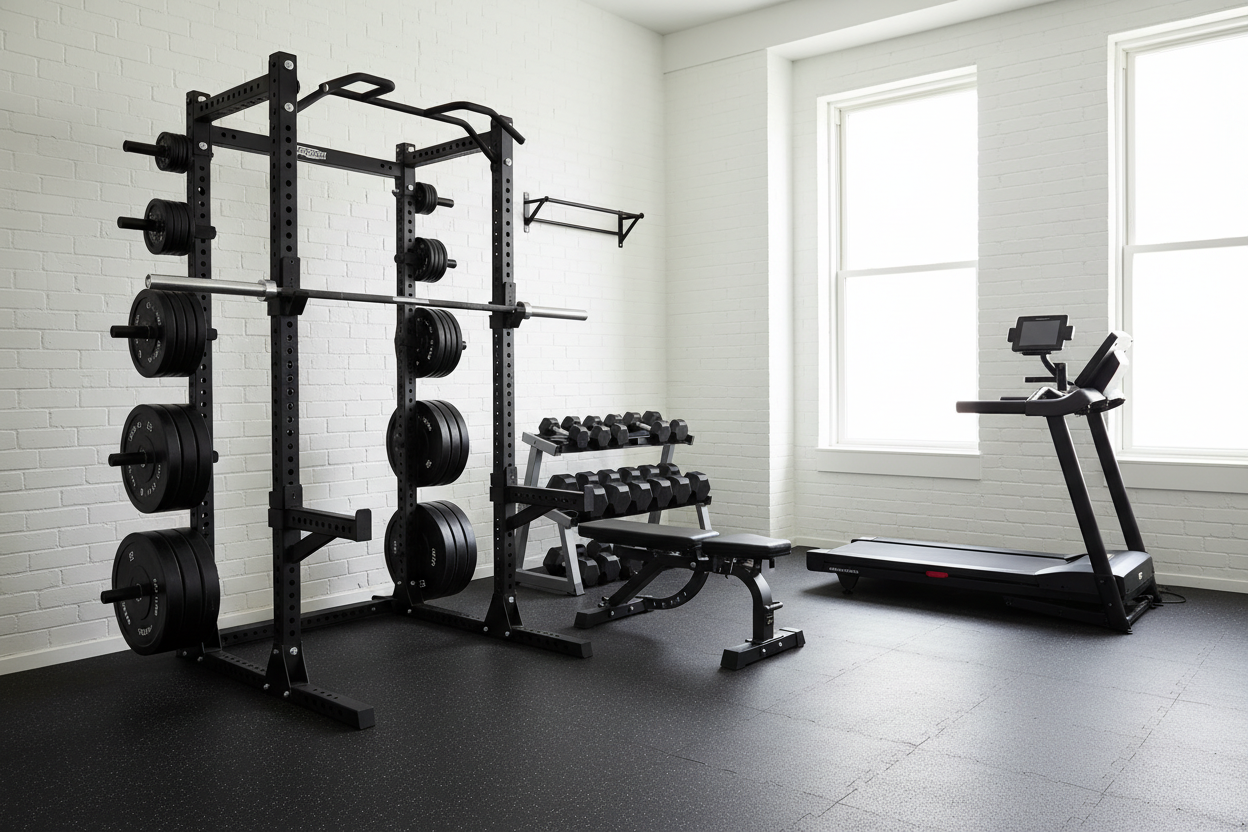
I spent years thinking my garage was a gym, but it was really just a graveyard for cast-iron plates and expensive cables. I'd spend ten minutes moving a lawnmower just to do a set of squats, and by the time I was warm, my motivation was dead. Building the best weight room isn't about how much you spend on a rack; it's about whether you can actually move inside the space.
Most of us start by scrolling through gear lists and clicking \"buy\" before we've even measured the floor. We end up with a high-end rack jammed against a wall and a pile of dumbbells we have to step over every time we want to change the weight. It’s frustrating and inefficient.
Quick Takeaways
- Leave at least 2 feet of clearance on all sides of your rack for plate loading.
- Group equipment by \"flow\" (Heavy, Accessory, Mobility) to avoid backtracking.
- Floor space is a premium feature, not a vacancy to be filled.
- Lighting and airflow dictate the mood more than the brand of your barbell.
Why Your Current Setup Feels Like a Storage Unit
We’ve all been there: you buy a beautiful piece of steel, and the only place it fits is right up against the drywall. Suddenly, you’re shimmying sideways just to slide a 45-lb plate onto the sleeve. training in a cluttered garage isn't just annoying; it's a safety hazard. If you have to perform a balancing act just to get to your pull-up bar, you’re going to start skipping the movements that feel like a chore to set up.
The \"Tetris\" approach to gym design is a trap. You try to maximize every square inch, but you forget that you need space to move, sweat, and occasionally fail a rep. A gym that feels like a storage unit is a gym you'll eventually stop using. You need a layout that respects the barbell's path and your own range of motion.
The 'Zone' Method for Building the Best Weight Room
Commercial gyms don't just throw machines at the wall. They use zones. Your home setup should do the same. I break my space into three distinct areas: the Heavy Zone, the Accessory Zone, and the Open Zone.
The Heavy Zone is centered around your rack or platform. This is where the 11-gauge steel lives. The Accessory Zone holds your dumbbells and benches. The Open Zone is the most underrated part of the best weight room—it's where you do your mace swings, mobility work, or just catch your breath between sets. Even in a 10x12 spare bedroom, you can create these zones by simply grouping your storage and keeping the middle clear.
Stop Shoving Your Power Rack in the Corner
This is the biggest mistake I see. People shove their rack into a corner to \"save space.\" What they actually do is make the left side of the barbell unusable. You need at least 24 inches—ideally 30—of clearance on both sides of the rack. This isn't just for loading plates; it's so you can actually walk around the bar without hitting your head on a wall-mounted rack or tripping over a bench.
If you have a 4-post or 6-post rack, pull it out from the wall. This allows you to spot from the back and gives you room for rear-mounted plate storage. If you're constantly bumping into your drywall during a walk-out, your rack is too close. Give the iron some room to breathe.
Bench Placement and the Art of Accessory Flow
Your bench should be the most mobile piece of gear you own. I always recommend a versatile adjustable weight bench with high-quality wheels. You want to be able to roll it into the rack for presses, then move it to the center of the room for dumbbell work, and finally tuck it away when it’s time for lunges.
Fixed machines are different. If you’re adding a plate-loaded chest press machine, it needs a permanent home that doesn't intersect with your main barbell path. Place these fixed pieces along the perimeter, but ensure there’s enough room to fully load the weight horns without hitting your shins on the dumbbell rack behind you. Flow is about never having to move one piece of equipment to use another.
The Unsexy Stuff: Lighting, Flooring, and Airflow
You can have the best calibrated plates in the world, but if you’re training in a dark, stagnant basement, your workouts will suck. Lighting is huge. Swap those single 60-watt bulbs for LED shop lights—aim for at least 5000 lumens. It makes the space feel professional and keeps you alert.
Flooring is the foundation. Don't waste money on thin foam tiles that pull apart during lateral lunges. Go with 3/4-inch horse stall mats. They’re heavy, they smell like a tire shop for a week, but they’ll protect your concrete and your joints for a decade. Finally, get a high-velocity floor fan. If the air isn't moving, you're going to overheat before you finish your main lifts.
Less Is More When Designing Your Floor Plan
The urge to buy a massive corner multi-gym is strong when you're starting out. It looks like it does everything. In reality, those machines often have mediocre cable ratios and take up the footprint of three better pieces of equipment. They dictate the room's flow rather than serving it.
The best weight room is one that evolves. Leave some floor space open. That empty 6x6 patch of rubber matting is more valuable for your long-term progress than a leg extension machine you'll use once a week. You can always add more iron later, but you can't easily add more square footage.
My Biggest Layout Mistake
When I built my first gym in a 10x10 shed, I bought a massive 6-post rack with 42-inch depth. I thought it was awesome until I realized I couldn't actually fit a barbell inside and still close the door. I had to load the plates, then step outside to wait for my set. It was ridiculous. I eventually swapped it for a 4-post rack and gained back three feet of floor space. That extra room changed the entire vibe of my training. I stopped feeling claustrophobic and started hitting PRs again because I wasn't worried about hitting the walls.
FAQ
How much space do I really need for a power rack?
A standard Olympic barbell is 7.2 feet long. You need at least 9 or 10 feet of width to comfortably load plates and move around. For depth, plan for at least 4 feet for the rack plus another 3 feet for your bench and walk-out.
What's the best flooring for a second-story weight room?
If you're upstairs, you need more than just mats. Look into \"deadening\" platforms or high-density crumb rubber. You want to spread the load across the joists so you don't end up in your kitchen mid-deadlift.
Can I put my gym on carpet?
You can, but it’s not ideal. Carpet creates an unstable surface for heavy lifting. If you must, lay 3/4-inch plywood over the carpet first, then top it with rubber mats. This creates a solid, level \"subfloor\" for your rack.
Share:
Stop Guessing Your Lift Bar Weight (It Isn't Always 45 Lbs)
The Only Machines for Lower Back That Won't Destroy Your Spine