
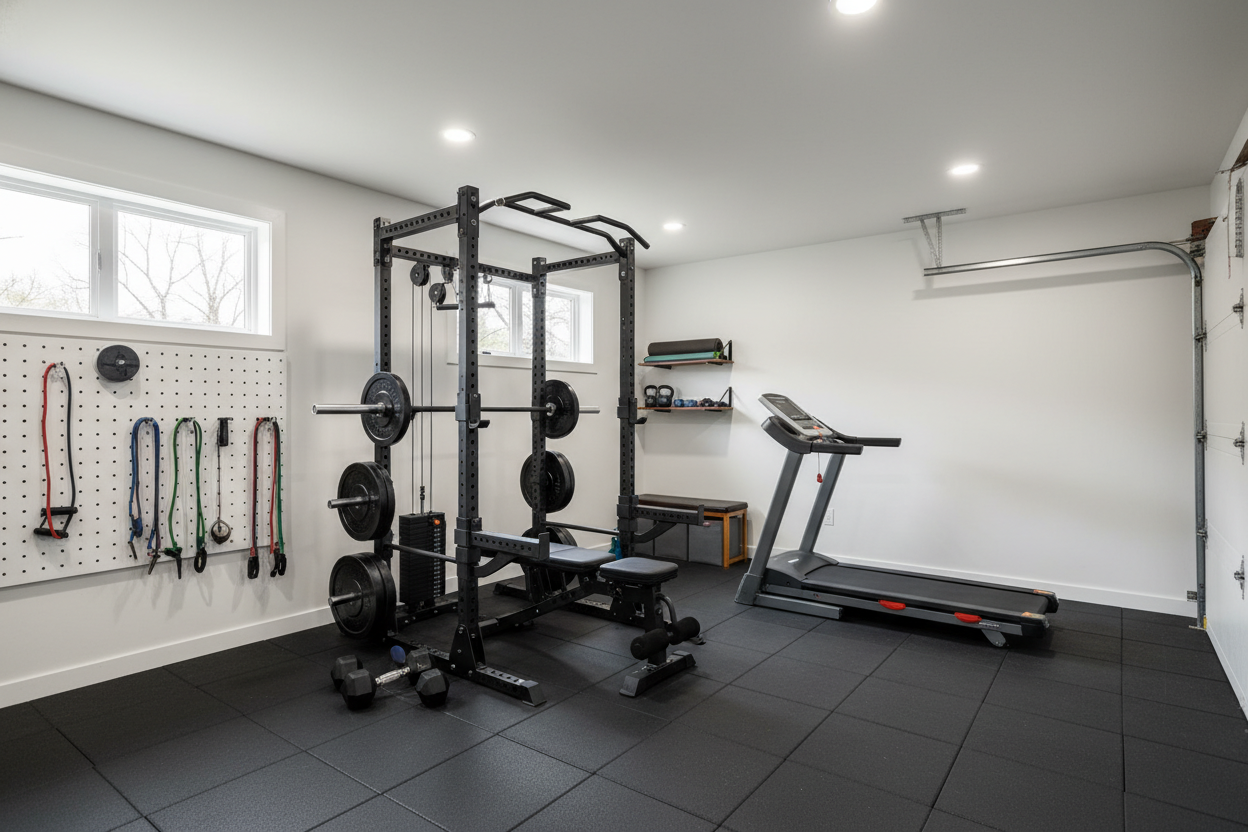
I remember staring at my two-car garage three years ago, convinced I needed a dedicated leg press. I spent twelve hundred bucks on a beast that took up 25 square feet and only did one thing. Now, it serves as a very expensive shelf for my shop vac and a pile of old moving blankets. Finding the best fitness training equipment isn't about matching the local commercial gym; it's about making every inch of your floor earn its keep.
Most people start their home gym journey by trying to replicate the rows of machines at Big Box Fitness. That is a fast track to a cluttered, unusable room. When you lift at home, your priorities shift from 'what looks cool' to 'what can I do 50 different things with?' If a piece of gear only trains your hamstrings, it better be the size of a shoebox, or it has no business in your house.
- Versatility over Isolation: Prioritize gear that allows for compound movements (squats, presses, rows).
- Footprint Matters: Measure your floor space and ceiling height twice before clicking buy.
- Quality Steel: Look for 11-gauge or 14-gauge steel for racks to ensure safety and stability.
- Storable Cardio: Choose machines that fold or have wheels for easy relocation.
Why the Commercial Gym Blueprint Ruins Your Garage
The biggest mistake I see is the 'machine creep.' You buy a standalone leg extension, then a preacher curl bench, then a dedicated low row station. Suddenly, you have $4,000 worth of equipment but no room to actually move. Commercial gyms have 20,000 square feet to waste; you probably have 400. You need to stop buying single machines if you want a space that stays functional for the long haul.
Every single-use machine is a liability. That leg extension might feel great for isolation, but it won't help your overhead press or your deadlift. When you fill your space with specialized gear, you lose the ability to do high-intensity circuits or even just stretch properly. I’ve seen guys with incredible setups who end up working out in their driveway because their garage is literally too full of equipment to stand in.
Think about the ROI of your square footage. A power rack takes up about 16 square feet but allows for hundreds of movements. A seated calf raise machine takes up 10 square feet and does exactly one. The math doesn't favor the specialists. Stick to the basics that allow for heavy, multi-joint loading. Your joints and your floor plan will thank you.
The Core of the Best Fitness Training Equipment
The foundation of any serious home gym is a power rack. If you have a solid rack, an adjustable bench, and a quality barbell, you can do 95% of what any pro bodybuilder or powerlifter does. I prefer racks with 3x3-inch uprights and 1-inch or 5/8-inch holes. This isn't just about weight capacity; it's about the ecosystem of attachments. You can add dip bars, landmines, and pull-up handles to a rack, turning a 4x4 footprint into a total-body station.
An adjustable bench is the second non-negotiable. Look for one with a ladder-style adjustment and no massive gap between the seat and the back pad. If you're benching 225 lbs, you don't want a bench that wobbles or feels like it's made of soda cans. I look for a weight rating of at least 1,000 lbs—not because I'm benching that much, but because it indicates the structural integrity of the welds and frame.
Functional trainers are the dark horse of home equipment for training at home. While they look like they take up a lot of room, a dual-stack cable system replaces about ten different machines. You can hit chest flies, face pulls, lat pulldowns, and cable crossovers in a single spot. If you get a rack-mounted cable system, you’re saving even more space. This is the ultimate resistance equipment for home because it provides constant tension that you just can't get with free weights alone.
The Unfair Stigma Around Modern Combo Machines
For a long time, 'all-in-one' machines were junk. They were flimsy, the cables were rough, and the biomechanics were off. That’s changed. A high-quality Smith machine home gym station is now a legitimate centerpiece for a residential setup. These modern units combine a power rack, a Smith bar, and a cable crossover into a single footprint.
The benefit here is safety and efficiency. If you're training alone at 6:00 AM, the Smith bar gives you a built-in spotter for heavy squats or incline presses. The integrated pulleys mean you don't have to walk across the room to switch from a heavy set of rows to face pulls. I’ve tested units where the cable travel is as smooth as anything you’d find in a $100-a-month health club. Don't let the old-school lifters tell you these are 'cheating'—they are space-saving tools that get results.
Cardio Gear That Doesn't Ruin Your WFH Office
If you're working from home, your gym might also be your office. Nothing kills a professional vibe like a massive, greasy treadmill behind you during a Zoom call. This is where you need to be smart about work from home workout equipment. You need high-intensity options that disappear when you aren't using them.
I've seen too many people buy a commercial-grade treadmill only to realize it weighs 300 lbs and requires a dedicated 20-amp circuit. For most people, a foldable upright exercise bike is a much better play. It gives you the metabolic hit you need between meetings, but it can be rolled into a corner or a closet when the workday starts. Magnetic resistance is key here—it’s nearly silent, so you won't wake up the kids if you're getting a session in before sunrise.
Don't overlook simple tools like a heavy jump rope or a set of adjustable kettlebells either. These are the kings of training at home equipment because they require zero dedicated floor space. You can get a world-class conditioning session done in the same spot where you stand to answer emails.
How to Vet Gym Equipment to Use at Home Without Regrets
Before you drop a grand on a new piece of gear, you need to run the numbers. First, check the ceiling clearance. A 90-inch power rack sounds great until you realize your basement ceiling is 88 inches and you can't actually do a pull-up without hitting your head. Always account for the 'active' space—the area you need to actually move the weights, not just the static footprint of the machine.
Second, look at the gauge of the steel. In the world of home workout devices, anything thinner than 14-gauge is going to feel shaky. If you're serious, 11-gauge is the gold standard. I spent hours digging through the best at home workout equipment Reddit swears by to see what actually survives years of abuse. The consensus is always the same: buy once, cry once. Cheap gear with plastic pulleys and thin frames will end up on Facebook Marketplace within six months.
Finally, consider the maintenance. Does it have greasable fittings? Are the cables nylon-coated? If it’s a home fitness device that requires a technician to service it, skip it. You want equipment you can maintain with a wrench and some 3-in-One oil. The best home fitness setup is the one that is always ready to use, not the one waiting for replacement parts.
My Biggest Gear Mistake
I once bought a 'budget' power rack from a big-box store. It looked fine in the photos, but the first time I racked 315 lbs, the whole thing swayed three inches to the left. The J-cups were thin and started to bend after a month. I ended up selling it for half what I paid and buying a real 3x3 rack. I lost $200 and a lot of confidence in my lifts that month. Now, I won't touch anything that doesn't have a solid warranty and beefy hardware.
FAQ
What is the minimum space needed for a home gym?
You can get a lot done in a 6x8 ft space with a set of adjustable dumbbells and a bench. If you want a full power rack, aim for at least 10x10 ft to allow for plate loading on the sides of the bar.
Is a Smith machine better than a power rack for home?
It depends on your goals. A power rack is more versatile for functional strength, but a Smith machine combo is safer for solo lifters and often includes integrated cables that save massive amounts of space.
How do I stop my equipment from rusting in a garage?
Keep your gear wiped down with a light coat of 3-in-One oil or a dedicated equipment protectant. A dehumidifier in the garage is also a massive help if you live in a humid climate.
Share:
Why Your Smith Machine Starting Resistance Is Lying to You
How to Judge Weight Machine Cost Without Getting Ripped Off