
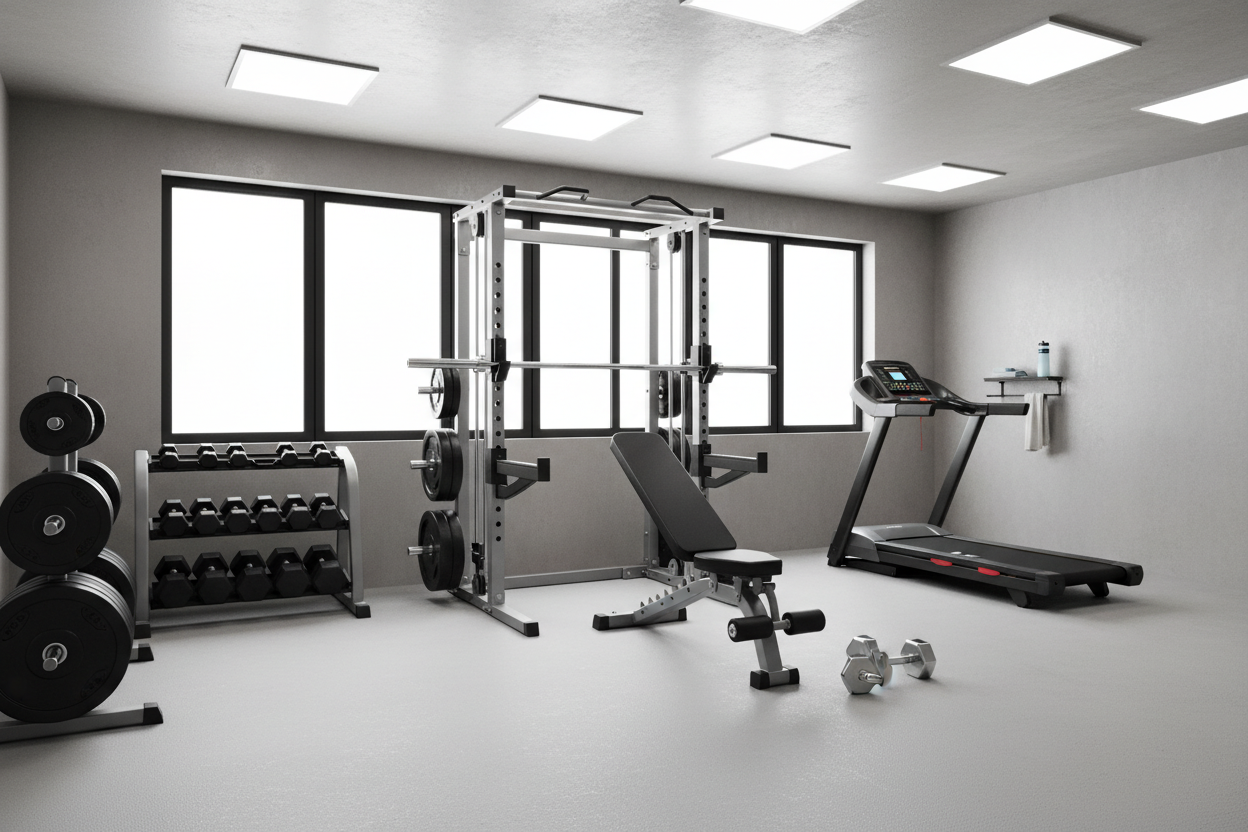
I remember the first time I hit a heavy incline press on a commercial gym unit and felt like my shoulders were being fed into a woodchipper. I couldn't figure out why it felt so much worse than my home rack until I looked at the guide rods. They were perfectly vertical. Most people don't realize that the smith machine angle is the difference between a massive chest pump and a week of icing your rotator cuffs.
- Angled machines (7-12 degrees) mimic the natural arc of human movement.
- A straight smith machine is better for isolation moves like calf raises or shrugs.
- Facing the wrong direction on a slanted rack is the fastest way to wreck your knees.
- Home gym owners should prioritize angled tracks for better versatility in compound lifts.
Wait, Why Are Some Smith Machines Angled?
If you've ever watched a pro powerlifter bench press, you'll notice the bar doesn't travel in a straight line. It moves in a slight 'J' curve. This is why are smith machines angled in the first place. Engineers realized that forcing a human being to move a heavy load in a perfectly vertical line is a recipe for joint impingement.
Most commercial and high-end home units feature a pitch between 7 and 12 degrees. This slant allows the bar to move slightly forward or backward as you descend, which tracks much closer to how your bones and tendons actually want to move. When people ask why are some smith machines angled, the answer is simple: physics and anatomy finally started talking to each other.
Straight Smith Machine vs. Angled: The Bar Path Showdown
A straight smith machine isn't inherently 'bad,' but it is specialized. I find vertical tracks are king for movements where you want zero horizontal deviation. Think seated calf raises, behind-the-back shrugs, or even some types of rack pulls. In these scenarios, the vertical line helps you stay stacked directly over your center of gravity.
However, for the big stuff—squats, presses, and rows—the angled track wins every time. On an angled machine, you can lean into the bar or push away from it, creating a more 'free weight' feel while keeping the safety of the lockout hooks. If you try to bench 315 lbs on a vertical track, you're forcing your elbows into a fixed plane that doesn't account for the natural flare of the humerus. It feels clunky because it is clunky.
Squatting on a Slant: Saving Your Knees and Back
Squatting on an angled smith machine can be a revelation if you do it right. By utilizing the pitch, you can mimic a hack squat or a traditional back squat with much more precision than a vertical drop allows. If the track slants 'away' from you as you go down, it encourages a hip hinge that keeps the load off your patellar tendons.
I've found that for quad-dominant work, an angled track lets me tuck my feet slightly forward without feeling like I'm going to tip over. On a vertical machine, that same foot placement puts a brutal amount of shear force on the knees. If you've got cranky joints, the angle isn't just a feature; it's a necessity.
Pressing Movements: How to Not Shred Your Shoulders
The bench press is where the smith machine angle truly shines. A natural bench path starts over the shoulders and ends at the lower chest. That's a diagonal line. If you use a slanted machine, you can align that rod to match your natural press. This keeps the tension on the pecs and off the delicate front delts.
The same goes for overhead pressing. A slight backward slant as you press up allows your head to clear the bar naturally without you having to perform a weird neck contortion. It’s the difference between a smooth, powerful drive and a jerky, uncomfortable struggle against the machine's frame.
The Golden Rule: Which Way Do You Face on a Slanted Rack?
This is the 'idiot-proof' part that most people get wrong. If you are pressing (bench or overhead), you should face the direction that allows the bar to travel *toward* your face as you push up. This mimics the natural J-curve. If you face the other way, you're forcing the bar to move away from your center of mass, which is a great way to tear something.
For squats, it depends on your goal. If you want to hit your quads like a hack squat, face away from the angle so the bar moves 'back' as you descend. If you want a more traditional powerlifting feel, face into the angle. Just remember: the bar should never feel like it's pushing you out of balance. If it does, turn around.
Picking the Right Track for Your Home Gym
When you're ready to stop paying that monthly membership and build your own dungeon, the track type matters. A vertical unit is often cheaper and has a smaller footprint, but you'll outgrow its limitations quickly. If you're looking for a Smith Machine that can actually replace your barbell work, go angled.
I recently tested the All In One Smith Machine With Cable Crossover S1 V4 and was impressed by how the fixed path felt natural even during heavy incline work. It’s a beast of a unit that handles the 'weird' angles of the human body without complaining. I actually wrote a piece on Why I Replaced 5 Pieces of Gear With an All In One Smith Machine because, honestly, most of us don't have the room for five separate stations and a slanted smith covers about 80% of my needs.
Personal Experience: The 7-Degree Mistake
I spent years thinking Smith machines were 'cheating' until I blew out my L5-S1 disc. Suddenly, the stability of a fixed track was the only way I could squat. But I bought a cheap, vertical-track used rack off Craigslist. Big mistake. My back felt better, but my knees started screaming within a month. I finally swapped it for a 7-degree angled unit, and the difference was night and day. Don't be cheap with your biomechanics.
FAQ
Is a straight smith machine better for anything?
Yes. For pure isolation moves like shrugs, calf raises, or even some types of bicep drags, the vertical path is actually superior because it prevents any 'cheating' through horizontal momentum.
What is the most common smith machine angle?
Most commercial-grade machines use a 7-degree angle. Some heavy-duty or specialized units might go up to 12 degrees, but 7 is the industry standard for a reason—it fits the widest range of body types.
Can I do lunges on an angled smith machine?
Absolutely. In fact, it's better. Face the direction that allows the bar to travel slightly 'back' as you drop into the lunge. This helps keep your front shin vertical, which is much easier on the knees.
Share:
Are Smith Machine Hip Thrusts Effective for Real Glute Growth?
Tight on Space? The Best Smith Machine UK Garages Can Fit