
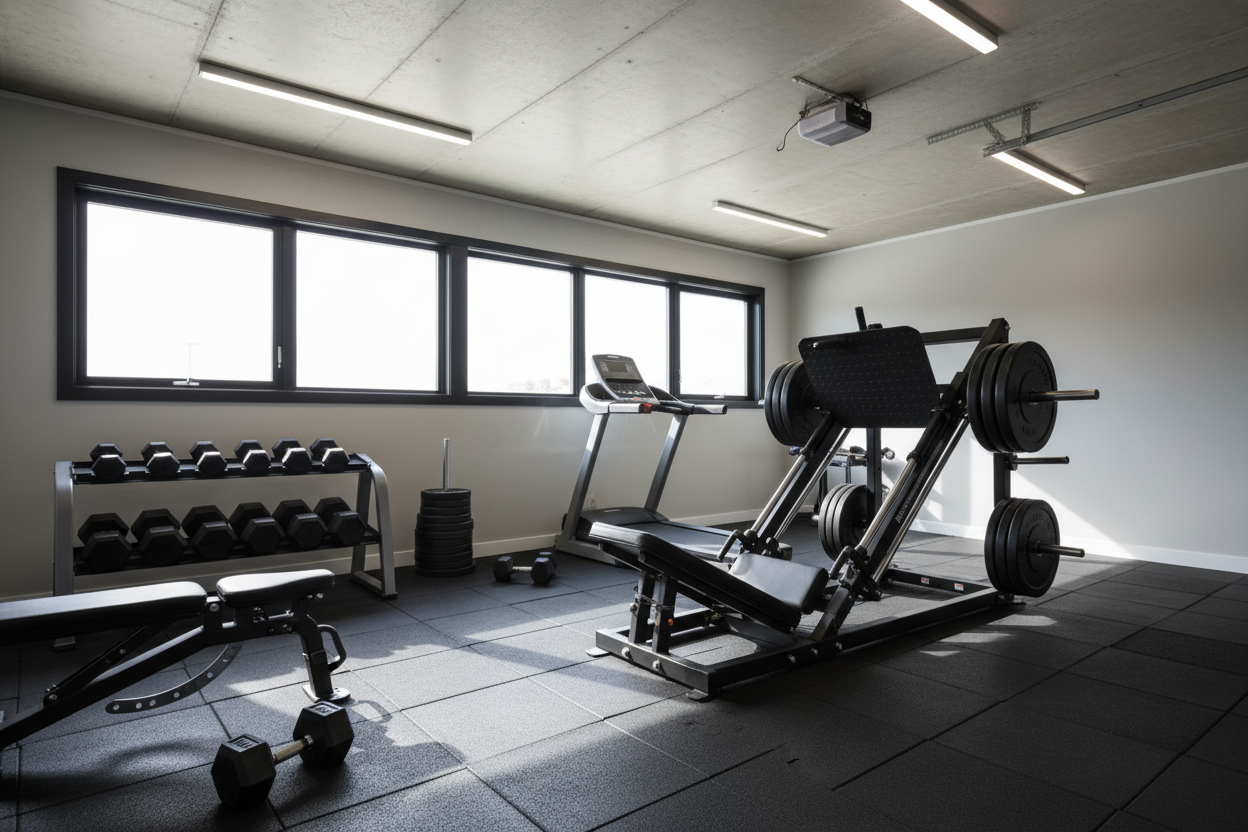
I remember the day the freight truck pulled up with my first weight leg press machine. It was sitting on a double-wide pallet, wrapped in enough industrial plastic to survive a hurricane, and the driver just looked at my driveway and shook his head. He asked me if I was opening a Gold’s Gym or if I just hated my foundation. That’s the moment the anxiety hits: you realize you’re about to put nearly a ton of concentrated iron on a slab of concrete that was originally designed to hold a Honda Civic.
Quick Takeaways
- Standard 4-inch garage concrete slabs are rated for 2,500 to 3,000 PSI, but point loads are the real enemy.
- The starting weight of leg press machine sleds usually sits between 75 and 115 lbs.
- A fully loaded commercial unit can easily exceed 1,500 lbs including the user and plate storage.
- Plywood distribution platforms are the best insurance policy for your floor.
The Sudden Terror of Gym Floor Physics
Adding a rack is one thing. A rack spreads its weight across a large rectangular footprint. But a heavy-duty weight leg press is a different animal. These machines are dense. You are taking 400 to 800 pounds of steel frame and concentrating that mass into four or six small rubber feet. When you start stacking 45-pound plates on the storage horns and the sled, you aren’t just training legs; you’re conducting a structural stress test on your home.
Most residential garages use a 4-inch pour. In theory, that’s plenty. In practice, if your builder took shortcuts or if there are air pockets under the slab, a 1,000-pound rig vibrating during a heavy set can turn a hairline fracture into a genuine problem. I’ve seen guys bolt these down only to find the concrete spider-webbing six months later because they didn’t account for the 'thud' of a locked-out safety catch.
Calculating the True Weight of Leg Press Machine Sleds
Before you even touch a plate, you’re fighting the sled. People always ask how much leg press machine weight
they are actually pushing at the start. Because of the 45-degree angle, you aren’t moving 100% of the sled’s mass. Physics tells us you’re moving about 70% of the actual weight due to the incline. It is a deceptive bit of math, much like trying to figure out how much weight does a Smith machine take off when you’re used to a free-weight barbell.
If your machine has a 100-lb sled, it feels like 70 lbs. But don’t let the 'feel' fool you. Your floor doesn’t care about physics or angles; it only cares about gravity. Every plate you add to those horns is a direct vertical load on the concrete. If you’ve got 10 plates a side, that’s 900 lbs of iron, plus a 600-lb machine, plus your own body weight. You are looking at a 1,700-lb footprint in a 4x7 area. That is heavy.
Can Your Concrete Actually Handle the Load?
Most modern concrete is rated for 3,000 PSI (pounds per square inch). That sounds like a lot, but that rating is for the entire slab. The danger is the 'point load.' If your machine has four feet that are each 2x2 inches, you are focusing all that weight into 16 square inches. If you drop a heavy load onto the safety stops, that momentary force can spike way past the static weight of the machine.
I always tell people to check for 'hollow' sounds by tapping a sledgehammer lightly on the floor. If it rings hollow, don't put a leg press there. You also need to consider the weight of your plate tree if it’s right next to the machine. You’re creating a 'hot zone' of weight that can cause the slab to settle unevenly. I’ve seen garage doors start sticking because the floor shifted half an inch under a massive leg rig.
Lighter Alternatives for Wooden Subfloors
If you are training in a spare bedroom or an upstairs apartment, stop right now. Do not put a commercial leg press on a wooden joist system. You will literally end up in the kitchen below you. For those situations, you need to be smarter about how you isolate the quads without the 1,000-pound footprint.
A solid bench with a leg extension attachment is a much safer bet for upstairs gyms. It gives you the quad isolation you’re craving without requiring a structural engineer's approval. If you really want to punish your legs, a standard weight bench used for high-volume Bulgarian split squats will build just as much mass as a leg press, and it weighs about 60 pounds instead of 600. Your floors (and your shins) will thank you.
The Final Verdict on Heavy Leg Days at Home
Should you buy a dedicated leg press? If you have the space and a solid concrete floor, absolutely. Nothing builds quad volume like it. But don't just shove it in the corner and hope for the best. My pro tip: build a 'burrito' platform. Lay down a layer of 3/4-inch horse stall mats, put two layers of 3/4-inch plywood on top, and then another mat. This spreads the point load across the entire 4x8 sheet of wood, saving your concrete from cracking.
My Personal Horror Story
I once bought a used commercial leg press from a closing gym. I didn't use a platform because I thought my garage was 'tough enough.' Three months into a high-volume program, I noticed a crack running from the back left foot of the machine all the way to the garage drain. It cost me three times the price of the machine to have the crack injected and the floor leveled. Learn from my arrogance—distribute the weight or buy a smaller machine.
Leg Press FAQs
How much does the average home leg press weigh?
Most home-use units weigh between 300 and 500 lbs empty. Commercial units can easily double that, often hitting 800 to 1,000 lbs before you even add plates.
Does the weight of the sled matter for my max?
Yes. You should always find out the 'starting weight' of your specific machine. Most brands list it in the manual. Usually, it is 75-100 lbs, but on some vertical presses, it can be significantly less.
Can I put a leg press on carpet?
Technically yes, but it’s a bad idea. The machine will wobble, and you’ll permanently crush the carpet fibers and the padding underneath. If you must, put a piece of 3/4-inch plywood under the machine to stabilize it.
Share:
Why Most Exercise Equipment for Legs at Home Is a Waste of Space
Why the Most Incredible Home Gyms Don't Look Like Gyms at All