
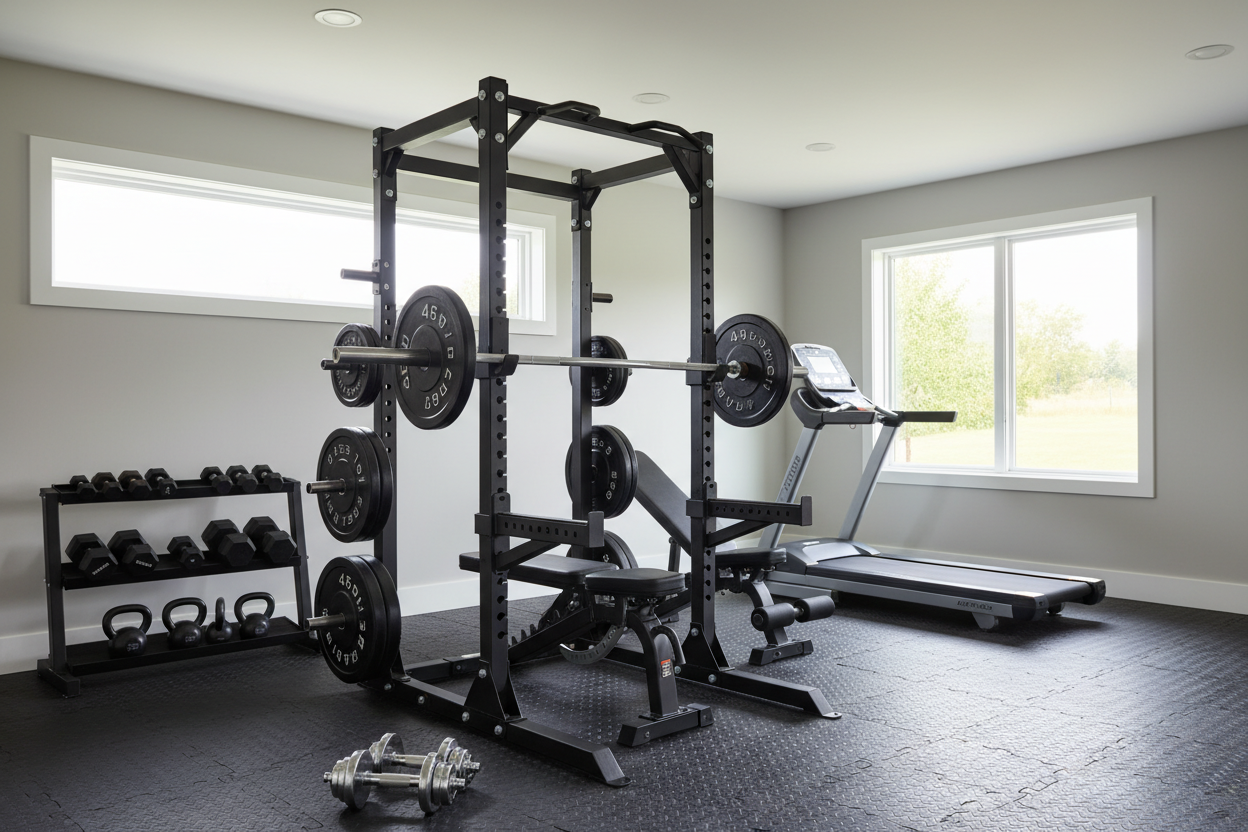
I was at the bottom of a heavy squat, knees shaking, and the bar felt like it had gained 50 pounds in the last two seconds. In a commercial gym, a random bystander might jump in to help. In my garage at 6 AM, it is just me, the cold concrete, and the smith machine safety catch. If that little piece of steel fails, I am spending my morning in the ER.
We have all seen the fail videos. The bar drops, the equipment buckles like a lawn chair, and the lifter gets pinned. I decided I was tired of wondering if my gear was actually up to the task. I decided to stop guessing and start dropping heavy weight on purpose.
Quick Takeaways
- Adjustable block stoppers are vastly superior to thin, spring-loaded twist pins.
- Testing your gear at 50-70% of its rated capacity builds the mental confidence needed for PR attempts.
- Miscalculating your safety height by even two inches can turn a safe fail into a rib-crushing disaster.
- A quality smith machine should show zero rod warping after a high-impact drop.
The Solo Lifter's Biggest Fear (Getting Stapled)
Lifting alone is a double-edged sword. You get the peace of your own space, but you lose the safety net of a spotter. Getting 'stapled'—that lovely moment where the bar wins and you are stuck under it—is the primary reason most home lifters never truly hit a 10/10 RPE. You always leave one or two reps in the tank because you are afraid of the consequences.
We rely on our equipment to be our silent partner. We buy these racks and machines thinking they are invincible, but the reality is that smith machine safety is only as good as the weakest weld. If you do not trust your catches, you are not training; you are just exercising with a governor on your engine.
What Actually Makes Up a Good Safety Catch?
Not all safeties are created equal. You will see some budget machines using thin, 1/2-inch pins that look like they belong on a curtain rod. A real safety catch needs mass. I look for heavy-duty adjustable block stoppers—essentially thick steel collars that slide up the guide rods and lock into place with a secondary pin.
When you are browsing for a Smith Machine, pay attention to the gauge of the steel and the locking mechanism. You want 'steel-on-steel' contact. If there is too much plastic in the load-bearing path, that is where the failure will happen. I want a safety catch that feels like a tank component, not a toy.
The 300-Pound Drop Test Setup
To put my money where my mouth is, I stripped the weights off my other racks and loaded 300 lbs onto the bar. For this test, I used the All In One Smith Machine With Cable Crossover S1 V4. This rig is rated for significantly more, but 300 lbs dropped from a height of about 12 inches creates a massive amount of kinetic energy—way more than a 'controlled' fail would.
I set the safety catches at waist height, cleared the area, and rotated the bar out of the hooks. I did not just lower it; I let it go. This was a pure free-fall test to see if the pins would shear or if the guide rods would bend under the sudden impulse. Most people will never fail this hard, but if it survives this, it will survive anything I throw at it.
The Sound of Steel on Steel
The sound was enough to wake the neighbors. It was a violent, metallic 'crack' that echoed through the garage. My first instinct was to look for metal shards or a bent carriage. I checked the locking pins first—they were perfectly straight. No shearing, no stress fractures in the welds.
Next, I checked the guide rods. If those bend even a millimeter, the smith machine becomes a paperweight because the bar will stick. I ran the carriage up and down the full length of the track. It was as smooth as the day I assembled it. The safety catches did exactly what they were designed to do: they ate the impact and stayed put.
The Mistake That Renders Your Safeties Useless
The best equipment in the world won't save you if you're using it wrong. The most common mistake I see is setting the catches too low. You think you want 'full range of motion,' so you drop the stops to the bottom. But if you fail a squat and the bar travels six inches past your natural depth before hitting the stop, your spine is the thing that absorbs that momentum first.
You need to find the 'sweet spot' where the bar clears your chest or your squat depth by an inch, but no more. It takes five minutes to dial this in before your work sets. If you are unsure how to find that height without ruining your form, check out this guide on Don't Get Pinned: How to Use Smith Machine Safety Stops. It is better to have a slightly restricted rep than a crushed ribcage.
Why I Push Harder Now
After seeing the catches hold 300 lbs in a dead drop, my brain shifted. That 'fear governor' in the back of my head turned off. Now, when I am grinding out that last rep of a bench press or a hack squat, I am not worried about the 'what if.' I know the steel will hold.
That mental shift is where the real gains are made. You can actually train to failure, which is where the hypertrophy happens. If you are still babying your lifts because you do not trust your safety catches, it is time to either test your gear or upgrade to something that does not make you flinch when the weight gets heavy.
FAQ
Can I use the safety catches for rack pulls?
You can, but I would not make it a habit with maximum loads. Safety catches are designed for emergency stops, not as a primary starting point for heavy pulls. Repeatedly slamming 400+ lbs onto them can eventually fatigue the metal or the guide rod mounts.
Do I need the springs at the bottom of the rods?
Those springs are there to save the machine's frame, not necessarily you. They dampen the shock of the safety catch hitting the base. If your machine came with them, keep them on. They make a failed lift much quieter and less jarring for the hardware.
How do I know if my safety catch is worn out?
Look for 'mushrooming' on the pins or any visible bending in the metal plates. If the pin does not slide in and out of the adjustment holes easily, or if you see light through a weld, stop using it immediately. Steel doesn't usually fail silently; it will give you warning signs.
Share:
The Sketchy Truth About Building a DIY Smith Machine
That Sleek Picture of Smith Machine Rigs Is Lying to You